Showing posts with label kale. Show all posts

Saturday, March 19, 2011

Kale Chips?


Am I the last one to hear about these? Have they entered the mainstream while I wasn't paying attention? Are they being sold at ballparks? Kale chips are really, really good: light, crunchy, oven-dried flakes of flavor. And so easy to make.

I first learned about them from a friend who was visiting the garden. Noticing the rather spindly stand of dinosaur kale (also known as Tuscan kale, lacinato kale, black kale, etc., etc.) she asked if I had ever made chips. When she described the simple process I resolved to try it out.


First, of course, you get your hands on some kale. (Any kind will do.) I gathered a big bunch and washed it carefully, checking for earwigs, tiny slugs, aphids -- the usual routine of the organic gardener.


A brief whirl in the salad spinner takes excess water off fast.


Stripping the leaves from the thick stem and central rib goes fast too. Pick up a leaf, hold the stem end firmly in your right hand (if you are right-handed), grasp the base of the leaf lightly with your left hand, then pull hard with your right hand. The leaf should rip right off. If some of the leaves border the stem all the way down to the base -- common for dinosaur kale -- just peel the two sides back a bit and proceed as described.


Now you have a nice pile of dark green ribbons. Cut them into smaller pieces.
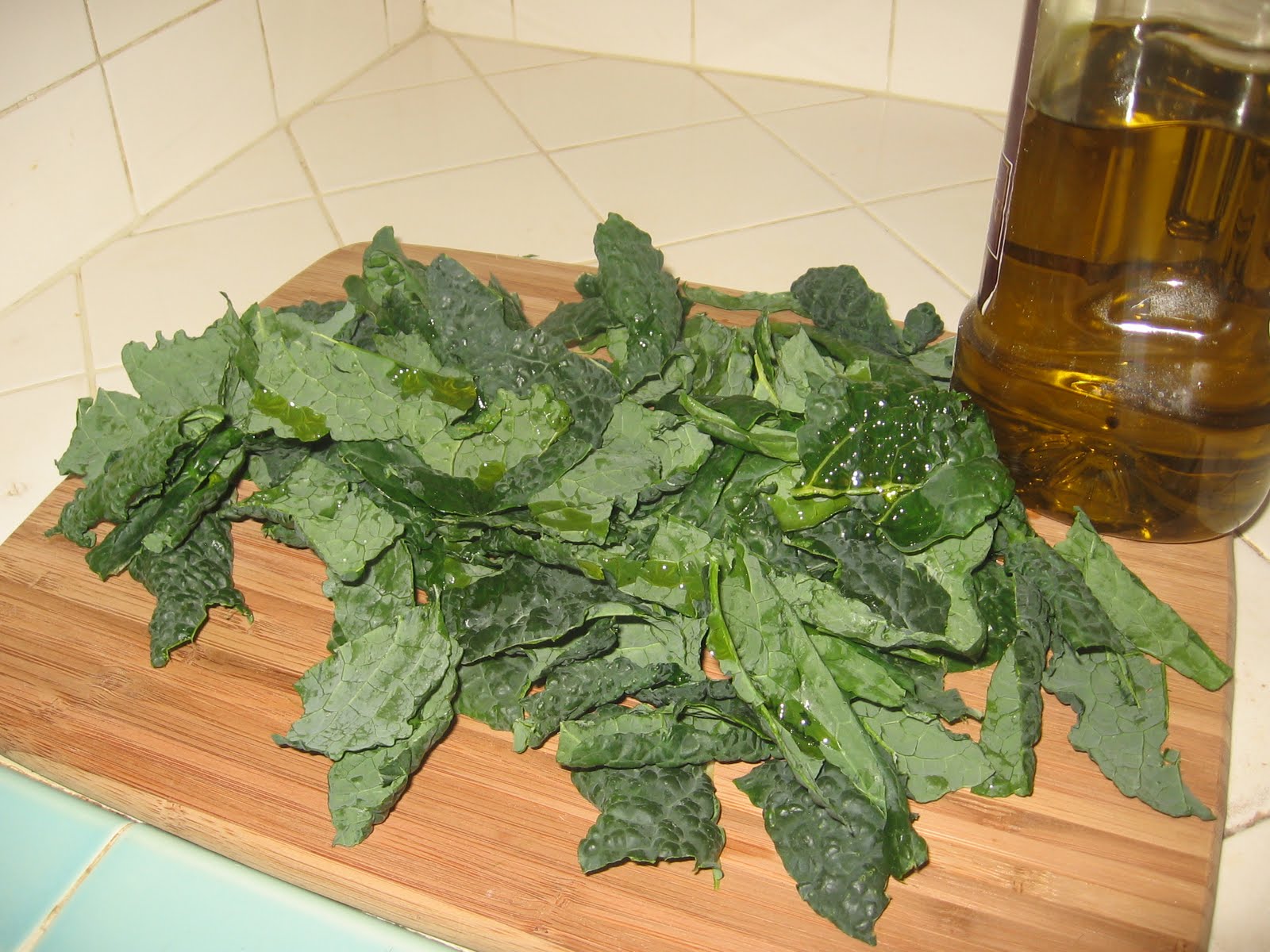


Drizzle some good olive oil over the pile.


Put it all in a brown paper bag and shake gently until all the pieces are lightly coated with oil.


Coat a cookie sheet with oil and arrange the kale pieces in the pan in a single layer.


Grate up some fresh parmesan cheese and sprinkle lightly over the kale pieces.

Put the pan in a slow oven for 10 to 15 minutes. It might take some experimentation to get the temperature and timing right. I followed an online recipe that asked for 15 minutes at 375, which turned out to be too long and too hot. I pulled the pan out after seven minutes because some of the pieces were clearly overcooked and turning an unappetizing color. Nonetheless, they were crackly and delicious.

If you want to hear how crunchy kale chips can be, take a look at this charming video at katheats.com. Kath used a different type of kale and a slightly different approach but the general idea is the same:

http://www.katheats.com/favorite-foods/kale-chips

"Eat your greens" has a whole new meaning.

UPDATE 5/19/11: OK, today is May 19. I was cleaning out the refrigerator and way at the back of a bottom shelf found the container of kale chips with a few left at the bottom. Two months later they are still crunchy and still tasty. Is this a way to preserve the crop?

Saturday, January 15, 2011

A Fine Spring Day


Hello sour grass, my old friend! Welcome back again. Here you are with one, lone, bright-faced bloom lighting up a neglected corner of the yard. Can spring be far behind?

It was such a splendid, dirt-under the fingernails day I ended up spending the whole morning in the garden. The usual inspection tour -- lately just a quick look around our damp, cold, scraggly, uninviting backyard patch -- turned into a flower photo op.

The first oxalis blossom opened nearly a month earlier than last year -- mid-January as opposed to the week of February 10. (One of the great features of a garden blog is the gradual accumulation of exact data from year to year.) Spring does seem to be running early. There are golden fields of wild mustard blooming already out by the coast and our neighborhood is sporting the first gorgeous tulip magnolias.


The volunteer arugula has put forth its trademark four-petaled blossom, delicately veined like the wings of some kind of exotic helicopter insect. I've seen the hummingbirds buzzing these blooms.


Here is borage -- not a very good photo. I'm sure it looks at lot better than this to the bees who gather here.


The pea plants are blooming again, unfurling like the Japanese folded paper flowers that "bloom" when you put them in water.


More flower origami: elegant black-trimmed fava bean blossoms are opening on three-foot tall stalks.


These hot pink rosettes aren't flowers at all, just some garden art that resulted from the thinning out of an overgrown clump of volunteer chard. Lots of the leaves had been so thoroughly mined by leaf miners that they had rotted into slime during the rainy spells. Yuk!

Undaunted, and energized by the unexpected spring day (I know, I know, it won't last), I weeded and trimmed until the plants could breath and soak up the sun. The lipstick chard pictured above is growing back from a venerable gnarled stump, all that's left of a plant that grew six or seven feet tall last season.


There are several varieties of chard in the patch, some growing from over-wintered stumps, some springing up for the first time.


Here's a shot of the north half of the winter garden. The oxalis and the borage are in the back corner where the fences meet; the arugula is to their right, the peas are in the foreground twining up the wooden stakes, the favas and the patch of chard are out of view to the right. In the foreground you can also see spinach, lacinato kale, and a bed of sponsored arugula. In the background are a couple of beds of lettuce. Out of view are broccoli and leeks. The paths are covered mostly with miner's lettuce. And that's about it.

We are harvesting lettuce, miner's lettuce, spinach, arugula, kale, and chard. We are waiting for broccoli, leeks, another round of peas, and favas.

Ready to pick or not, edible or not, everything looks beautiful on this fine spring day.

Monday, April 26, 2010

Broccoli Flowers


Another member of the Cruciferae family has joined the bloom party! Out of six Romanesco broccoli plants, only one of them produced side shoots after the main head was harvested. I've let it stand and now it's putting out the four-petaled blossoms characteristic of its family.


Here's a blossom of Dinosaur Kale for comparison: same general cross-shaped design, with variations. The broccoli now joins the kale and the arugula for the family flower festivities.

Friday, March 26, 2010

Homage to Cruciferae


There are striking similarities among the broccoli, kale, and arugula plants, all flourishing right now in our backyard. The sibling resemblances should not come as any surprise since they are in the same family, the Cruciferae, also known as Brassicaceae (that is how it's spelled -- I checked). Personally, I think of them as Cruciferae. For one thing, it's easier to pronouce.

They are also in the same sub-group or genus within this huge family. The genus is known as the brassicas. It contains more important agricultural and horticultural plants than any other genus. (Isn't Wikipedia wonderful?) There are your cabbages, your turnips, your brussels sprouts, your kohlrabi, cauliflower, broccoli, mustards, on and on, and that's just the vegetables. A farmer's market of cousins.

Above is Purple Sprouting Broccoli, doing its thing. From this plant we eat the buds.


Here is Dinosaur Kale, also putting out buds and looking a lot like sprouting broccoli. But in this case the appearance of these sprouts means the plant is past its prime (from our perspective) and going to seed. The prized leaves will lose flavor as the plant puts its energy into budding, flowering and seeding.


Here is the lovely blossom of the Dinosaur Kale. The name Cruciferae comes from the four-petaled flowers in the shape of a cross that are a stable characteristic across the entire family of hundreds of sub-groups.


And here are arugula blossoms, also cruciferous. This plant has a nice bud stalk. Would it be good to eat, like broccoli? And what about the Dinosaur Kale buds?

We are very conventional and eat only the customary parts of each of these plants. There is more than enough as it is. But it's nice to know the family tree all the same.

Friday, March 19, 2010

The Eatin' o' the Greens


As long as we are in St. Patrick's Day mode, it's worth saying a word or two about the spring tonic version of green soup, which is very very green. The summer version is mostly zucchini, a light concoction with fairly good crowd appeal. The spring version is for true believers only -- mostly kale and chard with whatever broccoli shoots can be gleaned.

I made some recently and have been enjoying the results for lunch. This never gets served at dinner because the Army surplus color of the soup is a little off-putting for some.

Above is an array of kales: Siberian, Redbor, and Lacinato (also known as Tuscan, Black Tuscan, or Dinosaur kale -- for obvious scaly reasons), and also a few shoots of Purple Sprouting and Romanesco broccoli. For connoisseurs of green, this is a delight for the eye. For connoisseurs of green soup, a delight for the palate.


In the last couple of weeks of warmer weather, the chard has been sizing up. There is more than enough anytime we need it. I can't keep track of the varieties any more because it comes up as it pleases and I move the seedlings around wherever a good spot opens up. The palest leaves are most likely Bionda de Lyon. But once it's harvested and headed for the soup pot it's all just yard chard.


There is one bed of Rainbow Lights chard planted from nursery starts that contributed to this batch. The photo captures only part of the spectrum which ranges farther into shades of red and orange.


The soup-making process is the same as for the summer version (see "Zucchini Factory," June 30, 2009, for description of process). But it's not the same soup -- the spring tonic version is so muscular I felt like the pot might get down off the stove and start doing one-handled push-ups.


Here's the final mixture, after blending. Intimidating for some, thrilling for others.

Anything extra goes in the freezer. There is still some summer soup left in there and now there will be plenty more until the zucchini starts coming in in a few months. The eatin' o' the greens goes on all year.

Thursday, February 4, 2010

Survey of the Winter Garden


Rain, rain go away. Oh well, I can't go out and play in the mud so I might as well use the time to record for posterity the winter garden of 2009 - 2010. These photos are from January 22, a couple of weeks ago. The plants look pretty much the same now.

None of the winter plantings grew as fulsomely as I had pictured in my imagination last fall. Perhaps I got them out too late (October), or perhaps they are just biding their time for a spring surge. At any rate, they have kept us in salads and winter greens all through the dark months.

Pictured above is a bed of Dinosaur and Redbor kale, slug-tattered but productive. We've also been getting nice kale from volunteers around the yard, Siberian and Curly Blue, I think. I was
given some seedlings a few years ago and now they come up on their own.


Romanesco broccoli (from nursery starts), which has been growing very slowly and has not yet formed heads. Around the edges of the bed are little cilantro plants (from gathered seed). Although still small, the leaves have spiced up many a salad.


The purple sprouting broccoli (nursery starts) also has not produced anything yet but broad gray-green leaves. Quite successful as an ornamental.


Sparse looking spinach patch (Bloomsdale and Gigante d'Inverno, from purchased seed). Every now and again I can pick a leaf from each plant to fill out a salad, but so far there is not enough to cook with. The California poppies are starting to grow here and could easily take over this bed.


Assorted chard (from gathered seed). The back row includes plants from last year that just kept going, re-sprouting from the base that died back in the summer.


Rainbow chard (nursery starts) surrounded by parsley that just keeps going from last season.


Assorted lettuce (from purchased and gathered seed), including a volunteer Black Seeded Simpson seedling that I moved here from one of the paths where it had sprung up. In front is some red chard that just won't quit.


Forellenschluss lettuce (from purchased seed).


Black Seeded Simpson lettuce (from gathered seed).


Bronze Arrowhead and Red Lollo Antago lettuce, ravaged by slugs but still producing a lot for eating -- eating by people, that is.

These beds have been in continuous use, summer and winter. It may be that I need to re-examine my soil building program to make sure they have enough fertility to sustain so much growing.

Friday, January 22, 2010

Winter Pizza!


This fine artisan pizza is a one-handed creation, courtesy of B., who refuses to let a broken wrist interfere with his artistic process. (And thanks to the no-knead method of the very useful tome: Artisan Bread in Five Minutes a Day.)

On Christmas Eve B. fell off a stool while changing a light bulb and we found ourselves in the emergency room, where -- at the stroke of midnight -- a cheerful doctor strode into our cubicle, exclaiming "It's Christmas Day! Merry Christmas!" Not at all like the terrifying Ghost of Christmas Yet to Come, the dreadful apparition who appeared to Scrooge as the clock struck twelve, he seemed more like Scrooge himself on Christmas morning, brimming over with holiday cheer.

Since it was the left wrist that had a hairline fracture, pizza making continues with only a little help here and there from willing bystanders. The garden contribution is a bit of sauteed kale and chard strewn sparingly over the tomatoes and cheese. Evidently the artistic secret is not to overdo the toppings.

As for the 2010 Eat the Yard Challenge (something from the garden every day), we have hit the three week mark -- which is probably about average for New Year's resolutions.

January 18: a bit of fresh cilantro in the chili, garden salad
January 19: same
January 20: winter pizza, with chard and kale topping
January 21: spaghetti with garden tomato sauce from the freezer, leftover sauteed greens

Tonight it's salad again; I picked a basket full of makings this afternoon when the sun came out.

Sunday, December 13, 2009

Winter Bounty at the Table


Mmmmmmm, frost-kissed greens for dinner: mostly chard chopped up fine, with a little chopped kale for added character, sauted in olive oil with garlic and some canned tomato. I could eat this every night.

Saturday, December 12, 2009

Winter Bounty


We had only three nights of temperatures in the twenties. By Thursday we were back to cloudy skies and predictions of rain, finally fulfilled today. All the winter-hardy plants are looking really perky now, coming into their own as their summer compatriots are reduced to limp brown rags, or, in the case of the nasturtiums, green goo.

This afternoon I went out in the rain -- accompanied by a wild-eyed, stir-crazed canine companion -- to do a little picking.

Pictured above, top row, left to right: Redbor kale, Blue Curly kale, a few leaves of dinosaur kale, right below the dinosaur kale some Red Lollo Antago lettuce, Rainbow chard, with some Bloomsdale spinach right below.

Bottom row, left to right: cilantro, Bronze Arrow lettuce, Black Seeded Simpson lettuce, arugula (a self-seeding volunteer coming up all over the garden), Forellenschluss lettuce.

A festival of vitamins and minerals!


The lemon tree seems fine. Some of its leaves have more of a yellow tinge than they did before the freeze, but that's all.

Thursday, June 11, 2009

Interregnum


"Water, water everywhere and not a drop to drink," cried the Ancient Mariner. "Green growth all around," I think to myself, standing in the midst of the burgeoning backyard, "and barely a bite to eat." Only a few lettuce leaves, a handful of peas, some arugula are worth bringing in as dinner fare. It's the time of waiting -- as the winter garden goes to seed and the summer plantings are not yet harvestable.

As always there is plenty to marvel at: the kale plants, for instance. Bold stalks between three feet and six feet tall are in various stages of seed production. "Going to seed" is a process with many stages.


Stage 1: Here's a three-footer with a demure little bouquet of buds in the center.


Stage 2: As the stalk grows -- this one is taller than I am -- the bouquet of buds lengthens out into a spiky spiral of short stems with a yellow blossom at the tip of each stem.


Stage 3: Over six feet tall, waving in the breeze, a self-contained forest of elegant pods carries hundreds of seeds for next year's kale harvests.

Wednesday, January 2, 2008

Nightime Foray

It's a small domestic adventure to go out at night to pick a few greens for the soup. The cats trail along companionably, as they always do whenever I show enough good sense to spend some time in the yard -- and in the dark to boot, an unexpected bonus! They are ready for whatever comes. The flashlight beam darkens the night around it, and the plants that are spotlighted look strange and alien -- grey-green, contorted.

I snip some leaves -- no more than three or four -- from the sturdy little kale plant that is in its second winter. It's the only survivor of a group of seedlings set out in the fall of 2006; now it's crowded into the corner of a bed, towered over by tall, bolting arugula. Last summer, a kale-loving, non-gardening friend was given the go-ahead to pick some leaves -- not knowing the protocol she cropped it to a nub. I thought it was a goner; but here it is, a greyish bouquet of curly fronds, crisp and upstanding in the cold air.

A few snips from the chard (not too many; we've been hitting it hard lately and we do know the protocol), a few more from the parsley, and back I go to the house. The cats dart ahead and sit down directly in my path. What's your rush? they imply; the night is young.