Showing posts with label flowers. Show all posts
Tuesday, February 25, 2014
Hyacinth and Friends
A little white hyacinth is blooming in our backyard, where no hyacinth has bloomed before!!! I've bought them before, of course, at the supermarket, in tiny ceramic pots for forced blooming indoors. After all, who can resist a hyacinth in the springtime?
This one was growing up out of a pile of compost. I imagine the spent bulb came out with the kitchen scraps and landed in a propitious spot. Not realizing what it was -- no blooms were showing -- I unwittingly uprooted it while shoveling compost and adding insult to injury, or rather injury to insult, I sliced off a bit of the bulb with the shovel.
When I saw what it was I immediately planted it in the rich soil along the fence. I was sure it was done for, but plants can surprise you and I am always ready to be surprised. How nice to be rewarded with an un-looked for bloom. Let's hope it prospers in its new home as a symbol of rebirth, regeneration, and second chances, or, actually, third chances: house, compost pile, and now, planting bed. A three-time winner and a fitting tribute to the beautiful youth Hyacinth, beloved by Apollo but accidentally, tragically, slain by him and immortalized in an ever renewing flower.
Flowering at the same time across the yard in the bed along the other fence is a little mystery bulb, a migrant from the front yard. It must have come in with the leaf litter I collect in the front yard to cover paths in the back yard, following the permaculture practice of using onsite materials whenever possible.
There are dozens of these unknowns in the front yard, coming up every spring as long as we have lived here. And now they will be colonizing the backyard too. Another un-looked for spring bloom.
The wild onions are also blooming now in the shade under the plum trees. No mysteries or surprises are involved. These are tenacious weeds I happen to be fond of. They appear with the early spring bloomers and spread opportunistically everywhere there's an opening. I like them as additions to spring salads -- all parts are edible and have a mild oniony tang.
What all three of these pretty volunteer plants with their hopeful white flowers have in common is that they have chosen to grow in our yard. May they prosper (within reason).
Labels:
february,
flowers,
mystery plant,
volunteers,
wild onion
Friday, February 21, 2014
Spring Begins, Again
It's been a long, long journey round the sun since the last heralding of backyard plum blossoms. But spring springs eternally and nothing can stop its burgeoning progress. Neither 500-year-drought nor neglectful gardeners with other priorities will hold it back. Welcome, little beauties! We are really, really glad to see you, bringing fresh chances and new opportunities to begin again.
Saturday, March 2, 2013
Sunday, August 5, 2012
Season of Plenty
The blooming of the pink lilies signals the season of plenty in our backyard. As the blossoms gradually opened this week, we brought in several harvest baskets of lush produce:
Dona tomatoes
Better Boy tomatoes
Sungold cherry tomatoes
Padron peppers
Fairy Tale eggplant
Prosperosa eggplant
Ronde de Nice zucchini
Emperor's Jade zucchini
Genovese basil (the best for pesto)
Summertime lettuce
Michelle lettuce
A few stray leaves of volunteer arugula
Assorted leaves of volunteer yard chard
Purple plums (last few of their waning season)
Yellow plums (more than we can deal with)
Pears!!!!!!! (See below).
And that's not even the full roster. Still to come are:
Roman Stripe paste tomatoes
Indigo Blue tomatoes
Sweet Million cherry tomatoes
Pimento peppers
Lemon cucumbers
Blue Lake beans
Fortex beans
Volunteer mystery squash most likely descended from the Trombetta di Albenga of previous summers (judging by the size of the vines).
The lilies bloom in early August, announcing the all too short season of feasting on our summer specialties: Insanely Great Pasta Sauce and the inimitable Pear Tarte Tatin.
When the lilies bloom the pears are ready to drop. It's time to start watching the pear tree carefully because pears, counter-intuitively, should not be allowed to ripen on the tree. When the first one falls the whole harvest must be picked at once.
This year we got impatient and didn't wait for that first plopped pear before sending H. up on a ladder to gather in whatever he could reach -- everything but a few fat ones clinging to the topmost branches.
I think the blooming lilies are now so strongly associated in my mind with the season of plenty that, like Pavlov's dog, I start to salivate when I see them! Fill the harvest baskets; it's the time of fruiting and feasting!
Tuesday, March 20, 2012
Freesias in the Rain
A miracle of water has been falling out of the sky! We have had currents in the gutters, rushing streams, fallen blossoms pasted to the sidewalks, and in the backyard, plants bent down with the weight of accumulated moisture. In the middle of this happy hulabaloo the first freesias of the season quietly opened up their golden throats and took a gentle drink. I photographed them the morning of March 13 after several days of rain with more rain following.
Monday, May 23, 2011
Tomato Guild
The permaculture concept of planting in communities or "guilds" has intrigued me ever since I first learned about it. Today I put together a permaculture-for-dummies installation including tomatoes (the tomatoes were already there) and a few of the beneficial companions said to enhance their growth: marigolds, basil, parsley, and nasturtiums. Whether the purported mutual benefits are science or merely lore, I do not know, but it makes an attractive grouping and I look forward to seeing how it fills out.
Here are the members of this guild, nestled together in a nine-foot-square raised bed:
1. Better Boy hybrid seedlings from Garden Crossing mail order nursery (Better Boys, B.'s favorite, are getting harder and harder to find. This is the first time we had to resort to online shopping to locate some.) The tomatoes are the lead plant in the guild. These were planted out May 9.
2. Queen Sophia marigold seedlings from Natural Gardening. The roots deter nematodes.
3. Genovese basil seedlings from Natural Gardening. Who could imagine tomatoes without basil! It's said to improve flavor not just in the kitchen but in the garden too. The flowers attract beneficial insects. It's edible. Being pesto lovers, we grow it as a crop in its own right. B.'s most frequent comment on the garden: "Not enough basil!"
4. Italian Flatleaf parsley seedlings from Natural Gardening. I'm not sure what parsley does but it's always on the guild lists for tomatoes. Edible.
5. Moonlight nasturtium seeds from Renee's Garden. Nasturtiums deter pests, draw beneficial insects, and are edible.
As I understand it, a true guild is based on perennials and ideally starts with trees, but hey, you garden with the plants you have, with the materials at hand, and with the time available. I've discovered that the best way to learn new things in the garden is to start some small scale experiments and see where they lead.
Tucked in with all the seedlings and seeds in this bed are two sunken clay pots filled with water and covered with the pot's own drip dish turned upside down to form a lid. This was an experiment from several year's back that has yielded good results. The pots provide a steady water supply close to the root zone as the water slowly seeps through the clay walls, responding to the moisture level in the surrounding soil. I think the plants like this system because when I pull the pots out at the end of the season the hole is lined with a thick netting of pale roots.
Here's hoping this tomato installation becomes a happy little cul de sac in the larger garden community.
Labels:
basil,
experiments,
flowers,
herbs,
marigolds,
may,
nasturtiums,
parsley,
permaculture,
tomatoes
Wednesday, February 23, 2011
Crocus!
For some reason I get really excited to see the first crocus of the season. It reminds me of childhood spring times in Virginia, where one of the earliest harbingers of winter's demise was a few brave little buds poking through the snow.
We haven't had snow, but there's been plenty of wintry weather and, true to its kind, this exuberant bloom was waiting to greet me during a string of gloomy days we've been having. Unseasonably warm weather lasted through January and half of February, then shifted dramatically, thanks to a low-pressure system from the Gulf of Alaska bringing cold temperatures, pounding rain, and snow in the mountains.
The crocus is in the Iris family and one particular variety is the source of saffron seasoning. What we call saffron is hundreds and hundreds of deep orange stamens hand-gathered from crocus blossoms and carefully dried and packaged. That's why it's the most expensive spice by weight in the world. It takes a football field to make a pound's worth.
I don't know what variety of crocus has just bloomed in my backyard, but I'm really glad to see it, bright orange stamens and all.
Monday, February 14, 2011
Plum Blossoms
The plum trees are in bloom! We've had a stretch of unseasonably warm, dry weather for more than a month, so I guess I shouldn't be too surprised.
The two photos above were taken on February 13, just in time for Valentine's Day. As usual, we are running behind the rest of the neighborhood where the dancing girls of spring in their lacy pink and white tutus have been lining the streets for some time now.
But we are running ahead of last year in this same backyard. Pictured above is the first plum blossom of 2010. The photo was taken on February 7, 2010. You can tell that I hadn't yet learned to use the close-up feature on my Canon Powershot camera! Oh well, it might not work as art but it will serve as evidence.
Here are the plum trees on February 12, 2010. Quite a contrast with this year. Each year tells its own story.
Thursday, January 13, 2011
The Case for Narcissism
The pale translucent beauty of these indoor Narcissus blooms (the cultivar is Paperwhite, 'Ziva') does indeed invoke their mythic namesake: the youth Narcissus, so entranced with his own image reflected in a stream that he literally fell in love with it, toppled into the water, and perished. A cautionary tale of self-absorbed infatuation. He gave his name to a psychological disorder of extreme preoccupation with oneself, Narcissism, but these delicate flowers, also namesakes, make the case for a more inspiring legacy. Anything so lovely has to be admired.
We've been gazing, entranced, at their slow unfolding for the past month. Every year my sweet sister sends a Christmas gift that grows.
The bulbs arrived mid-December, along with planting rocks, vase, and instructions on how to force them for maximum effect. At first, there wasn't much to look at, just the papery bulbs with pale growths emerging like the long, curved fingernails of a sloth.
Following the instructions, I filled the bottom of the vase with the planting rocks, pushed several bulbs into the rocks so they stayed upright with growing ends on top, and added water within an inch of the bulbs so they weren't sitting in it but the roots could grow down towards it. This was all new to me so every step was fascinating.
When everything was in place, I set the vase in a cool, dark corner. And waited.
It took a few weeks for the roots to twine downwards into the labyrinth of rocks. When the bulbs were anchored and green shoots were heading hopefully upward, it was time to bring them forth into the light.
By early January the tall slender stalks were tipped with swelling buds.
And the roots had woven themselves into a tangled, shiny, white mat at the bottom of the vase.
Here they are at peak beauty, blossoms leaning into the light, or, perhaps, bending toward their reflections in the window glass.
Thanks, Sis! It's been a great show.
Sunday, September 19, 2010
Hollyhock Lore
The hollyhocks along the fence are finally coming into their own. These are the second growth stalks that came up after I cut down the towering (ten or twelve feet) spring flagpoles that were not blooming and had acquired a layer of rust, due to the relentlessly cool weather.
This is a popular gathering spot for all manner of bees. Once, I saw a hummingbird inserting its tiny beak along the base of a partially opened blossom -- not inside the flower but outside. It reminded me of the deft skill of my favorite dental hygienist probing my gums. Not the most poetic image, but it does capture the expert precision of the hummingbird at work. Perhaps there are pockets of nectar hidden in the showy blooms even before they open wide?
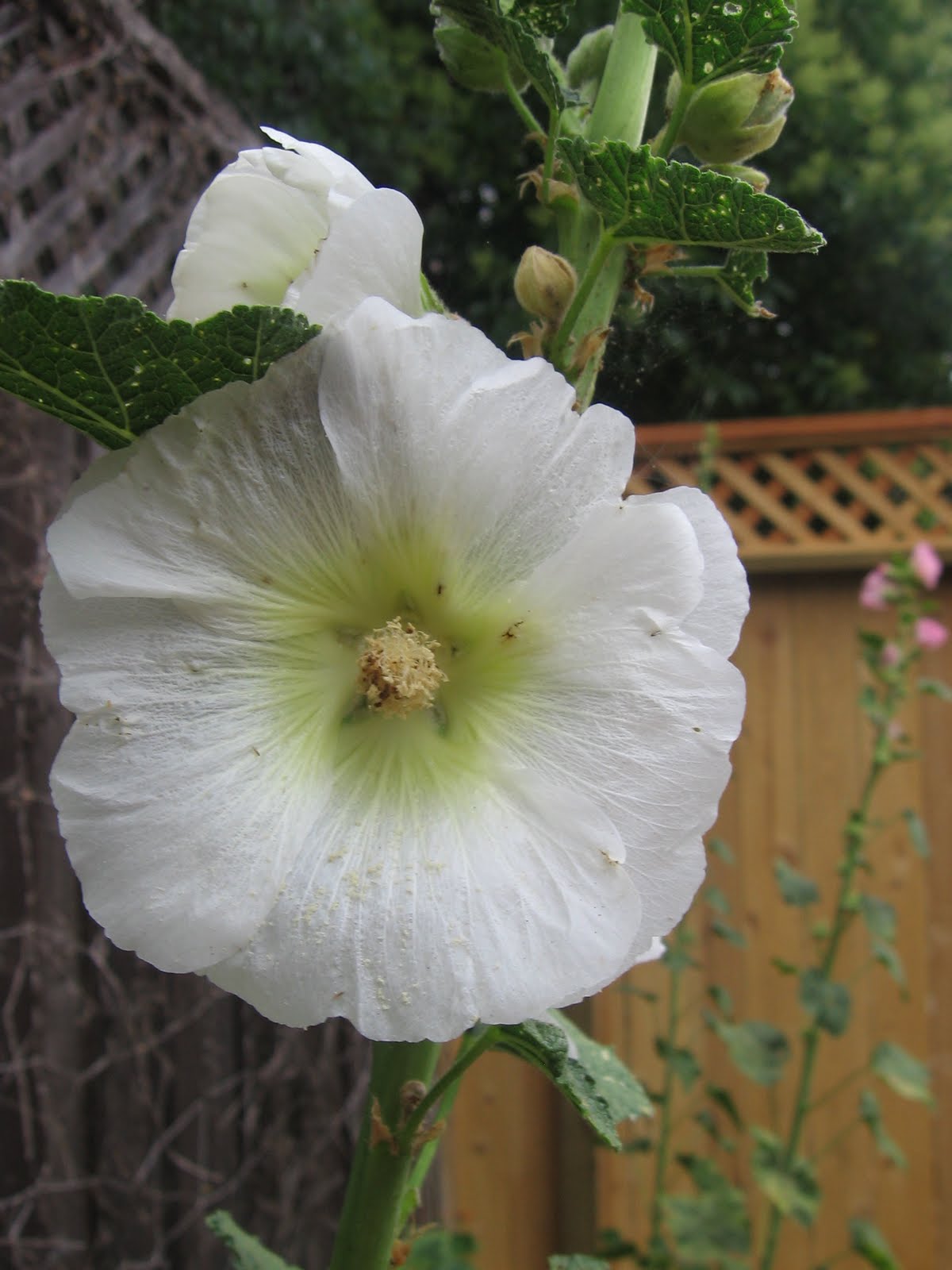
Here's a wide open blossom, a stunning pink banner unfurled to the sun. Rose pink is thought to be the original color of these ancient medicinal plants. The botanical name, Althaea rosea, comes from the Greek "althos" for "healing."
In medieval Europe, a related plant was used to treat horses. Ailing hocks, the part right above the hoof, were wrapped in the leaves. When crusaders came back from the Holy Land, bearing the botanical cousin of this hock plant, the new arrival came to be known as the "holy hock."
The dramatic knob in the center of the blossom contains both stamen and pistils and the plant is self-pollinating. Bees love the abundant pollen so cross-pollination occurs. I have often watched the giddy buzzing things burying themselves in one blossom after another.
Maybe cross pollination accounts for the range of colors that have evolved from the original seeds from plants with dark red blooms given by a friend from the south Bay. They grew in our yard as dark pink at first, then diversified into a range of dark pink to pale pink to white.
Pale pink and white blooms showed up this year for the first time -- the third season since the original planting.
Supposedly the "holy hock" brings good fortune and abundance to homes where it is planted nearby. Planting some certainly brings an abundance of hollyhocks, since they grow back from the base and also produce myriad seeds. In our yard, the row along the fence is well established and seedlings are popping up here and there.
Friday, August 27, 2010
Pears and Lilies as Seasonal Markers
The first ripened pears of 2010 dropped off the tree on August 16, in concert with the opening of the pink lilies growing at the base of the pear tree.
These two plants are good seasonal markers because their annual cycles are entirely in the hands of Mother Nature. The timing of the first zucchini blossom, for example, is affected by when I manage to get the plants into the ground but the pears and the lilies are on their own recognizance.
Last year, the first pears dropped on August 7 and the lilies started blooming on August 11. Thus, I conclude that the summer of 2010 is running about a week behind 2009, at least in our backyard. This is not as drastic as the two to three week delay of ripening that is plaguing the grape growers of our region, according to newspaper reports.
During most of this summer the temperature has hovered in the low 70s under persistent foggy skies. Nonetheless, our little micro climate is evidently not greatly affected, apart from our grumbling that it just doesn't seem like summer. The grumbling stopped entirely earlier this week when local temperatures shot up well over 100 for a few days. Now we are back to low 70s with no complaints!
One thing that is just the same as last year: Blackie the cat showed up to have her portrait taken with the first gathering in of pears. A remarkable coincidence, actually, because it's not like she's always sitting on the bench waiting for the paparazzi. Maybe she feels the pears and the August light set off her dusky fluffiness.
This photo is from August 16 because as soon as I saw the two pears on the ground I picked everything within reach. Pears should not ripen on the tree but should be picked when ready and stored in a cool place.
Here's what the lilies look like now, reaching their peak of bloom and just staring to wilt.
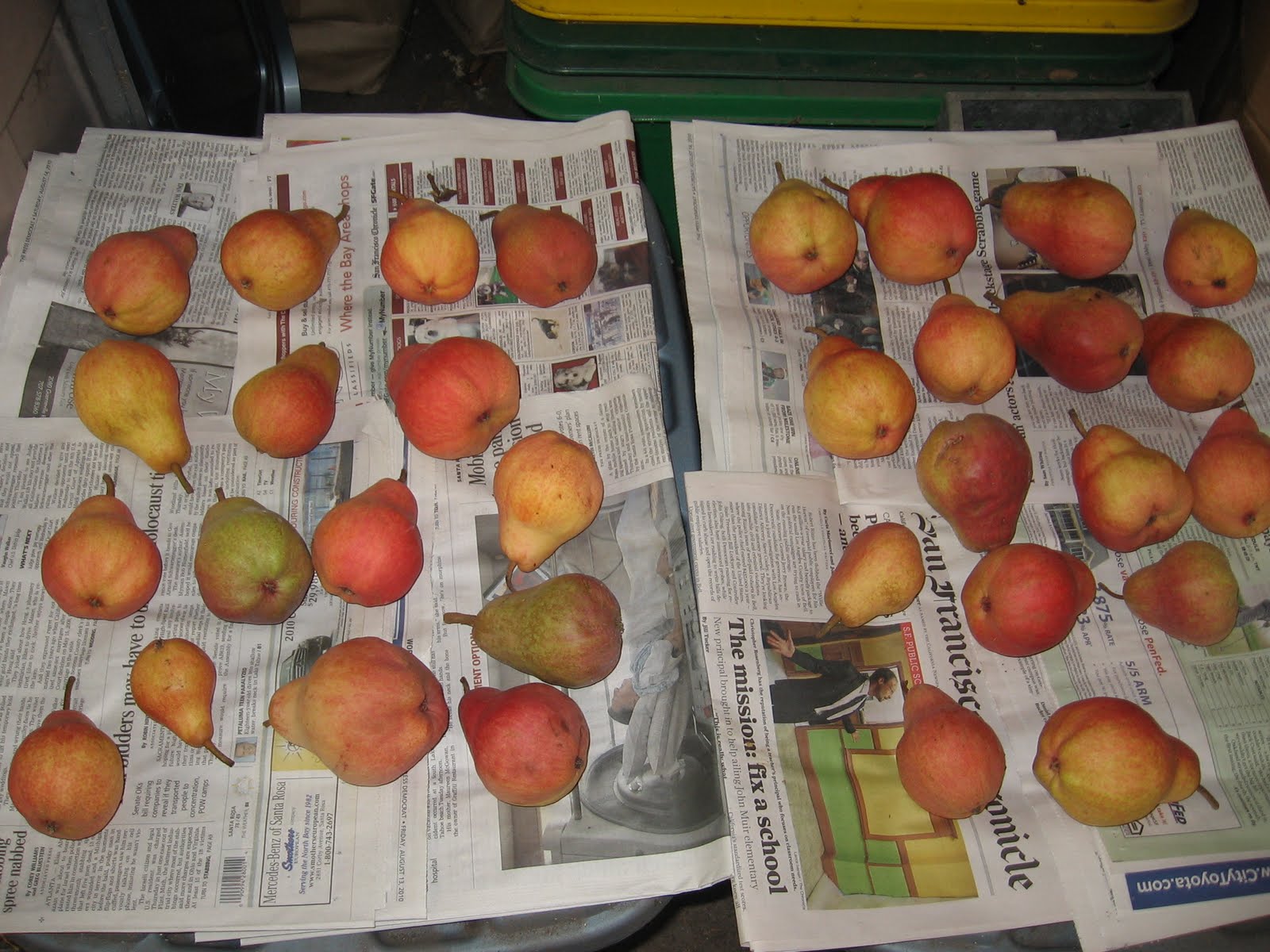
Here are the pears, laid out in the garage. A lot of them are already mushy, perhaps due to the blast of heat this week.
We are learning that the pear season is short and you have to move fast. Pears need to be picked all at once as soon as the first one drops, then stored right away and kept cool. They should be eaten a little bit before they feel ripe. I think they must ripen from the inside out, because when the outside seems perfect they are brown and mushy at the core. The ones that are golden with a rosy blush but still hard to the touch are the ones to go for.
Saturday, June 12, 2010
Flower Transition
Not only the lettuce is making a shift from one season to another. The spring displays of flowers are looking seedy -- literally -- and the summer show is just starting.
I stopped wearing socks not only because the weather has warmed up but because my ankles were thick with forget-me-not burrs after every trip outside. No wonder they have spread all over the yard (forget-me-nots, that is, not socks).
The calendula was so ragged and mildewed I finally pulled it out. For some reason it didn't form seeds before going into decline. But there's no time to be sad because the hollyhocks have started blooming.
This incredible blossom greeted me on an early morning inspection tour.
This one opened a day or two later. All of the hollyhocks have the same ancestry: seeds given by our dear friend P. from the plants in her yard. I scattered the seeds three years ago and they have come up on their own since then. Her plants in San Jose have dark red blossoms; in our North Bay yard they bloom pink. To add to the confusion, this is the first year they have shown different shades of pink. Who can fathom the mysteries of plants?
This Candystripe Cosmos was a surprise. It is a self-seeded volunteer from those I grew from Botanical Interests seeds last year. I hope it likes our yard and is the second of many generations.
The self-seeding morning glories are coming back too. The first one, a Grandpa Otts heirloom, bloomed on May 11, several weeks ahead of last year's first on June 7, 2009.
Each day it's a delight to go out and see what new blooms have appeared.
Friday, May 7, 2010
Lily of the Valley

My dear sister R. sent me this sweet photo on my birthday. Lily of the Valley is the flower for May. These are growing in her garden back in Virginia. She gathered them from our family home after Dad died and the house was being sold. I will think of them along with the wild violets I gathered from our front yard years ago at the time of our mother's funeral. I still have them, encased in waxed paper and pressed between the pages of a treasured hardback book. Clearly, we are both flower sentimentalists.
Wednesday, April 28, 2010
Spring Snowfall
Tuesday, April 27, 2010
Ixia
I planted these bulbs about five years ago because they were small and I liked the picture on the package. This lush batch is the only group still coming up except for a few smaller ones on the shady side of the yard.
The name slipped my mind but in some cobwebbed corner of my brain were stored some lingering wisps of information -- it starts with an "i," it's a short word with some strong consonants like "x" . . . .
An online search of "ixta" yielded only Mexican volcanoes and New York restaurants -- very interesting but not what I was looking for.
"Ixtia" yielded a Guatemalan musical group (I think) and some obscure business just setting up its web site. Finally the Great Google took pity on me and asked helpfully "Do you mean 'ixia'?"
Bingo! A flood of information ensued about the South African Cornflower or Wand Flower or -- Ixia flower, including many photos in diverse shades, including the coveted ixia veridiflora, with its pale green to turquoise blossoms.
The species we have growing in our yard is called ixia acaulis, the White Emperor, an appropriately regal name for this stunning flower which I stop to admire almost every day.
Monday, April 26, 2010
Broccoli Flowers
Another member of the Cruciferae family has joined the bloom party! Out of six Romanesco broccoli plants, only one of them produced side shoots after the main head was harvested. I've let it stand and now it's putting out the four-petaled blossoms characteristic of its family.
Here's a blossom of Dinosaur Kale for comparison: same general cross-shaped design, with variations. The broccoli now joins the kale and the arugula for the family flower festivities.
Sunday, April 18, 2010
Backyard Bouquet
Updated below
There are enough flowers blooming in the backyard to allow for bouquet making: nothing fancy, just a simple nosegay to commemorate a friend's birthday or brighten a convalescence. I really should try to find out what the striking red and yellow mystery flowers might be. . . . .
Update 4/19/10: A generous commenter (or commenters) has supplied a name for the mystery blooms. (Thank you, Three Sisters!) They are Harlequin flowers or Sparaxis tricolor. Having a name enables an internet search so I was able to learn that they are prolific, drought-resistant South African natives in the Iris family. They come in many different bright and showy colors and usually have yellow centers. Here is a photo of the variety that grows in our yard.
Monday, April 12, 2010
Salad Accoutrements
There is always something interesting growing in the yard to add to a salad.
Lately, one of the featured items has been calendula flowers. It's easy to pluck out the petals and sprinkle them into the bowl, where the little orange flecks make the various hues of green seem greener and more variegated. They don't contribute a noticeable flavor, but add eye appeal, and are reputed to have value as a medicinal herb with antibacterial and anti-inflammatory properties.
Another salad accoutrement free for the picking are the blossoms and blades of the wild onion. The little white flowers add color and they both add a subtle oniony tang, just the right amount for a hyper-sensitive person like myself who weeps when there are raw onions anywhere on the block, or so it seems. As the plants mature, the blossoms stop being delectable when hard seed pods form at their base, but the tender tips of the blades are still quite good.
These flowers and seed pods on the miner's lettuce signal that their season of perking up our salads is about over. It's been a long run, but now I will stand back and let them sow seeds for next year. The pods are forming along this stalk, like tiny green coin purses filled with a wealth of even tinier round black seeds.
Even though I regret seeing the miner's lettuce go to seed, it's a fascinating process. First the heart shaped leaves become round -- I have no idea how they manage to do it. Then they launch a sub-leaf from the center of the main leaf. This smaller version of themselves hosts the flower stalk, along which the seed pods will eventually form.
The mainstay components and added features of our salads vary from week to week and month to month. Right now the miner's lettuce, arugula, cilantro, spinach, and Black Seeded Simpson lettuce are winding down and the Red Lollo Antago lettuce is long gone. But there is plenty of Forellenschluss and Bronze Arrow lettuce, along with whatever accoutrements can be found here and there.
Tuesday, April 6, 2010
First Freesias
Updated below
The freesias are late this year, at least compared to last year, which is the only data point available. And only the yellow ones came back.
The ways of bulbs are mysterious to me and I am sure there is something I should be doing to keep them from slowly declining. But somehow the lack of care increases the sense of wonder and surprise when they do manage to bloom. And I am in awe of freesias, which hardly seem to belong to earth, they are so intimate with light.
Regardless of how they got here, these sunny blossoms are a haiku-worthy wonder.
Yellow freesias shine,
Gold candles of light arrayed
like candelabra.
Update 4/12/10: Improved version by person recovering from a cold, not coming down with a cold:
Golden freesias shine,
Glowing cups of light arrayed
Like candelabra.
Also a better photo has been substituted; one which shows how the blossoms are arranged on the stalks and how they seem to be a source of light.
Last year the pink freesia appeared first, around March 21, while the plum trees were still spilling petals everywhere.
Sunday, April 4, 2010
A Cold, Grey, Rainy, Windy Easter Sunday
The blooms are out there, but there is no incentive whatsoever to put on an Easter bonnet and go out to admire the floral displays. It's another cold, rainy day in a series, with more predicted. I looked at the forecast and discovered that all the days I will not be home this week are supposed to be lovely while rain is expected for all the days I will be home. Is this fair?
I will console myself with photographs of flowers. These photos were taken over the course of the past several weeks.
Above is the Lone Poppy. Poppies have been blossoming all over the neighborhood and by the roadsides for the past two weeks, but not in our backyard. The same thing happened with the plum blossoms. We must have a micro-climate that is a bit colder and shadier than nearby front yards and roadsides.
Shown here are lavender, forget-me-nots and calendula, along with the mystery bulbs that were here when we moved in and come up every year without fail. Some year I will find out what they are called.
At first they were only in the front yard but I've been unwittingly transferring them to the backyard by raking up the live oak leaves in the front and using them to cover garden paths in the back. The little bulbs get raked up and carried along. They are a welcome addition, popping up all over with jaunty assurance.
Another front yard mystery bulb. These don't tend to grow near the live oak so remain sequestered in the front yard.
And still another front yard mystery bulb. Just a few of these appear.
A showpiece of the backyard is the Sleeping-Beauty-sized thicket of Cecile Brunner roses, which forms a privacy wall along the southwest edge of the property and provides habitat for all manner of creatures. One year a deer used the thicket for afternoon naps.
Also known as the Sweetheart rose, it starts to bloom in early April. Here is one of the first specimens. There are only a few so far, dotting the dark green wall here and there.
Some volunteer violas, descendants of the 'Lemon Sorbet' I planted several years back. They look ready for the Easter parade. Sorry, ladies. Better luck next year.
Subscribe to:
Posts (Atom)