Showing posts with label weeds. Show all posts

Saturday, July 21, 2012

The Incredible Exploding Thistle


On a recent sunny afternoon, I noticed a mass of white gossamer fluff on the giant bull thistle that stands seven feet tall in one of the garden paths. It had not been there that morning. The mass consisted of spidery whorls of white threads, each carrying a tiny oval seed at the bottom. Some of the whorls -- "light as thistledown" because thistledown is exactly what they were -- were already lofting away on the breeze.

Uh oh.


s


I pulled out a handful of fluff, marveling at how neatly and densely the seeds were packed in -- dozens wedged into one small round seed pod about an inch across. No wonder the thing burst open.

In botanical circles there is a technical term for exploding plant parts: dehiscence.

I couldn't let this particular bull thistle go on exploding. There were enough seeds in one little pod and enough pods on a seven foot plant to eventually turn the whole yard into a thick thorny forest.


Already, the floating seeds were finding resting spots in quiet corners of the yard, ready to set up shop and bring forth new generations of towering bull thistles.


Before going after the plant with pruning shears and thick gloves, I took some final photos of the magnificent purple blossoms, full blown and feathery, or wilting, fading, and folding into themselves. Thistle blossoms are sought out avidly by bees and butterflies, and thistle honey, of course, is much prized. That's one reason I let the plant live out most of its span of time.

On YouTube I found an amazing video of a swallowtail butterfly feeding greedily from a thistle blossom for a full two minutes, in a scene I have never witnessed directly but fondly hope has occurred in our backyard and will occur again.


Saturday, January 15, 2011

A Fine Spring Day


Hello sour grass, my old friend! Welcome back again. Here you are with one, lone, bright-faced bloom lighting up a neglected corner of the yard. Can spring be far behind?

It was such a splendid, dirt-under the fingernails day I ended up spending the whole morning in the garden. The usual inspection tour -- lately just a quick look around our damp, cold, scraggly, uninviting backyard patch -- turned into a flower photo op.

The first oxalis blossom opened nearly a month earlier than last year -- mid-January as opposed to the week of February 10. (One of the great features of a garden blog is the gradual accumulation of exact data from year to year.) Spring does seem to be running early. There are golden fields of wild mustard blooming already out by the coast and our neighborhood is sporting the first gorgeous tulip magnolias.


The volunteer arugula has put forth its trademark four-petaled blossom, delicately veined like the wings of some kind of exotic helicopter insect. I've seen the hummingbirds buzzing these blooms.


Here is borage -- not a very good photo. I'm sure it looks at lot better than this to the bees who gather here.


The pea plants are blooming again, unfurling like the Japanese folded paper flowers that "bloom" when you put them in water.


More flower origami: elegant black-trimmed fava bean blossoms are opening on three-foot tall stalks.


These hot pink rosettes aren't flowers at all, just some garden art that resulted from the thinning out of an overgrown clump of volunteer chard. Lots of the leaves had been so thoroughly mined by leaf miners that they had rotted into slime during the rainy spells. Yuk!

Undaunted, and energized by the unexpected spring day (I know, I know, it won't last), I weeded and trimmed until the plants could breath and soak up the sun. The lipstick chard pictured above is growing back from a venerable gnarled stump, all that's left of a plant that grew six or seven feet tall last season.


There are several varieties of chard in the patch, some growing from over-wintered stumps, some springing up for the first time.


Here's a shot of the north half of the winter garden. The oxalis and the borage are in the back corner where the fences meet; the arugula is to their right, the peas are in the foreground twining up the wooden stakes, the favas and the patch of chard are out of view to the right. In the foreground you can also see spinach, lacinato kale, and a bed of sponsored arugula. In the background are a couple of beds of lettuce. Out of view are broccoli and leeks. The paths are covered mostly with miner's lettuce. And that's about it.

We are harvesting lettuce, miner's lettuce, spinach, arugula, kale, and chard. We are waiting for broccoli, leeks, another round of peas, and favas.

Ready to pick or not, edible or not, everything looks beautiful on this fine spring day.

Sunday, November 21, 2010

November is the Month of Greening


In many respects November in our little corner of the cosmos behaves as a proper fall/winter month should. Days get shorter, nights get longer, cold winds and rain blow falling leaves through chill air.

But at the same time a whole other narrative unfolds. In a Mediterranean climate like ours there are really only two seasons: wet and dry. The dry season runs through what is traditionally known as spring, summer, and early fall: May through October. The wet season runs more or less from late fall to early spring: November through April.

When the first rains fall, announcing the shift from dry season to wet, the parched brown earth responds immediately with tiny shafts of new green growth pushing up through dead thatch. Out in the countryside dusty hillsides take on a pale greenish blush and gradually get covered with luminescent carpets of gaudy green.


In our backyard there are newly fallen leaves layering the ground and vigorous seedlings sprouting beside them.


Our backyard "meadow" changes -- with some help, consisting mainly of removing the dead debris -- from a stand of dried up Queen Anne's Lace, wild fennel, and mallow to a quasi-lawn: the only time of year we have what could remotely be called a lawn.


The winter garden surges: spinach, kale, lettuce, peas, broccoli, chard, leeks. The paths start filling up with lush volunteers: arugula, lettuce, kale, yard chard galore, along with the usual roster of weeds. Alongside the flourishing winter growth, the summer garden languishes as the plants turn limp and yellowed: tomatoes, peppers, summer squash, eggplants, basil.

I'm always reminded of the lines from Bob Dylan (It's Alright Ma): "He who is not busy being born, is busy dying."

Saturday, August 28, 2010

The Umbrella Family


All over the backyard tall swaying clumps of Queen Anne's Lace are going to seed, thickened blossoms drooping earthward with their load of raspy pips.

About three years ago, along a country lane near the coast, I gathered a lot of seeds from these ubiquitous wildflowers and flung them around in our yard. They are biennials, evidently, and take some time to get going, but once established have no trouble holding their own and might even take over if not restrained.

Despite invasive tendencies they are welcome here because of their delicate lacy beauty at all stages of development and their ability to attract beneficial insects like lady bugs and tiny wasps.

Legend has it that someone named Anne known for her lace-making skill -- perhaps Good Queen Anne of England or Saint Anne, the mother of Mary and patron saint of lace-makers -- pricked her finger while making her famous lace. A single drop of blood fell on her handiwork and is memorialized in the tiny purple floret found at the center of some of the doily-like blossoms of her namesake flower.

Whatever the story may be, our wildflower "meadow" is an important part of the garden.


A close cousin of Queen Anne's Lace is the fennel that has been growing wild in this yard since before we moved in almost twenty years ago. Several stands of eight foot tall hollow stalks are bending under the weight of their airy grey-green disks of seed.


In one corner of the yard a lone parsley plant stands tall, offering up small plates of tiny brown seeds not heavy enough to bend the thin stalks.

Parsley, fennel, and Queen Anne's Lace are the current local representatives of the huge family of umbelliferae, a term derived from the same root as "umbrella" -- perhaps, and this is just a guess, because of the shape of the flowers. The family includes carrots, celery, cilantro, and the dread poison hemlock. Don't ever mistake the hemlock plant for wild carrot, children.

I plan to gather some parsley seed for planting next year and let the other plants come up where they will, within reason of course.

Saturday, May 8, 2010

Weed of the Week: Sow Thistle


Sonchus oleraceus or Common Sow Thistle is a close cousin of lettuce and will be eaten by livestock in preference to grass. It can grow over six feet tall and it reseeds profusely, with clear plans for world domination, a fact I will attest to, having seen it first hand in this yard.

The specimen pictured above is about three feet tall and you can see the zillions of seeds about to take off in the next breeze. However, once again, I have to change my attitude now that I know more of the story behind this weed.

The Latin term "oleraceus" means "really good to eat and good for you too." Those livestock are no fools (except, of course, for the ones that like to chew on black locust bark). The plant is also called "Sow Thistle" because it was fed to lactating sows to increase milk production -- in olden times plant properties were often judged by appearances, and this plant gives off a milky sap when broken or crushed. It makes good fodder for bunny rabbits too.

The leaves are bitter, albeit tasty in salads if picked young, and the bitterness is supposedly good for you. Too late in the season now to try it out, which is something of a relief.

Saturday, May 1, 2010

Weed of the Week: Mallow


As far as I can determine, this ubiquitous weed, commonly called Mallow, is malva parviflora, also picturesquely known as Cheeseweed because the seeds look just like tiny wheels of cheese. Although the malva family is large and there are many types of mallows, the identification photos look just the same as the ones I took in our backyard except for some expected variation in the color of the tiny blossoms.


The ones in our yard are pale lavender.

There is a lot of interesting lore about this plant, or some type of mallow known to the ancients. It is supposedly edible and Herodotus spoke of it as part of his diet. It was planted on graves as a gesture of respect because it was such a perfect plant.

In our yard it is treated quite differently: I pull it up whenever I see it unless it is tangled in with the arugula or unless I'm busy elsewhere and the weeds gain the advantage. That's the only way the plants get as big as the one pictured above, which is about two feet tall.

Saturday, April 24, 2010

Weed of the Week: Sticky Willy


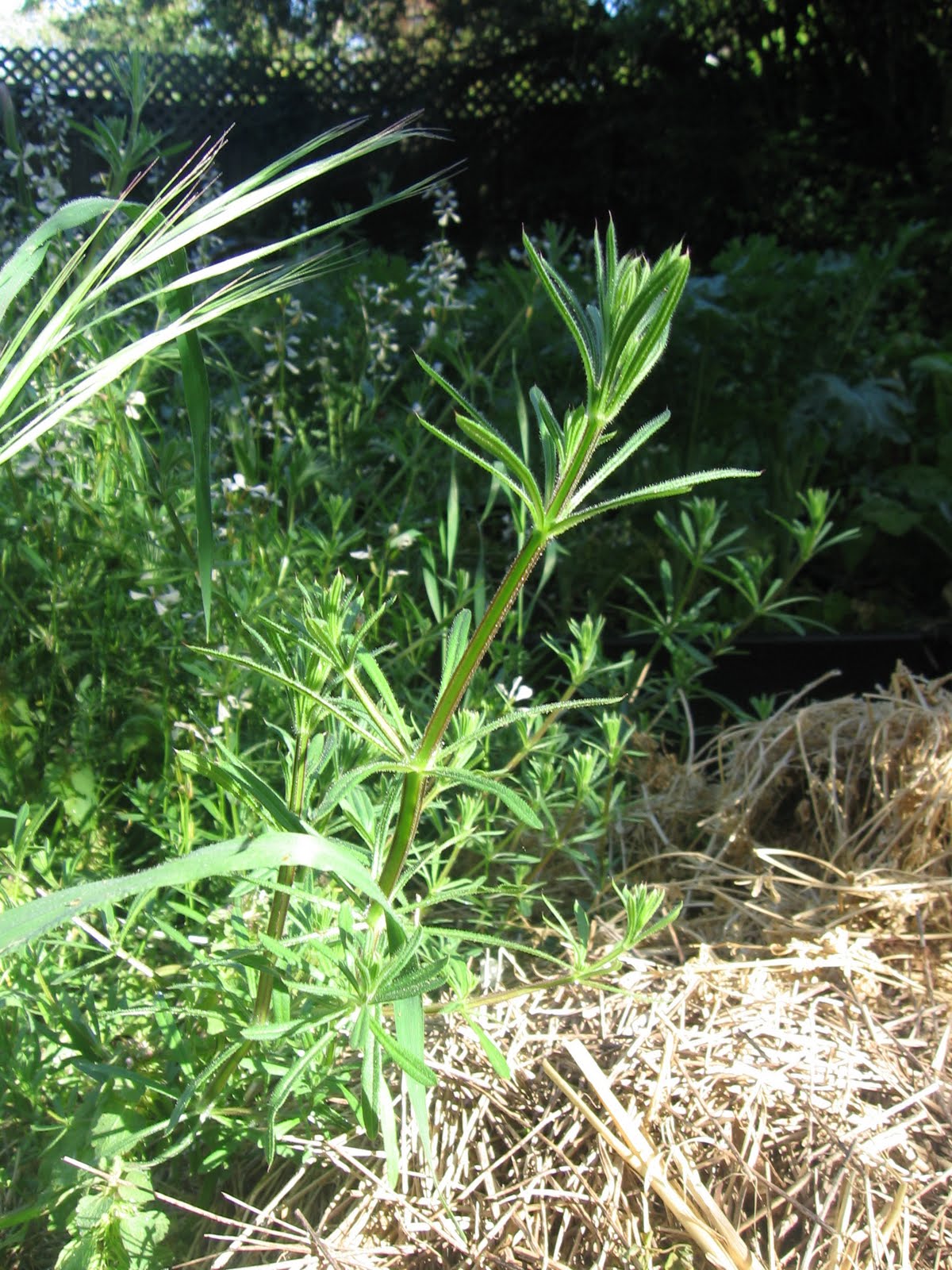
This pesky, clinging, climbing weed grows abundantly all over the yard.

However, it turns out that the sticky little fellow is not only prolific but also useful. I will try to complain less when the myriad, minuscule hooks lining the stems and leaves attach themselves to whatever is available, including gardeners -- just trying to do a little weeding -- who find themselves caught in big tangles of the stuff.

Sticky Willy (Galium aparine), also called Cleavers, Goose Grass, Catchweed Bedstraw or Common Bedstraw (because a closely related plant was used in medieval times to stuff mattresses), and, in modern times, Velcro Plant (for obvious reasons), has numerous healing properties known to herbalists, and its seeds can be ground up as a coffee substitute (it is actually related to the Arabian coffee plant).

If civilization collapses we can live off the backyard, at least for awhile.

Saturday, April 17, 2010

Weed of the Week: Henbit


Henbit is one of the most prolific spring weeds. At first I'm glad to see it as it is one of the earliest blooming backyard plants and the little pink tubular blossoms are a welcome sight. According to Wikipedia, honeybees also love them and they help get the hives going. A spring tonic for all concerned.

It's a member of the mint family, as its appearance would suggest: square stems, opposite leaves, tubular flowers. As a soil indicator (one of the beneficial features of weeds) it signals moist, rich soil -- which makes sense to me because in our yard it grows densely around the raised beds. It is said to be edible but we have not experimented with it.

After the forget-me-nots start blooming around the beds I begin to pull out the henbit because it can easily take over whatever spot it favors.

Friday, April 16, 2010

Weeds Gone Wild


Late rains have added a burst of energy to the already luxuriant weed growth. This photo shows the main garden path in mid-April: a jungle of arugula, mallow, henbit, burr clover, miner's lettuce, grasses, sow thistle, sticky willy, bindweed and other upstarts I haven't learned to identify yet.

I left it to grow unchecked because of the preponderance of arugula -- the tall plants with white flowers. We eat the flavorful leaves in salad almost every night so it seems a small sacrifice to have the main path, which is usually wide enough and more for a garden cart to pass, reduced to a barely visible trail through the undergrowth.


In this close-up I can see fennel, forget-me-not, gopher weed, burr clover, and what I think is Queen Ann's lace. Since reading Michael Pollen's chapter on weeds in his early book, Second Nature, I've come to have a grudging admiration for these entrepreneurial pioneers that move in wherever we gardeners disturb the soil, unwittingly creating the conditions these plants are looking for. Our common garden weeds are not representatives of wild nature into which our cultivated patches are inserted. They appear as a result of our efforts to clear and dig. It seems their job is to cover up bare ground, which Mother Nature avoids as strongly as she abhors a vacuum.

So I take a fairly laissez faire approach to the garden paths -- letting the "good" weeds grow (forget-me-nots, poppies, arugula, miner's lettuce, Queen Ann's lace) and letting the "bad" weeds grow along with them until it gets to be time to get serious about the summer garden.


In a few areas where it was mostly "bad" weeds starting to come up thickly back in February, I covered the ground with lots of folded newspaper before they got tall. Unsightly but useful, the newspaper made a good base for collecting the mounds of weeds that I did manage to pull up. (You have to keep your wits about you walking around this garden in the spring: threading through jungles, avoiding piles of decaying greenery.)

Last week, when I thought the rains might be done for the season, I pulled up the newspapers to clear the paths. Above is a scenic view of a cleared path. During the long dry season it will be a hard-packed track where only bindweed and some hardy grasses like to grow.


And here is a not-so-scenic view in the back corner: the half-composted newspapers make a good layering material for starting a new brush pile. Over several years, the pile will decompose and transform the heavy black clay beneath it into fluffy soil.

Monday, April 12, 2010

Salad Accoutrements


There is always something interesting growing in the yard to add to a salad.

Lately, one of the featured items has been calendula flowers. It's easy to pluck out the petals and sprinkle them into the bowl, where the little orange flecks make the various hues of green seem greener and more variegated. They don't contribute a noticeable flavor, but add eye appeal, and are reputed to have value as a medicinal herb with antibacterial and anti-inflammatory properties.


Another salad accoutrement free for the picking are the blossoms and blades of the wild onion. The little white flowers add color and they both add a subtle oniony tang, just the right amount for a hyper-sensitive person like myself who weeps when there are raw onions anywhere on the block, or so it seems. As the plants mature, the blossoms stop being delectable when hard seed pods form at their base, but the tender tips of the blades are still quite good.


These flowers and seed pods on the miner's lettuce signal that their season of perking up our salads is about over. It's been a long run, but now I will stand back and let them sow seeds for next year. The pods are forming along this stalk, like tiny green coin purses filled with a wealth of even tinier round black seeds.


Even though I regret seeing the miner's lettuce go to seed, it's a fascinating process. First the heart shaped leaves become round -- I have no idea how they manage to do it. Then they launch a sub-leaf from the center of the main leaf. This smaller version of themselves hosts the flower stalk, along which the seed pods will eventually form.


The mainstay components and added features of our salads vary from week to week and month to month. Right now the miner's lettuce, arugula, cilantro, spinach, and Black Seeded Simpson lettuce are winding down and the Red Lollo Antago lettuce is long gone. But there is plenty of Forellenschluss and Bronze Arrow lettuce, along with whatever accoutrements can be found here and there.

Wednesday, March 17, 2010

Happy St. Patrick's Day!


In honor of the green, here are the shamrocks by the kitchen door. We had some in salad tonight -- our minor observance of the day. This is actually just some wild oxalis, sour grass, that opportunistically took over this pot and the little plot it sits in. Actually, no-one really knows what the true shamrock might be, according to an article I read in a doctor's waiting room, in an glossy Irish horticultural magazine. Too bad I had to leave it behind before finishing the article.

But here's the gist of it: researchers sent out requests all over Ireland for people to mail in samples of the real and true shamrock. They got a variety of different plants, all having the tri-partite leaves that St. Patrick legendarily used to explain the Trinty. Many of the plants were in the oxalis family, so I rest my case. The true shamrock is the one growing right outside your door.


Another green tribute -- the velveteen hills of Sonoma County, dotted with live oaks. This vista is in walking distance of our house. The new grass has that dizzying green-gold light of early spring.

Wednesday, February 10, 2010

Sour Grass Soup?


OK, it happened like this: B. read an article about Sorrel Soup, by our local food and garden writer, Michele Anna Jordan, who is always eloquent and interesting. The description was so tantalizing he felt inspired to follow through, even though his left wrist is still in a cast and two fingers on the right hand are bandaged. Must be that irrepressible springtime energy that keeps manifesting itself in the midst of rain and fog and cold and chill.

There is wood sorrel growing wild by the back door and out near the garden, a definite sign of spring -- the first yellow blossoms opened this week in our yard. I've seen lots of them along the roads and in corners of neighbors' yards for several weeks now.

Wood sorrel is a common weed also known as oxalis. It is known to California children as sour grass (at least to the California children of my acquaintance). Just as we East coast children knew for certain -- as irrefutable childhood lore handed down from no one knows where -- that you could make sassafras tea from the root of the sassafras bush, West coast children know that you can chew on the stems of sour grass for a nice lemony, tangy treat. But soup from sour grass? That, we didn't know. However, as adults, we believe what we read in the newspaper or on the Internet.


Michele Anna Jordan used red-veined sorrel, a different plant entirely -- not in the oxalis family but a Rumex species related to Rhubard. However, a little bit of Web sleuthing revealed that wood sorrel is just fine for soup. Here's the money quote from an article on culinate.com:

"California children love to chew the stems of a yellow-flowered wood sorrel, which they call sour grass. According to Patience Gray, in her book Honey from a Weed, the French once considered oxalis the best sorrel for sorrel soup, or potage Germiny, which even today bears slivers of French sorrel in imitation of tiny wood sorrel stems, for the stems didn’t break down with pounding as the leaves did."

Even though B. didn't follow either of the published recipes, the end result was very like what Michele Anna Jordan described seeing in a scene set in a Paris restaurant in the TV miniseries of Evelyn Waugh's Brideshead Revisited: "a pale green soup served in a wide pretty soup plate."

It was remarkably good -- no doubt helped along by mushroom broth, leeks, potatoes, and asparagus -- with just a touch of lemony tang. And, so it seems, humble backyard sour grass soup is actually the ancestor and inspiration for fancy French sorrel soup.

Monday, January 18, 2010

Gathering Wild -- and Semi-Wild -- Greens


C. and I took a long walk today when the sun broke briefly through the lowering clouds. The gutters were running lavishly with rain water and some of it was pooling into the streets -- we haven't seen that for a while. It made me think of e. e. cummings: everything was "mud-lovely and puddle-wonderful." C. certainly thought so and sniffed his way though this damp world with doggy enthusiasm.

Rain is no deterrent for backyard excursions either. All things green and growing are a delight for the eye -- encrusted with sparkling droplets. Miner's lettuce (above) really shows up well in the gloomy light.

When I first came to California, lo these 45 years ago (!!!), one of the first bits of local lore I was entrusted with by the natives was familiarity with this charming little plant, favored during gold rush days by the miners who valued it for its Vitamin C, a remedy against scurvy. This is the perfect time to gather as much as can be eaten in fresh salads, while the leaves are still heart-shaped and tender. A basic California weed, it is showing up all over the back yard and, like the miners, we are glad to see it.


Another common weed is fennel -- its bright green feathers grace many a roadside in early, early spring and then mature into tall, fragrant poles topped with little round trays of white blossoms, followed eventually by the wonderful seeds. We have one large plant that has dug in next to the fence and comes back year after year. In fall I gather the seeds, and also the hollow poles to use as light plant supports. In spring the mother plant is surrounded by hundreds of tiny seedlings just right for perking up a salad.


Arugula has naturalized in our yard and comes up everywhere on its own. I planted some several years back and let it go to seed. Good move. Salads don't seem complete now without some of its dark leaves with their distinctive spicy, nutty flavor.

In the fall, after letting the tall seed stalks dry out, I merely pile them in a promising corner and wait for nature to take its course. It's only a few months until the new plants come bursting forth.


Parsley too has branched out on its own into a semi-wild state. It comes up wherever I pile the dry seed heads and also wherever seeds happen to fall by chance. I'm always being surprised by an unexpected volunteer. Just as salad doesn't seem complete without arugula, vegetable soup is not a true soup without some fresh parsley, just picked.

And parsley is the loophole ingredient for the 2010 Eat the Yard challenge. So far we haven't had to resort to the token sprig to meet the challenge of eating something from the yard every day:

January 11: vegetable soup (chard, kale, parsley) with garden salad
January 12: tacos with chopped garden lettuce and a squeeze of Meyer lemon in the guacamole (we forgot to add fresh cilantro!!)
January 13: garden salad
January 14: garden salad
January 15: garden salad
January 16: a squeeze of Meyer lemon on the store broccoli, garden salad
January 17: vegetable soup

Tonight, no salad unless I go pick right now, but there is a small bag of kale, chard, and parsley left over from last night's soup making. Maybe a side dish of greens?