Showing posts with label february. Show all posts

Thursday, February 27, 2014

A Benediction of Rain


We owe a mighty vote of thanks to all the folks who were praying for rain. Two storms, one yesterday, another due in tonight, are expected to bring four to six inches in the lowlands and more on the hills. What a difference a little bit of moisture makes.

Even thought it's not nearly enough to save us from unprecedented drought -- the current soakings will only bring total rainfall so far to not quite forty percent of normal -- the backyard is a whole new place. How long has it been since there were fat water droplets clinging to the textured surface of the kale leaves? It seems like years.

There is a softness in the air, a new urgency in the song of the birds, and a sweet fragrance from the darkened soil. St. Francis had it right when he praised "Sister Water, so humble and precious and clean."


There is a heightened awareness now, all across California, of every precious drop, gallon, and acre foot. Trying to do my small part, I set out a plastic garbage can in the back yard as an instant rain water cachement system. A few inches have been collected already from the first storm. It's a tiny tiny drop in an extremely large bucket (the whole state and its water deficit) but it works as a consciousness raising gesture.

We are ready for the next storm, and the next.

Tuesday, February 25, 2014

Hyacinth and Friends


A little white hyacinth is blooming in our backyard, where no hyacinth has bloomed before!!! I've bought them before, of course, at the supermarket, in tiny ceramic pots for forced blooming indoors. After all, who can resist a hyacinth in the springtime?

This one was growing up out of a pile of compost. I imagine the spent bulb came out with the kitchen scraps and landed in a propitious spot. Not realizing what it was -- no blooms were showing -- I unwittingly uprooted it while shoveling compost and adding insult to injury, or rather injury to insult, I sliced off a bit of the bulb with the shovel.

When I saw what it was I immediately planted it in the rich soil along the fence. I was sure it was done for, but plants can surprise you and I am always ready to be surprised. How nice to be rewarded with an un-looked for bloom. Let's hope it prospers in its new home as a symbol of rebirth, regeneration, and second chances, or, actually, third chances: house, compost pile, and now, planting bed. A three-time winner and a fitting tribute to the beautiful youth Hyacinth, beloved by Apollo but accidentally, tragically, slain by him and immortalized in an ever renewing flower.


Flowering at the same time across the yard in the bed along the other fence is a little mystery bulb, a migrant from the front yard. It must have come in with the leaf litter I collect in the front yard to cover paths in the back yard, following the permaculture practice of using onsite materials whenever possible.

There are dozens of these unknowns in the front yard, coming up every spring as long as we have lived here. And now they will be colonizing the backyard too. Another un-looked for spring bloom.


The wild onions are also blooming now in the shade under the plum trees. No mysteries or surprises are involved. These are tenacious weeds I happen to be fond of. They appear with the early spring bloomers and spread opportunistically everywhere there's an opening. I like them as additions to spring salads -- all parts are edible and have a mild oniony tang.

What all three of these pretty volunteer plants with their hopeful white flowers have in common is that they have chosen to grow in our yard. May they prosper (within reason).

Friday, February 21, 2014

Spring Begins, Again


It's been a long, long journey round the sun since the last heralding of backyard plum blossoms. But spring springs eternally and nothing can stop its burgeoning progress. Neither 500-year-drought nor neglectful gardeners with other priorities will hold it back. Welcome, little beauties! We are really, really glad to see you, bringing fresh chances and new opportunities to begin again.

Sunday, February 17, 2013

Waiting for Spring


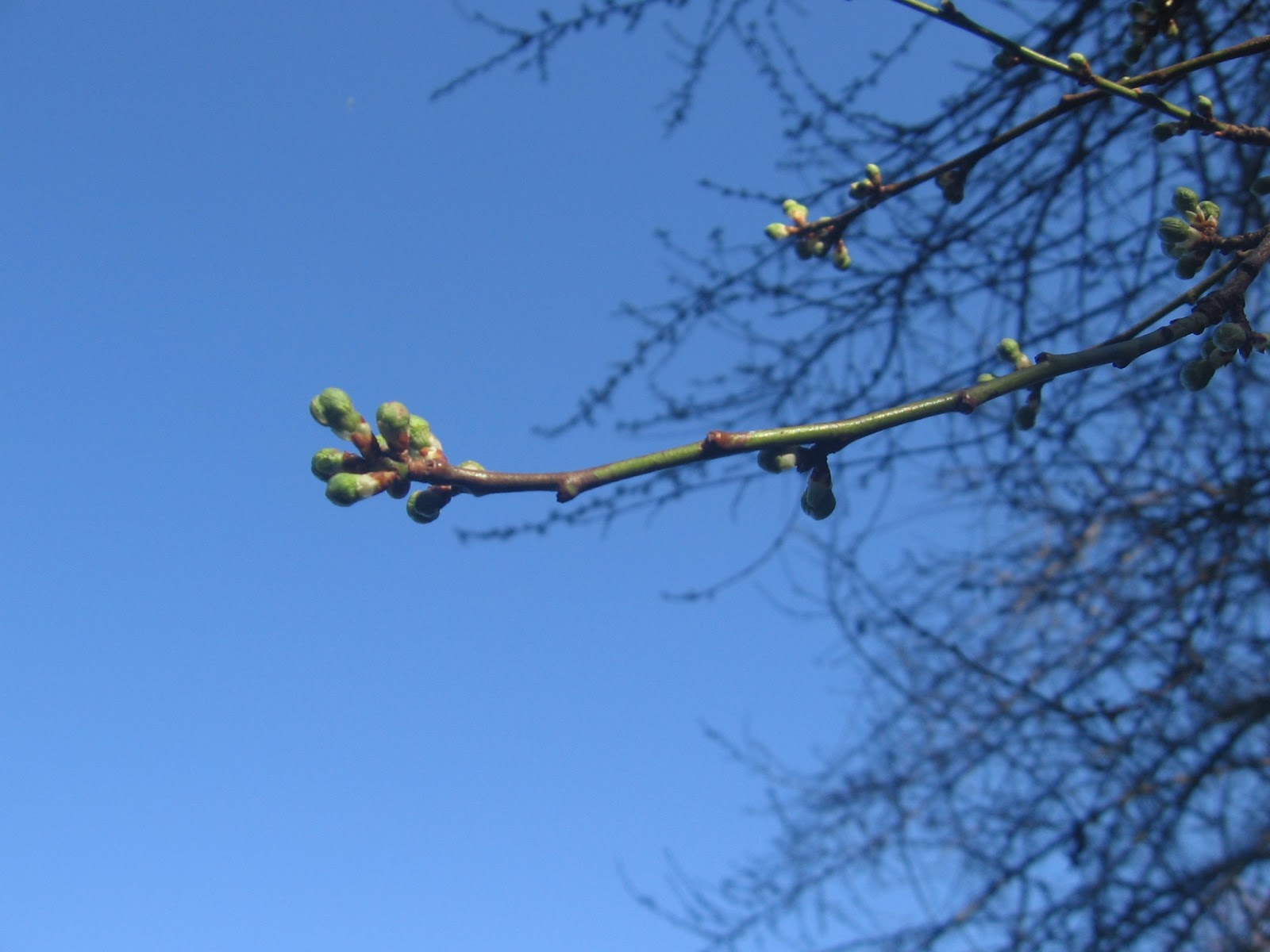
It's time for the plum blossom extravaganza to begin in our backyard, but continuing chill has put a damper on things. The best we can manage is to make a fuss over some fat buds lining the bare twigs at eye level and a few hard-to-see blossoms way up at the top of the tree -- a mere handful. Not much is happening in the neighborhood, either. Usually by Valentine's Day there is an appropriately festive display of ruffly pink and white bloom lining the streets.


As a reference point, last year on this exact date, February 17th, I took the annual iconic photo of a just-opened perfect white plum blossom low enough on the tree to allow for close-ups. This year, fat buds will have to do.


Plum blossoms call for haiku, of course, but will buds suffice? Pondering this deep question, I noticed the waxing half moon, faintly visible through the denuded upper branches of the tree (not very visible in my photo, unfortunately): a reminder that poetry is where you find it.

Half moon caught in the
Bare branches of the tall plum --
Yet time does not stop.

If time is still moving then spring will surely come.

Sunday, February 19, 2012

First Plum Blossom!


The first plum blossom in our backyard inspired some haiku thoughts:

Spring makes a bargain
With the cold air of a bright day:
First white plum blossom.

Buson, when dying,
Hoped for plum blossoms of
Eternity's dawn.

Where every morning
Is the first morning and the
Blossoms never fall.

Buson, the cherished 18th century Japanese poet and painter, is said to have composed his final death-bed poem hoping to see the first iconic blossoms of early spring before he died and comparing them to what he hoped to see after he died.

Perhaps he was making up for an earlier verse with a less transcendent message:

"In nooks and corners
Cold remains:
Flowers of the plum."

(Translated by R. H. Blyth)

It's true that a large part of the haunting beauty of the fragile white flowers that spring suddenly from dead branches arises from their vulnerability and fleetingness. Storms may come; there might be frost. The brave new blooms could be littering the ground as quickly as they appeared.

But they also hold a promise of more beauty to come. Slow, hidden processes are coming to fruition and even though the petals may fall, life goes on and, perhaps, like a poet's prayer, merges with eternity.

That's why, although there have been blossoms all over town for several weeks -- flowering cherry, quince, tulip magnolias -- the first pale plum flower in our own backyard stopped me in my tracks. It's a surprise even when I know it's coming. Usually I'm not looking for it but just happen to notice it while walking by with other tasks in mind.

Something always impels me to note the occasion. I used to jot it down on my calendar. Now I take pictures with a digital camera that records for posterity the date and time.

According to my informal data of the past several years, the first plum blossom appears sometime around Valentine's Day, mid-February, when the seasons are shifting back and forth from day to day. The data is very informal since the "first blossom" is the one that I happen to see -- i.e. it's more or less at eye level, not way up on the high branches.

Let the record show that the first plum blossom of 2012 was photographed on February 17.

First blossom of 2011: February 13.

First blossom of 2010: February 7.

That's as far back as my photographic evidence goes.

Each year this momentary "first" seems more momentous.

Sunday, February 12, 2012

A Tweet Mob of Robins

All day long the robins have been in a state of high excitement. This morning the neighbors' redwoods and eucalyptus were shaking and fluttering with hidden activity and the sunlit air was alive with loud, rowdy birdsong. It took me a while but eventually I figured out what was going on, based on previous experience with robins and ivy berries.

I've seen it before. When the ivy is fruiting, the robins go crazy over the myriad clusters of small dark berries packed with nutrition and quick energy. The continuous twittering of the first arrivals seems to draw others and soon there are crowds of them swooping here and there. A tweet mob for sure. Occupy the ivy!!!

I could see thick twining vines of ivy snaking up the tallest redwoods -- that's where most of the activity was centered as fat birds dove in eagerly, dislodging others who flew up onto nearby eucalyptus branches.

Because neither redwood nor eucalyptus drop their greenery in winter it was hard to see the birds except in flight. But when I went back out in late afternoon the action had shifted to our yard. The skies had clouded over and, in the bare branches of the locust tree by the garage, plenty of plump, chesty silhouettes were visible against a luminous grey field of light. 


The mood was much quieter. Most of the birds were too stuffed to do more than chirp -- or perhaps burp -- contentedly and wait politely for their turn to fly over to the small, ivy-covered plum tree.


Just a few birds at a time held sway in the spindly branches of the plum tree, occasionally dropping down into the mass of ivy for a few last tidbits. A fine closing to a fine day.

Wednesday, February 8, 2012

Glorious Gloom

It seems churlish to complain about a long series of bright days with clear skies, but that's what's been going on on the West Coast as farmers look to their water tables, planners measure the reservoirs, and skiers long for snow. With a dry December followed by a dry January the Sierra snow pack is at 30% of normal and the big ski resorts have resorted to trucking in machine made frozen white stuff that isn't really snow. Where are the winter storms????

Let me add a gardener's voice to the chorus. It feels odd to have to water the backyard at this time of year. I'm even watering the weeds. The patches of volunteer miner's lettuce, usually lush swaths of green-gold splendor, are sparse and pale. Yesterday, therefore, was a welcome respite from the relentless blue glare overhead as a dark cloud cover swept in and released not nearly enough rain for the big picture but plenty for the enjoyment of the moment and a brief pick-me-up for the plants.

This morning I tried to take some pictures of the glorious gloom before the mists dissipated. Hooray for a grey day!!


Wednesday, February 23, 2011

Crocus!


For some reason I get really excited to see the first crocus of the season. It reminds me of childhood spring times in Virginia, where one of the earliest harbingers of winter's demise was a few brave little buds poking through the snow.

We haven't had snow, but there's been plenty of wintry weather and, true to its kind, this exuberant bloom was waiting to greet me during a string of gloomy days we've been having. Unseasonably warm weather lasted through January and half of February, then shifted dramatically, thanks to a low-pressure system from the Gulf of Alaska bringing cold temperatures, pounding rain, and snow in the mountains.

The crocus is in the Iris family and one particular variety is the source of saffron seasoning. What we call saffron is hundreds and hundreds of deep orange stamens hand-gathered from crocus blossoms and carefully dried and packaged. That's why it's the most expensive spice by weight in the world. It takes a football field to make a pound's worth.

I don't know what variety of crocus has just bloomed in my backyard, but I'm really glad to see it, bright orange stamens and all.

Saturday, February 19, 2011

The Last of the Tomatoes


I used to marvel at Christmas tomatoes and make jokes about New Year's tomatoes. Then, as I learned more about how to extend the tomato season and store some dangling branches in the garage, I would marvel at New Year's tomatoes and make jokes about Valentine's Day tomatoes.

Yet here we are, post Valentine's Day, and there are still a few hangers-on, a little wrinkled but still cheerful (like me and my friends!), ready to spark up a salad. It's a marvel.

Monday, February 14, 2011

Plum Blossoms


The plum trees are in bloom! We've had a stretch of unseasonably warm, dry weather for more than a month, so I guess I shouldn't be too surprised.


The two photos above were taken on February 13, just in time for Valentine's Day. As usual, we are running behind the rest of the neighborhood where the dancing girls of spring in their lacy pink and white tutus have been lining the streets for some time now.


But we are running ahead of last year in this same backyard. Pictured above is the first plum blossom of 2010. The photo was taken on February 7, 2010. You can tell that I hadn't yet learned to use the close-up feature on my Canon Powershot camera! Oh well, it might not work as art but it will serve as evidence.


Here are the plum trees on February 12, 2010. Quite a contrast with this year. Each year tells its own story.

Thursday, February 10, 2011

Mystery Fungus


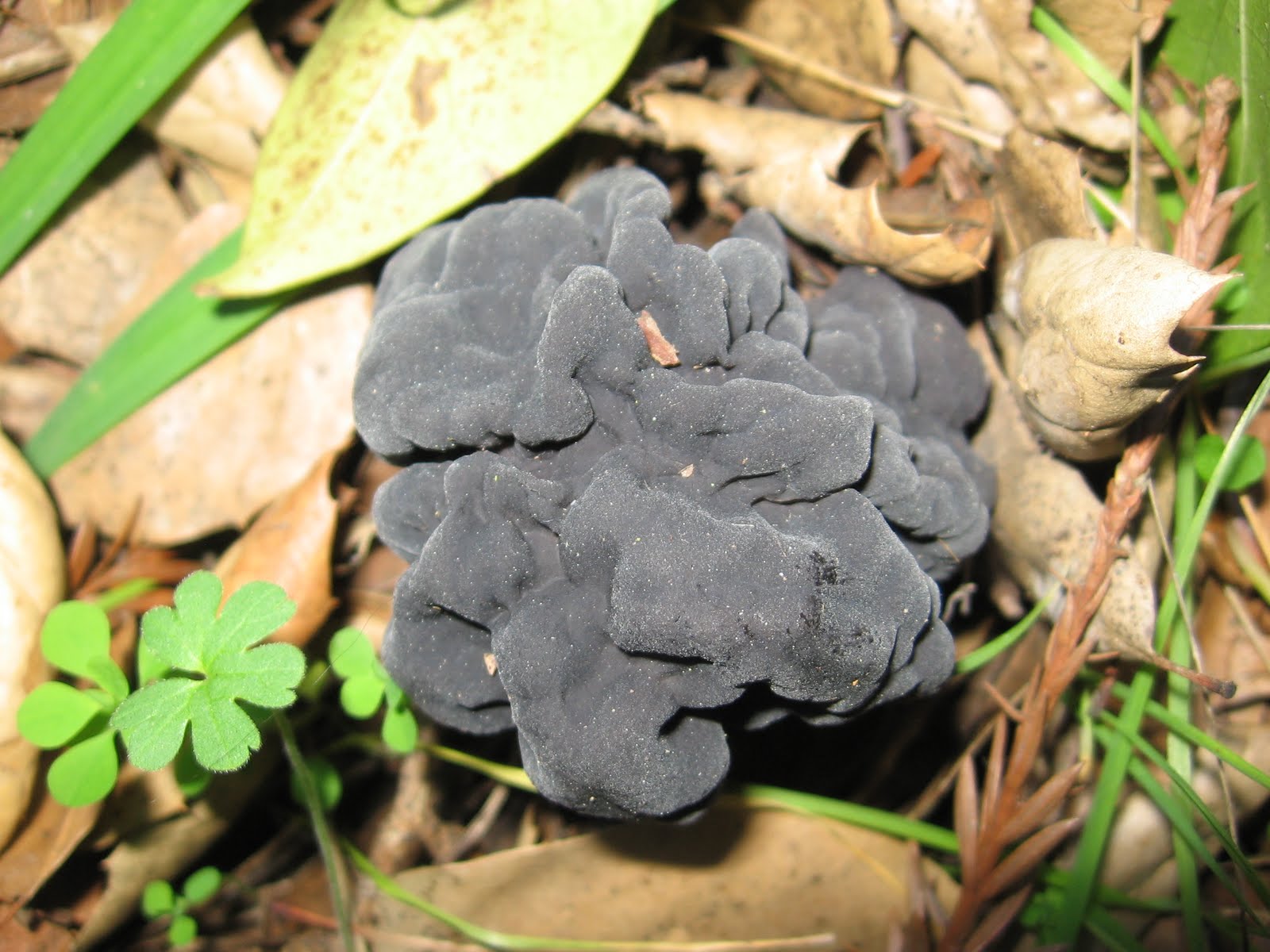
I was raking leaves in the front yard when I noticed this mysterious object amongst the leaf litter. My first thought, seeing it from a distance, was that the dog had chewed up one of my black socks and left it lying there (he does have a fondness for our well worn socks).


When I came closer it revealed itself as a strange growth, ominously alive.

Nothing stays mysterious for long in the internet age. I typed into Google Search the description of what it looked like to me: "wrinkled black fungus" -- and soon found a reasonably close photo and identification. The photo, taken on a trail side in Poland, is posted on TrekNature, a place for adventurous travelers to share their finds.

Adrian Szatewicz kindly provides the name and features, and Wikipedia fills out the story. This is an evil cousin of the marvelous and much-sought-after morel mushroom, called Gyromitra esculenta, or "brain mushroom." "Esculenta" means it can be eaten and supposedly, it can, if cooked properly, with all windows open to vent the poisonous fumes which have the same chemical composition as rocket fuel. In some parts of Europe it is sold in markets. But don't try this at home, kids! It can also cause illness and death.

I have never wanted to touch wild mushrooms since the time I read a newspaper article about the head of the local mycological society, who succumbed to an ill-chosen fungus. Even the experts can make mistakes.

The most interesting thing I learned is that some mushrooms, like this one, are mostly saprotrophic: they live on decaying organic matter. Others are mostly mychorrhizal: they send out thin white filaments which interpenetrate the rootlets of plants in a symbiotic exchange of nutrients, an important factor in soil chemistry. Having lots of mychorrhizal activity in your soil is a good thing for your plants.

Sunday, February 6, 2011

Lasagna Gardening: Gourmet Version


Although the winter garden has served us well, the plants aren't as large and sturdy as in previous years. Case in point: the rather spindly Bronze Arrow and Black Seeded Simpson lettuces pictured above. The vigorous volunteer Forget-me-not seedlings are taking over the bed.

The soil in all the beds is overworked, I think, because as soon as one crop comes out another goes in. I do add organic matter whenever possible but, clearly, it's not keeping up with the demand. What to do? Although there are now enough beds to let some go fallow and pile them with mulch for a season or two, I don't seem to be able to make time for that forward-looking task: the immediate gratification of planting and harvesting gets in the way.

Solution: lasagna gardening. As I understand it, this approach involves building what amounts to a mini-compost pile of layered materials -- hence lasagna -- with soil on top like a very thick layer of Parmesan cheese. The claim is that the plants grow just fine even as the various layers are slowly breaking down and enriching the soil.

It's certainly worth a try. Maybe it's the perfect way to have our vegetables and eat them too -- to build soil and grow plants all in one smooth operation, just the way Mother Nature does it. And there is the immediate gratification of planting right away.


So today I ventured out to the yard to turn one of the garden beds into a yummy casserole of nutrients for the hungry roots of some lettuce seedlings from Cottage Gardens.

The hardest part -- which required violating my no-dig philosophy in order to get a quick fix to the problem of declining fertility -- was removing all the old, overworked soil. Once that was taken care of, after lots of little weeding breaks to rest my aging lumbar vertebrae, the rest was fun. All it took was layering in the best ingredients I could find to make up a real gourmet masterpiece.

The first layer was some hand-selected, carefully-aged sections of newspaper gently moistened with the hose. It was not too thick, just one or two sections worth of newsprint. The worms love this stuff, so I hope the newspaper will draw them to the area and get them interested in turning all the undigested organic matter into the top grade soil amendment only they can create.


The second layer was an inch or two of well-aged, locally-sourced manure from Pt. Reyes Compost, self-styled "purveyors of premium poop." The version I used is cheekily called "Double Doody," a mixture of cow and horse droppings, and the bag is marked by an image, half cow, half horse that reminds me of the two-headed Pushmi-pullyu creature from the Dr. Doolittle stories.


The third layer was thick pads of organic alfalfa hay, sprinkled with some high quality general purpose organic fertilizer (Whitney Farms Tomato & Vegetable Food, with a 4-5-3 balance of nitrogen, phosphate, and potash).


Next came a layer of leaves, also locally sourced (just down the block) and organically grown. This layer, too, was dusted with fertilizer. In fact, all the layers were, starting with the bare dirt before the newspapers were laid down.


The last layer was shovelfuls of the original dirt from the bed. There was room for more than half of it to fit back in, so there should be plenty of room for the lettuce to take hold, right on top of the gourmet lasagna layers. I soaked the whole assemblage thoroughly and let it mellow a bit.


It was nice to find a fair number of earthworms in the soil. I sure hope some red wiggler worms will show up to start digesting the layers of organic matter.


The last step was to set in the lettuce seedlings -- Forellenschluss and Garrison. Hope you like my casserole, little guys. Enjoy!

Monday, February 22, 2010

Purple Mutant Broccoli


The garden is a never-ending source of surprises. The latest head-scratcher is this unexpected plant pictured above. The largest by far of the Romanesco broccoli, it has put forth a head that looks like some kind of cross between Romanesco and Purple Sprouting varieties. You can see the separate, fractal-like florets, but they are much less sharply defined than in a regular Romanesco, where the little components look as if they have been etched out by a laser beam. And instead of a pale. luminescent green, it has a heathery, purple color. Not unattractive, but slightly weird. It makes me a bit nervous.


Here is Purple Sprouting broccoli, which, like the Romanesco, I've never grown before. But it looks like what I expect from the label -- lots of small sprouts, just starting to appear, that will hopefully go on producing for some time. Both sets of seedlings came from Cottage Garden Nursery. Could there be cross-pollination?


Just for reference, this is what Romanesco is supposed to look like. The mutant head is three times bigger than these delicate specimens. We'll see what it tastes like. But then maybe we will end up with alien lifeforms sprouting from our foreheads. . . .

Sunday, February 21, 2010

Buds Bursting, Birds Singing


Last weekend, C. and I took a walk through the nature area that runs through the center of a nearby subdivision. I was looking for signs of spring; he was running his own, mostly olfactory, survey. Here he is sniffing the breeze in the middle of a field of buttercups. If we could add little thought balloons to this picture, it would be: Me (off-camera) -- "Ooooh, buttercups. They weren't here last time we came by." C. -- "Four raccoons, six cats, and a dog who is smaller than me passed this way in the last 24 hours. Is this spot in need of marking? I think not."


The nature area is the site of a watershed restoration project. The creek is being brought back to its natural state. I was expecting lots of bloom, but perhaps these native plants have their own style, more subtle than the showy trees along neighborhood streets. Here's how the creek looks in mid-February.


The giant willow by the waterhole where the local kids like to play in warmer weather is starting to leaf out. A delicate greening is the main clue to the advancing season. I noticed lots of fat buds on several different types of trees.


After we got home, I took this photo out the back bedroom window of a robin gorging on ivy berries. There were several of them rustling around and whistling their happiness over a beautiful day in early spring.

Friday, February 19, 2010

Garden of Eatin'


Over the past week the harvests have been keeping us amply supplied with fresh produce, and still on track with our Eat the Yard Challenge. A basketful of chard and kale went into a big pot of minestrone, with plenty left over that's still in the fridge. Fortunately it keeps well.


Three little heads of Romanesco broccoli, lightly steamed, made Valentine's Day dinner festive.


And salad greens are reliable daily fare. Above, top to bottom: Red Lollo Antago lettuce, cilantro, Forellenschluss lettuce.


Above, top to bottom: Bronze Arrowhead lettuce, Miner's lettuce.


Above, left to right: Black Seeded Simpson lettuce, spinach (mixed Bloomsdale and Gigante d'Inverno), arugula.

For the record, here is the ongoing tally of eating something from the garden every day:

February 11: Minestrone with with winter greens (chard, kale)
February 12: Same
February 13: Same
February 14: Pasta primavera with garden parsley, Romanesco broccoli
February 15: Pasta primavera with garden parsley
February 16: Oatmeal walnut burgers with garden lettuce
February 17: Oatmeal walnut loaf, garden salad
February 18: Garden salad

Sunday, February 14, 2010

Earth Valentines


Happy Valentine's Day!

Rather than visiting the mall to pick out cards or buy flowers flown in from distant lands, it's a lot more fun to walk around the neighborhood to see what's in bloom. On almost every block are exuberant displays of lacy pink or white creations.

These are the same streets we were walking just a month ago, in the dark, admiring the Christmas lights that most people still had up. Gradually, one by one, the houses went dark. Now they are decorated again with a whole different theme -- just like the stores, although Mother Nature's marketing promotions are far more enticing.

Above, I believe, is a flowering quince bush.


My rule of thumb used to be that the trees with pink blossoms are flowering cherry and the white ones are plum.


This one, right across the street from us, has white blossoms, and our neighbor assures me it is a flowering cherry. So, it must be admitted that I really have no idea what all these graceful trees might be. But who cares on a beautiful spring day?


About a 15 minute walk from our house is another white-blossomed tree, venerable with age and surrounded by Indian paintbrush, in the yard of an abandoned old farmhouse house on the edge of town.


In our own backyard, I know how to identify the plum trees because we've eaten the fruit for many a summer. So far, there are only two or three white blossoms showing, with lots more to come.

Thursday, February 11, 2010

Emergency Parsley


Parsley sprigs in a glass on the counter are a fail safe device for adding something from the garden to a meal when time is short and there is nothing on hand in the refrigerator. Last night we ran out of salad makings and winter greens and I didn't have time to run out into the yard.


But not to worry. A bit of chopped parsley sprinkled over the pizza at the last minute keeps alive the game of eating from the yard every day. And, it turns out, B. had already sauteed in some fresh rosemary with the mushrooms.

2010 Eat the Yard Challenge -- so far, so good:

February 2: mushroom sandwiches with garden arugula, garden salad
February 3: garden salad
February 4: chili with garden parsley, sauteed winter greens
February 5: garden salad
February 6: tacos with garden lettuce, guacamole with garden cilantro
February 7: spagetti with garden tomato sauce (freezer), garden salad
February 8: sorrel soup, garden salad
February 9: mushroom pizza with rosemary, garden salad
February 10: mushroom pizza with rosemary and parsley

Wednesday, February 10, 2010

Sour Grass Soup?


OK, it happened like this: B. read an article about Sorrel Soup, by our local food and garden writer, Michele Anna Jordan, who is always eloquent and interesting. The description was so tantalizing he felt inspired to follow through, even though his left wrist is still in a cast and two fingers on the right hand are bandaged. Must be that irrepressible springtime energy that keeps manifesting itself in the midst of rain and fog and cold and chill.

There is wood sorrel growing wild by the back door and out near the garden, a definite sign of spring -- the first yellow blossoms opened this week in our yard. I've seen lots of them along the roads and in corners of neighbors' yards for several weeks now.

Wood sorrel is a common weed also known as oxalis. It is known to California children as sour grass (at least to the California children of my acquaintance). Just as we East coast children knew for certain -- as irrefutable childhood lore handed down from no one knows where -- that you could make sassafras tea from the root of the sassafras bush, West coast children know that you can chew on the stems of sour grass for a nice lemony, tangy treat. But soup from sour grass? That, we didn't know. However, as adults, we believe what we read in the newspaper or on the Internet.


Michele Anna Jordan used red-veined sorrel, a different plant entirely -- not in the oxalis family but a Rumex species related to Rhubard. However, a little bit of Web sleuthing revealed that wood sorrel is just fine for soup. Here's the money quote from an article on culinate.com:

"California children love to chew the stems of a yellow-flowered wood sorrel, which they call sour grass. According to Patience Gray, in her book Honey from a Weed, the French once considered oxalis the best sorrel for sorrel soup, or potage Germiny, which even today bears slivers of French sorrel in imitation of tiny wood sorrel stems, for the stems didn’t break down with pounding as the leaves did."

Even though B. didn't follow either of the published recipes, the end result was very like what Michele Anna Jordan described seeing in a scene set in a Paris restaurant in the TV miniseries of Evelyn Waugh's Brideshead Revisited: "a pale green soup served in a wide pretty soup plate."

It was remarkably good -- no doubt helped along by mushroom broth, leeks, potatoes, and asparagus -- with just a touch of lemony tang. And, so it seems, humble backyard sour grass soup is actually the ancestor and inspiration for fancy French sorrel soup.