Showing posts with label compost. Show all posts

Sunday, November 4, 2012

The Elusive Soldier Fly


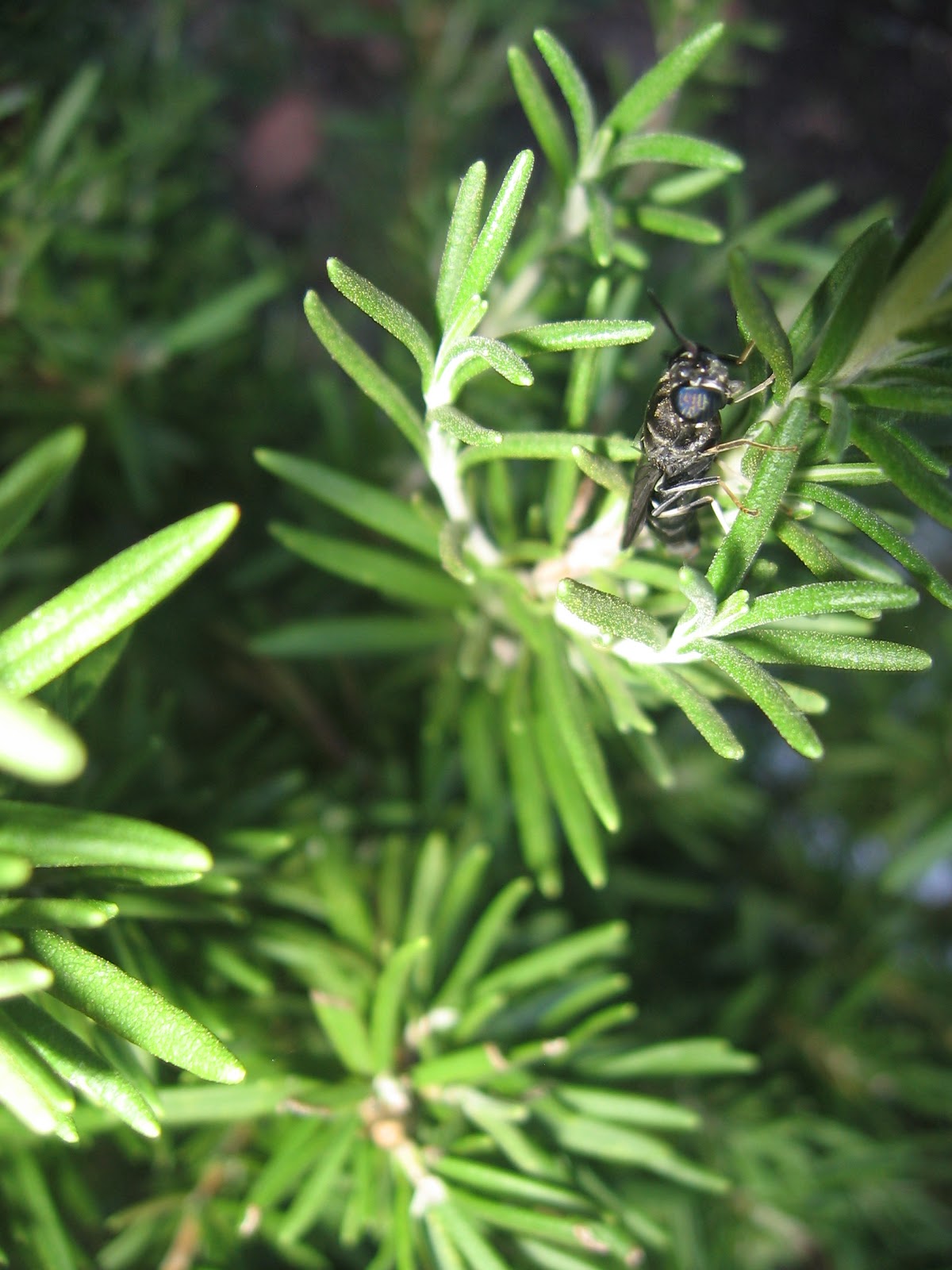
There have been a few soldier fly sightings in our yard before, always near our compost bins. But I've never gotten a photo because the large wasp-like creatures always fly off at the slightest disturbance. Today I managed to take several pictures -- with a flash, no less -- of one that remained determinedly in place on our little rosemary shrub, without even a twitch of its antennae.

Perhaps it was a female laying eggs?


The adult female Hermetia illucens or Black Soldier Fly (BSF), likes to lay her clusters of tiny eggs near a food source for the hatched-out larvae. Although she herself does not eat and does not even possess mouth parts, she is irresistibly drawn by the availability of decomposing kitchen scraps.

Thus, the rosemary shrub near the compost corner makes an excellent site for planting the next generation. I know that our local Hermetia moms make good choices because our bins always have an ample supply of larvae feeding on the freshest, juiciest layer of new compost material -- their preferred diet.

After first discovering these fascinating creatures, I have found myself irresistibly drawn to reading articles with titles like "The Bioconversion of Putrescent Waste" and watching videos on YouTube of proud gardeners showing off piles of garbage seething with fat Hermetia grubs. (It's amazing what an innocent hankering for tasty vegetables and beautiful flowers can lead to.)

The adult flies live only about a week, just long enough to reproduce. They are quiet, elusive, do not feed on anything and do not carry disease. They are quite common nearly everywhere, like the housefly; but most people are not aware of their existence.

Just start a compost bin that meets their standards, though, and see what happens. You will discover the grubs and be horrified. Then, as you learn more, you will become profoundly grateful for a free composting service rendered by Mother Nature. During their one to three month life span the grubs consume quantities of fresh waste. They work so fast that bacteria don't have a chance to make everything smelly and other types of flies are not attracted. They quickly establish what the experts call "niche dominance" and discourage the presence of fruit flies, blow flies, houseflies, and ants. Last but not least, or even last, the residue they leave behind when they crawl away to pupate is just right for redworms, who carry the breakdown process into the next stage of creating rich soil for your garden.

So if you see a shy BSF in your yard, treat it with all due respect.


Sunday, August 21, 2011

Green String Farm


Green String Farm nestles against the leonine flanks of Sonoma Mountain in the southeastern corner of Petaluma. It is just a short drive down the highway, right where Adobe Road takes a sharp curve east through the hills.

I can't remember exactly how I stumbled on this local treasure. It was recently and it was on the Internet, of course, venue for most of my explorations these days.

Searching for something or other about sustainable agriculture I followed a series of links which ended up at a Web site with news of unexpected riches right here in southern Sonoma County. Green String Farm and Green String Institute have been operating for nearly a decade and co-founder Bob Cannard has been an icon of the organic movement -- a famed purveyor of highest quality vegetables and fruits to Alice Waters herself -- for more than thirty years.

This was all totally new to me, local gardener for lo these thirty-four years.

I didn't waste any time in checking out this new-found cornucopia. As it happened they were having an open house so I was able to get the whole story in person.

First off, the farm store deserves a mention. Open throughout the year, summer and winter, every day except major holidays, it offers up heaps of "Beyond Sustainable" produce along with eggs, cheese, and dried and canned items produced on site -- all for affordable prices. Part of the farming philosophy that shapes this enterprise is the intent to grow good food at reasonable cost for local markets. No shipping pricey organic fare for thousands of miles.

Wonderful, I thought, as I wandered through the charmingly rustic open air displays admiring baskets of bright red cherry tomatoes, piles of dark green zucchini, bins of golden peppers: If it's good enough for Chez Panisse, it's good enough for us home folks.


Along with its fabulous food, Green String Farm is also growing a new generation of organic farmers. That's where Green String Institute comes in. The open house was put on by the most recent crop of farm interns: an eager band of young people who had been selected to spend three months living and working on the farm while attending daily lectures by Bob Cannard about his unique approach to farming. The Institute, too, operates year round. There are new groups of interns coming in each season -- summer, fall, winter, spring -- and each group plans and organizes an event for the local community.


So, on a late August Saturday, with the sun beating down out of a cloudless blue sky, I went from booth to booth getting a crash course in "natural process farming." One of the interns demonstrated a very simple set-up for brewing compost tea in a five-gallon bucket full of water. With just a small amount of compost starter suspended like a tea bag, a little molasses, a pinch of flour, an air pump and a bubbler, you can launch an aerobic process for growing lots and lots of micro-nutrients that will give your plants a power diet.


There were other booths describing soil biology and plant health, the importance of adding igneous rock powders to boost soil minerals, and mug shots of all the different types of crucial soil critters. The displays and demonstrations were clearly aimed at encouraging us to try out the Green String methodology in our own gardens. It was like a science fair of smart motivated kids all presenting different aspects of the same experiment.


An intern led a tour up the hill and out into the wide summer fields dotted with fruit trees and patterned with long dark rows of vegetables. We got to see where the cherry tomatoes, zucchini, and peppers had come from.

Our group seemed even more interested in finding out where the interns had come from. The guide, an eighteen-year-old college graduate from Florida, patiently answered lots of personal questions: Are you going to be a farmer? Yes. What are you doing after this program? I'm staying on here to do some research. Are you a brainiac? Hmmm, if you say so. . . . Look over here at this nice field of chard . . . .

Interns come from all over the country (e.g. Florida, Michigan) and from other countries (e.g. Serbia) to spend three months living together in an old farmhouse, planting, tending, and harvesting the crops, running the store, and studying natural process farming as a business as well as a labor of love.

(People, there might be some hope for our common future if the cool careers are now out in the fields rather than on Wall Street.)


Some of the fields looked like what you would expect on a farm. But these were in transition and not fully representative of the "natural process" approach.


A cabbage patch gave a better idea of the technique. It looked like a weed patch, overgrown with tall seeding heads of what is in fact a companion cover crop that will be left to mature in place and eventually die back to form a thatched ground cover.

The field seemed alive, rustling with subtle motion. Suddenly a flock of birds swooped up out of the weeds to swirl and twitter in the air and then settle back down for more feasting on the plentiful seeds. The cabbages seemed almost like an afterthought, tucked in among the natural pasture. The principle is: A crop for the people, a crop for the soil (and the birds, and the insects). This is how Mother Nature does it, with plenty to go around.


A large field of tomatoes was even more striking -- it looked like it was made up of long tidy rows of weeds. You couldn't see the tomatoes at all until you were right on top of them.


The plants were not staked and sprawled along the ground amidst the weeds. The tomatoes will go to the farm store, the weeds will die in place and be dug back into the ground to enrich the soil. The argument is that this approach builds a complete, thriving soil biology which supports healthy plants with complete nutrition and full flavor.


The highlight of the day was listening to Bob Cannard talk about healthy soil and healthy plants. A tall, intense man in well-worn jeans and work boots, he strode into the capacious old barn filled with folding chairs, running his hands through short spiky grey hair. Completely covered with a fine film of dust, he seemed to have materialized out of the earth itself.

"OK, where do you want to start?" Barely waiting for the first tentative question from the group he launched into a long rambling discourse describing the natural processes that build soil wherever Mother Nature has a free hand. It all starts in the mountains with the rushing freshwater streams that gather up particles of rocks, plant debris, animal remains -- whatever is there. The streams bring this rich brew of "mountain tea" down into the flat lands where unencumbered annual flooding spreads it out and deposits the nutrients into the soil. That's the way it used to be everywhere.

But human activity has put streams underground and interfered in thousands of ways with natural soil fertility; so the farmer or gardener has to make up the difference by supplying the missing nutrients. Hence, natural process farming.

With words and ideas tumbling out almost faster than he could articulate them, his talk began to seem like one the roiling bubbling streams he was describing.

Here's a small sample from my scribbled notes, which are cryptic clues to a wholly integrated philosophy I as yet see only pieces of:

Use igneous rock powder from quickly cooled volcanic rock -- has 80 essential elements. Is para-magnetic, not di-magnetic or magnetic, which are low energy. (???) Supplement with calcium, also sulfur, which are lost in steam from hot lava.

Plants are meat eaters, consume bacteria protein, protoplasm.

"Fixed air" is what the plant fixes out of the air into its body, source of carbon. (?)

Too much nitrogen means a plant drunk, on crack -- a weak, sick, fat, "water-body" plant that attracts pests and disease. Natural process farming is very low nitrogen method.

Majority of soil food comes from cover crops. High diversity. (?) Allow them to come to fruition, produce their "seed babies" and die of mature contentment. Over time this develops a unified soil culture.

The gist of it all is that foods grown on soils alive with the full spectrum of nutrients are incredibly tasty and maximally nourishing.

When his time was up, he invited everyone present to stop by the farm store on the way out and pick up a free basket of cherry tomatoes. If there was any chance I hadn't been convinced by the speech, one mouthful of a little bright red cherry bomb of flavor exploding across my palate closed the deal.

What I took away from the day is that natural process farming tries to replicate Mother Nature's own methods of soil replenishment through compost tea, rock powders, and cover crops left to decompose in place.

I can hardly wait to try some of it in my own backyard. Even with no eager interns on hand to do the heavy lifting it can't be terribly arduous to sprinkle compost tea and rock powder on everything and throw out some seeds for cover crops. And, to fill in the gaps for what our yard doesn't manage to produce, it's really good to know that just down the road is an all-year every-day farm stand.
Sunday, May 29, 2011

Nitrogen Fixing Nodules


The fava bean forest got cleared out today to make room for tomatoes. When I pulled up the towering plants I was glad to see that the root clumps are festooned with clusters of nitrogen-fixing nodules. That means that these fava plants, like all hard-working legumes, invoked their magical powers of pulling nitrogen out of the air and storing it in tiny sacs strung along the root systems.

Actually, the whole story is more complicated. The fava roots exude sugars into the soil to attract a particular type of bacteria which attach themselves to the roots. These bacteria are able to convert nitrogen from the air into a form that the plant can use. What the plant can't use right away is stored in the nodules. (I don't really understand this part. How does the nitrogen get to the bacteria way down on the roots?)


Here are the sturdy stalks and root clumps ready for the compost pile. If I were able to leave all this material in the bed and dig it under so it could break down right in place, the nodules would enrich the soil with their stored nitrogen.

Also, if I had dug in the plants before they formed their ample harvest of beans, there would have been lots more stored nitrogen and lots more enrichment. Unfortunately, none of these "ifs" are going to benefit the tomato seedlings which need to go into this bed right away.

But the extra nitrogen won't go to waste and will eventually make its way back to the garden as compost.

Meanwhile, here's a link to a great little video where a couple of enthusiastic agricultural scientists explain nitrogen fixation on soybeans. After listening to these guys, you just can't help rooting for roots! Yay roots!

Sunday, February 6, 2011

Lasagna Gardening: Gourmet Version


Although the winter garden has served us well, the plants aren't as large and sturdy as in previous years. Case in point: the rather spindly Bronze Arrow and Black Seeded Simpson lettuces pictured above. The vigorous volunteer Forget-me-not seedlings are taking over the bed.

The soil in all the beds is overworked, I think, because as soon as one crop comes out another goes in. I do add organic matter whenever possible but, clearly, it's not keeping up with the demand. What to do? Although there are now enough beds to let some go fallow and pile them with mulch for a season or two, I don't seem to be able to make time for that forward-looking task: the immediate gratification of planting and harvesting gets in the way.

Solution: lasagna gardening. As I understand it, this approach involves building what amounts to a mini-compost pile of layered materials -- hence lasagna -- with soil on top like a very thick layer of Parmesan cheese. The claim is that the plants grow just fine even as the various layers are slowly breaking down and enriching the soil.

It's certainly worth a try. Maybe it's the perfect way to have our vegetables and eat them too -- to build soil and grow plants all in one smooth operation, just the way Mother Nature does it. And there is the immediate gratification of planting right away.


So today I ventured out to the yard to turn one of the garden beds into a yummy casserole of nutrients for the hungry roots of some lettuce seedlings from Cottage Gardens.

The hardest part -- which required violating my no-dig philosophy in order to get a quick fix to the problem of declining fertility -- was removing all the old, overworked soil. Once that was taken care of, after lots of little weeding breaks to rest my aging lumbar vertebrae, the rest was fun. All it took was layering in the best ingredients I could find to make up a real gourmet masterpiece.

The first layer was some hand-selected, carefully-aged sections of newspaper gently moistened with the hose. It was not too thick, just one or two sections worth of newsprint. The worms love this stuff, so I hope the newspaper will draw them to the area and get them interested in turning all the undigested organic matter into the top grade soil amendment only they can create.


The second layer was an inch or two of well-aged, locally-sourced manure from Pt. Reyes Compost, self-styled "purveyors of premium poop." The version I used is cheekily called "Double Doody," a mixture of cow and horse droppings, and the bag is marked by an image, half cow, half horse that reminds me of the two-headed Pushmi-pullyu creature from the Dr. Doolittle stories.


The third layer was thick pads of organic alfalfa hay, sprinkled with some high quality general purpose organic fertilizer (Whitney Farms Tomato & Vegetable Food, with a 4-5-3 balance of nitrogen, phosphate, and potash).


Next came a layer of leaves, also locally sourced (just down the block) and organically grown. This layer, too, was dusted with fertilizer. In fact, all the layers were, starting with the bare dirt before the newspapers were laid down.


The last layer was shovelfuls of the original dirt from the bed. There was room for more than half of it to fit back in, so there should be plenty of room for the lettuce to take hold, right on top of the gourmet lasagna layers. I soaked the whole assemblage thoroughly and let it mellow a bit.


It was nice to find a fair number of earthworms in the soil. I sure hope some red wiggler worms will show up to start digesting the layers of organic matter.


The last step was to set in the lettuce seedlings -- Forellenschluss and Garrison. Hope you like my casserole, little guys. Enjoy!

Wednesday, December 15, 2010

Leaf Lady


I think I know how the squirrels and the woodpeckers must feel when they have laid in a good supply of acorns.

The backyard leaf pile has reached a satisfying height. The top layer, a bright cascade of colorful confetti, comes from two flowering cherry trees across the street. I spent about an hour raking them up at the invitation of a neighbor who was glad to have his yard cleared and, in the bargain, donate the leaves to a worthy cause.

Everything in this pile comes from various trees on our short street, one block long, plus a few bags I've collected during our nightly walks around the neighborhood. Feeling only slightly eccentric, I carry a grocery bag, a dustpan, and a flashlight, and whenever we come across a lush drift of leaves covering the sidewalk, I scoop them into the bag. Leaf Lady strikes again.

Leaves are free mulch, free fertilizer, and -- eventually -- free soil if you are willing to wait a couple of years for everything to break down. I use them in the compost bin to form alternate layers with kitchen scraps and also to cover dormant garden beds.


As my greed for leaves has become more widely known, some neighbors on the block have started leaving them in our front yard. Now I have two leaf piles!

Monday, October 4, 2010

A Confederacy of Worms


The first time I encountered solider fly larvae in my compost bin it was as a slowly heaving mass of damp leaves. The whole surface of the bin was creepily undulating up and down. When I used a trowel to push aside the thin layer of leaves, uncovering the recently added kitchen scraps, I saw the huge, whitish, maggoty creatures pictured above. Ewwww! Backing slowly away from the bin with a sick feeling in my stomach, I ran into the house and googled "huge maggots in compost!!!!"

That's how I found out about BSF, the black soldier fly, a great friend to lazy composters everywhere, we folks who never turn the pile, just add new layers and let it sit. Now, instead of recoiling in horror, I gaze fondly on the hard-working worms and urge them on.


BSF, you are my BFF.

The black soldier fly is an attractive large flying insect that looks more like a wasp than a fly. It has no mouth parts and lives briefly in order to mate and lay eggs. It does not bite, swarm, come into houses, or carry disease. The eggs are laid in wet, organic matter in the first stages of decomposition -- such as the layer of kitchen scraps in my compost bin.

The eggs hatch in just a few days into ravenously hungry larvae that start chewing their way through any nice juicy stuff they can find. They work so fast and wiggle around so much, aerating the pile where they are working, that there is no time for nasty smelling bacteria to get a foothold and create bad smells which attract the less desirable kinds of flies.

What's not to like? No smells, no flies, and very fast breakdown of organic matter, including materials usually not recommended for compost piles, such as dairy products.

They will eat anything, including manure, sewage, roadkill, etc., and are being studied for use in municipal waste systems. Although the thought of acres of undulating worms going after a city's worth of discarded organic matter is a bit nightmarish, it doesn't diminish my admiration for these first responders of Mother Nature's breakdown team.

When the larvae are ready to pupate, they crawl away from their feeding grounds, leaving behind a dark residue that is just right for the next set of responders.


Red wiggler worms like their organic matter a bit more aged than the greedy BSF larvae. When I see masses of red worms in my bin, I know the breakdown process has moved into the next phase. When the numbers decrease then it's time to add the compost to the garden beds. If I'm impatient to add some fertility ASAP I can use the compost at the red worm stage, adding some extra organic nitrogen to make up for the nitrogen needed to fuel humus making.

When the garden variety earthworms appear, it's a signal that the compost has now become soil. I have never seen earthworms in the compost bin, only in the garden. These worms, honored by Darwin for their soil building capacity, go after the tiny broken down bits of remaining organic matter and transform them into the castings that nourish good green growth.

This confederacy of worms works together to produce the rich medium needed for continuous vegetable production in our backyard.

Friday, April 16, 2010

Weeds Gone Wild


Late rains have added a burst of energy to the already luxuriant weed growth. This photo shows the main garden path in mid-April: a jungle of arugula, mallow, henbit, burr clover, miner's lettuce, grasses, sow thistle, sticky willy, bindweed and other upstarts I haven't learned to identify yet.

I left it to grow unchecked because of the preponderance of arugula -- the tall plants with white flowers. We eat the flavorful leaves in salad almost every night so it seems a small sacrifice to have the main path, which is usually wide enough and more for a garden cart to pass, reduced to a barely visible trail through the undergrowth.


In this close-up I can see fennel, forget-me-not, gopher weed, burr clover, and what I think is Queen Ann's lace. Since reading Michael Pollen's chapter on weeds in his early book, Second Nature, I've come to have a grudging admiration for these entrepreneurial pioneers that move in wherever we gardeners disturb the soil, unwittingly creating the conditions these plants are looking for. Our common garden weeds are not representatives of wild nature into which our cultivated patches are inserted. They appear as a result of our efforts to clear and dig. It seems their job is to cover up bare ground, which Mother Nature avoids as strongly as she abhors a vacuum.

So I take a fairly laissez faire approach to the garden paths -- letting the "good" weeds grow (forget-me-nots, poppies, arugula, miner's lettuce, Queen Ann's lace) and letting the "bad" weeds grow along with them until it gets to be time to get serious about the summer garden.


In a few areas where it was mostly "bad" weeds starting to come up thickly back in February, I covered the ground with lots of folded newspaper before they got tall. Unsightly but useful, the newspaper made a good base for collecting the mounds of weeds that I did manage to pull up. (You have to keep your wits about you walking around this garden in the spring: threading through jungles, avoiding piles of decaying greenery.)

Last week, when I thought the rains might be done for the season, I pulled up the newspapers to clear the paths. Above is a scenic view of a cleared path. During the long dry season it will be a hard-packed track where only bindweed and some hardy grasses like to grow.


And here is a not-so-scenic view in the back corner: the half-composted newspapers make a good layering material for starting a new brush pile. Over several years, the pile will decompose and transform the heavy black clay beneath it into fluffy soil.

Monday, January 25, 2010

Neither Rain Nor Sleet . . . .


It's been raining hard for what seems like forever. Last week we had storms, one after another, with brief respites in between. Now a steady, cold rain is coming down.

But if the compost buckets on the counter by the sink are full, the compost chores must be attended to. This is where I start to feel like a farmer, not a recreational gardener! It's time to suit up and head out -- rain or no rain -- on my appointed rounds, carrying the clanging metal buckets full of gloppy earth offerings. The compost bins are underwired to keep out rodents, so I dump everything in without guilt: moldy cheese and spoiled oatmeal are just as welcome as the usual egg shells, coffee grounds, and produce scraps. A meatless lifestyle makes it easier too.


The secret is to have lots and lots of dry matter on hand to cover up the slimy stuff. Thus, the leaf pile is an essential component of our compost system. "Dry" means "high carbon" rather than "not wet" -- the leaves, too, are a soggy mess right now.

A compost pile should have alternating layers of High Carbon materials (leaves, straw, peat moss, ripped up newspaper, etc.) and High Nitrogen materials (kitchen scraps, green garden waste). As far as I can deduce, it seems to be a contrast between things that are still juicy and things that are dessicated.

The leaf pile represents an ongoing process of begging leaves from neighbors, because our yard lacks the type of deciduous trees, such as maples, that yield a rich supply of sweet compostable stuff. We have redwood (too acid), live oak (too much tannin) and black locust, two tall trees, which, for most of the year, rain tiny leaves that disappear into the grass and never accumulate enough to be raked into piles.

So far, four people on our street have made contributions to the leaf pile. I have a regular arrangement with one friend. She gives me leaves and I give her various items from the garden that she favors: basil, cilantro, Bionda di Lyon extra-tender chard. Most people seem pleased when you offer to rake up their leaves and take them away. The only downside is when the neighborhood leaf dealers get addicted themselves and want to save leaves for their own compost piles!


The kitchen scraps go into the bin that is currently being filled. I use a trowel to spread them around into a thin layer and then cover them (at a ratio of about 30 to 1) with a thick layer of leaves. To be honest, I'm not too precise about the mixture and don't try to create a hot pile, which requires a good balance of carbon and nitrogen, proper moisture, and periodic turning of the pile. My crude approach is easier on an aging body, even if it takes a lot longer.

It's important to note that this method is pretty much odor free. I don't know why. Maybe the masses of leaves just absorb the smell. When the bin is full -- which takes several months -- the pile of organic materials just sits until it starts to look like something a reasonable person would want to dig into the garden.

UPDATE: January 22, 2011
Now I know why the compost doesn't smell. It's because of the magical black soldier fly larvae that gorge on the kitchen scraps, chewing their way through them so fast that there is no time for the bad-smelling bacteria to build up.


Pictured above is the bottom layer of the second, not-currently-being-filled bin. What magic! Yucky garbage and pesky leaves have become fragrant humus, just by sitting there. Last fall, I dug out the marvelous stuff and put it on the beds not being used for winter crops. This is what's left. These bins from Smith and Hawken come in three sections that are easy to stack and unstack, which makes both the filling process and the digging-out process easier.


This wheelbarrow load of compost didn't make it into the garden before the storms hit last week. But maybe it will work as compost tea. . . .

Friday, April 3, 2009

Homemade Dirt

"Chocolate cake" is the standard applied to really good soil full of organic matter: dark, crumbly, and sweet. I never appreciated the comparison until I was able to ladle out shovelfuls of the wonderful stuff onto my own garden beds from my own rather makeshift compost system.