Showing posts with label june. Show all posts

Thursday, June 21, 2012

Zucchini Time Is Here Again!


It's always a thrill when the first zucchini blossom of the summer season opens for business! Adding to the thrill is the mysterious identity of this year's first bloom.

Some weeks back at Green String Farm I was looking over a long wooden table of seedlings: squash and melons with generic labels like "zucchini" or "cantaloupe." The young intern on duty couldn't tell me which variety of zucchini was being offered for sale. "I think it's one of the round kind, but I'm not sure," she said. "It could be one of the long kind."

Just starting your internship, eh? I thought to myself. No matter -- the timing was right, the garden space was available, I love trying a new type of plant, and we all need to support the next generation of idealistic farmers. I bought two sturdy seedlings and, on May 12, transplanted them into one of the cucurbit beds in the northwest corner of the garden.


On June 19 the first sunshine yellow crepe paper blossom unfurled at the end of its long thin stem -- a lone male flower, testing the summer air of this new season.


As yet unopened, the first mysterious female flower was a tight green bud with a baby zucchini, distinctively round, at its base. So, it's one of the round kind -- but which one? I decided to let it grow a bit before beginning my online research.


The neighboring bed with three plants of Emperor's Jade zucchini from Sweetwater Nursury via Whole Foods was also planted on May 12. Nothing was blooming yet but a baby zucchini was in evidence beneath a bud furled tight as a folded umbrella.


By the next morning, June 20, the mystery squash had opened its first female flower.


And the Emperor's golden flags were flying too, both male and female standards.

Male flowers on both varieties are quite similar in the formation of the anthers, the pollen bearing parts, but there are subtle differences in the convoluted surfaces of the female stigmas, which receive the pollen.


So far it's a good year for zucchini, unlike last summer's spider mite disaster, a most demoralizing episode. I had to buy zucchini for green soup, feeling very furtive about it. If you can't grow zucchini you might as well turn in your trowel.

I think we will be able to pass the zucchini test this year.

Data from the last several seasons shows a pretty consistent pattern of growth even though I planted different varieties each year: Seedlings set in the ground in early May start to bloom about a month later, more or less. Perhaps, all in all, it doesn't matter a lot whether it's the round kind or the long kind. Zucchini is zucchini is zucchini. But that won't stop me from tracking down the mystery squash, for the record.

Seedlings planted:

2009 May 10 (Green Racer)
2010 Not sure, but later than May 10 (Green Bush)
2011 May 8 (Cocozelle, Zephyr)
2012 May 12 (mystery squash, Emperor's Jade)

First blossom:

2009 June 8

2010 June 13
2011 June 12
2012 June 19 (mystery squash); June 20 (Emperor's Jade)


Friday, July 1, 2011

Grafted Tomatoes: An Experiment


Grafted tomatoes? Grafted fruit trees make sense, of course, because they last for decades. But why go to the trouble of joining a vigorous, disease-resistant rootstock to the delicate stem of a coveted variety in an annual that will be pulled up after a few brief months? In the photo above you can see the join where two different tomato plants, rootstock and scion -- the top part -- have been painstakingly bonded together through a lengthy process which requires highly specialized growing conditions.

This approach might make more sense than seems evident at first. Grafted vegetables of all types are common in Europe and Asia and are in use among commercial growers in this country. There are notable advantages to strong, healthy, high-yielding plants that can adapt to changing weather and produce lots of the tender heirloom veggies we love to eat.

I first learned all these fun facts about grafted tomatoes last summer from Amy Stewart of the seminal, rabble-rousing blog Garden Rant. It was too late in the season to do anything more than scour the internet for additional information and vow to track some down for 2011.

Our particular Sonoma County micro-climate allows for growing good tomatoes. However, our particular backyard has boggy black clay soil which is very fertile but doesn't drain well and harbors disease. Tomatoes seem especially susceptible. Every year our plants are gradually afflicted with thick curled leaves marked with brown spots. The process starts with the bottom leaves and works slowly upward. It never reaches more than a third of the way up, doesn't kill the plant, and we pick plenty of tomatoes, but it's sooooooo discouraging to watch helplessly as it climbs inexorably, leaving dead branches behind. It affects heirlooms most but doesn't spare the hybrids and doesn't seem to be controlled by rotating the beds each year.

So, when the Territorial Seeds catalog arrived earlier this year from Oregon, with -- surprise! -- a page full of tempting grafted varieties, I ordered six plants, admittedly a bit of a splurge, because the grafted seedlings are about twice as much as regular vegetable starts. Like most backyard tomato growers, I lose judgment when rainbow visions of green vines heavy with jewel-toned heirlooms float before my eyes.

Due to this spring's prolonged chilly, wet weather on the West coast, the plants arrived a couple of weeks later than planned and did not look very good when they got here. All of them were spindly with pale stems and curled, pale leaves; a couple had grown too tall for the shipping box and were broken off at the top. Dilemma: should I send them back and call off the experiment? No. Why wait another whole year to make the trial?

Now I'm grateful to myself for the decision to forge blindly ahead.


I planted out four seedlings and gave two away to a good home. The Brandywine and Japanese Black Trifele pictured above went into the ground on May 29.


Here they are today, a month later. Looking good!


Here are Big Beef (on the left) and San Marzano Gigante 3, planted out at the same time. All of the grafted tomatoes are now about two feet tall and thriving. My friend who took in my two leftover seedlings says his little foundlings are doing just fine.

The grafted tomatoes are running behind our other tomatoes planted on May 9, three weeks earlier: two Better Boy hybrids from Garden Crossings mail order nursery in Michigan (the only place we could find our tried and true favorite workhorse tomato), and the can't-do-without organic Sungold (an F1 hybrid) from our local Sonoma County mail order nursery, Natural Gardening. These "control" plants are now about four feet tall with flowers on both varieties and tiny first fruits on the Sungold. They are also showing the first tell-tale signs of leaf thickening and curling, with accompanying brown spots, just a few here and there on lower leaves.

It's a pretty informal, haphazard experiment. Fortunately, others are conducting much more organized trials.

Amy Stewart is back with an account of a sponsored test she is running in her yard. The wholesale nursery Log House Plants sent her a grafted Big Beef and a non-grafted version. They are set up in identical containers, ready for the grow-off.

I will be following her reports with interest, and watching what happens in my own yard.

Wednesday, June 29, 2011

Zucchini Flatbread


We noted with pride the first zucchini blossom of the season, and the first harvest. Here's the first zucchini feast! A stunning Zucchini Flatbread, courtesy of Healthy Bread in Five Minutes a Day.


The process is even simpler than growing way too much zucchini. Place a baking stone in the bottom third of your oven (of course you have a baking stone) and preheat the oven to 450 degrees. The stone should heat up slowly along with the oven.

Pull out your favorite saute pan. Pictured above is a mixture of one Cocozelle zucchini grated up and simmered in olive oil and garlic with green onions sliced thin, plenty of chopped parsley, some cashew pieces (the called-for pine nuts are too pricey) and a couple of handfuls of freshly grated Parmesan cheese.


While the zucchini is softening and soaking up flavor, prepare the dough. If you are following the Five Minutes a Day system -- as we are -- this step consists of pulling the current container of dough out of the fridge, pinching off a grapefruit-sized piece, forming a ball, and rolling it out as evenly as possible to about 1/8 inch thickness. You can roll it out right on your oven peel (of course you have an oven peel) if you have enough counter space. If not, use your available rolling-out surface and then slide the round onto the peel.

Spread the warm zucchini mixture artistically over the top of the dough, carefully slide the dough and topping onto the heated up baking stone, and cook for 12 to 15 minutes before checking for doneness. If necessary, let it cook a little more until nicely browned.

We had this for dinner tonight with a garden salad. Outstanding.

Monday, June 27, 2011

First Zucchini Harvest


Here are the first zucchini's of the season -- Zephyr and Cocozelle, picked on June 25, a bit later than previous years, but not by much.

Zephyr is golden, Cocozelle has elegant ridges. On the left are unpollinated first attempts. As I understand it, the plant stops putting energy into fruit that will not form seeds and won't produce future generations of zucchini offspring. That's why the unpollinated ones are stunted and shriveled.


The Cocozelle plant is definitely open for business with numerous flowers and buds, both male and female, along with the first fruits, shown just before picking.


Zephyr doesn't have as much going on yet, but still managed to produce a pickable specimen.


This is a female flower on the Zephyr plant with its distinctive landing pads for bees bearing pollen.


This is a male flower on the Cocozelle plant with its pollen bearing center. Zucchini and other squash will cross-pollinate across varieties so it doesn't pay to save seeds unless you follow special procedures to make sure only Cocozelle pollen lands on Cocozelle blossoms. I think this means that the lone female flower on the Zephyr plant has a good chance of producing a harvestable fruit even if the seeds wouldn't be worth saving.

I don't want seeds; I want green soup. Let the pollen land where it may!

Saturday, June 25, 2011

Nocturnal Nibblers


Some morning surprises are not as welcome as others. First zucchini blossom? Wonderful. Lady bug pupa? Amazing. Evidence of nocturnal nibbling by wandering deer? Not so wonderful.

When I did the garden inspection tour early today I noticed some denuded stems on the Blue Lake beans, which -- up to now -- have been doing so well as they twine upwards around the bean poles and string trellis. Along with this incriminating evidence, there were two tell-tale foot-prints in the soft soil.

I can picture the culprit as she put her front feet into the raised bed and stretched up to munch delicately on some of the higher leaves.


Then I saw the lettuce! Two beds of going-to-seed stalks had been greedily chomped off at the top. Welcome to BB's Backyard Salad Bar.


After sampling the bean leaves and lettuce, my nocturnal visitor evidently spiced up her salad with some nasturtium leaves . . . .


. . . . newly-formed buds of Queen Anne's Lace . . . .


. . . . and tender tips of new leaves on the Cecil Brunner roses.


Thank goodness she spared the new lettuce and basil seedlings waiting to be planted out.

In fact, once I got over the surprise, I could see that not much damage was done. Everything she snacked on will grow back. The lettuce stalks will put out side shoots, as will the Queen Anne's Lace; the beans, nasturtiums, and roses will grow new leaves. Nonetheless, it won't take much more nibbling to do real harm. I will shut the garage door tonight and roll some bamboo fencing across the spot next to the house where the fence is low and hungry deer have been known to jump over.

Things must be getting dry up in the hills outside of town. We've seen deer in the neighborhood on our evening walks lately. They come down from the hills via the creek bed, which functions as a wildlife corridor for lots of different woodland creatures. I love seeing the groups of deer, two or three together, step primly along the green lawns or bolt -- startled -- across the park.

Usually, in our own backyard the high fences keep them out, but in the dry part of the summer they get bolder and will walk through the garage or come down the narrow corridor along the other side of the house and jump the old wire fence there.

It seems early for that to happen. There is still water running in the creek from our very wet spring. Did the extra rain mean extra grass, with the result that there are more deer than usual this year? They are welcome to the front yard, which is an untended patch of trees and climbing roses, but I intend to protect the backyard veggies.

Wednesday, June 15, 2011

Ladybug, Ladybug . . . . . .


A ladybug pupa: something I've never seen before "in the wild!"

On June 7, the morning inspection tour led to this tiny surprise on one of the Poblano pepper leaves. It looked very much like a ladybug larvae, with a rough, corrugated black surface and red markings, but more rounded and compact, without visible legs or mouth parts.

When I gently touched it with my finger, this strange little being reared up from the spot where it had attached itself to the leaf -- a protective mechanism, no doubt. Inside this shell, the mysterious process of metamorphosis was going on. If the process is the same as for butterflies, the larval worm was dissolving into a cellular soup and reassembling itself into the next stage of its life, in this case as a cheerful little red bug.


Voila! A week later, on the morning of June 14, the bug had emerged, pale and as yet immobile, clinging to the wreckage of its pupation shell. By the end of the day it had wandered to the top of the leaf.


This morning, June 15, the ladybug had disappeared from the pepper leaf. I don't know its fate for sure, but hope that this little critter on an aphid-infested stalk of Siberian kale, only a few feet away, is the same bug. If so, it managed to size up and acquire its characteristic flashy red sheen in about 24 hours.


The ladybug pictured above was photographed earlier this year, March 5, on an arugula plant. I see them everywhere in the garden and am glad for their presence, of course, because I also see the pests they feed on: aphids, white flies, spider mites, etc.

I have occasionally found the larvae, the black alligator-like creatures that are even more voracious. They appear mostly on the tall fennel fronds. I have searched on the undersides of the feathery fennel leaves for evidence of the tiny, elongated golden eggs, without luck. But the eggs are around here somewhere.

There are generations of ladybugs living and dying in the garden, playing their role in the grand scheme of things.

From a gardener's perspective, their role is to eat as many pests as possible. They are so good at this task -- the average ladybug adult consumes perhaps 5000 aphids in its lifetime of one year -- that they are sold in quantity and released by hopeful cultivators. I used to do this, but have learned that they show up on their own eventually if you can manage to wait out a season of infestation. If you want the ladybugs, you have to tolerate some aphids. That's part of the deal. But usually you want the ladybugs because you have the aphids, so it's hard to know which comes first!

I guess what I want is a front row seat on the natural processes going on in my habitat garden, and that requires both pests and predators of pests in reasonable balance.

Monday, June 13, 2011

Pea Harvest: Golden Sweet


There are now lots and lots of pale, lemony, flat-podded Golden Sweet peas hanging on the ample vines along the fence. Most of them have a cute little blue frill at the stem end, the remnants of the faded blossom. They are crunchy and sweet to the taste.


We tried them in a stir fry with great results.


Some of them are fattening up. By this stage they have lost the little blue neckerchief.


We tried shelling some and adding the shelled peas to a pesto dinner, with mediocre results. They were not bad-tasting but didn't add anything, pretty much starchy and tasteless. Lesson learned: use the Golden Sweet like snow peas, not like English peas.

There are plenty left on the vine so I think I will let them go full cycle and see if they work as dried peas.

Sunday, June 12, 2011

First Zucchini Blossom of 2011


Updated below, 6/27/2011

Ta-da! Somehow it's always a surprise to find the first zucchini blossom of the season flaring like a golden trumpet in the morning air.

This is a female flower waiting hopefully for pollination, and, indeed, there is a bee at lower left. The bee will get what it needs (nectar, if not pollen), but this first bloom of a Cocozelle seedling from Natural Gardening is all alone. Even hand pollination by a willing gardener won't work because no male flowers have opened yet and zucchini blossoms seem to last only a day. By tomorrow this proud beauty will be drooping, limp, and shriveled.

Nonetheless, the official trumpet blast has sounded (in my head) and summer has begun.


Here's a side view, with a baby zucchini ready to go. It won't grow much and won't be harvestable but it has played a role in announcing the season.


Combing through blog posts from previous years, I gathered some comparative data on zucchini plantings for the past three years:

Seedlings planted:

2009 May 10 (Green Racer)
2010 Not sure, but later than May 10 (Green Bush)
2011 May 8 (Cocozelle, Zephyr)

First blossom:

2009 June 8
2010 June 13
2011 June 12

First harvest:

2009 June 14
2010 June 21
2011 We'll see Update: 6/27/2011: First harvest occurred June 25

Empirical generalization: Get the seedlings in the ground by the second week of May, expect the first blossom by the second week of June and the first harvest by the third week of June.

The harvest can't come too soon for me because I'm down to about ten containers of this winter's green soup in the freezer. It's time for the summer version!

Friday, June 3, 2011

People Who Stare at Pea Vines


Back in March, I fell prey to two lovely packets of exotic peas from The Baker Creek Seed Bank in downtown Petaluma: Golden Sweet and -- wait for it -- Blue-Podded Blauwschokkers (which sound to me like some kind of Shakespearean insult: "Thou knave! Thou cur! Thou Blue-Podded Blauwschokker!").

On March 14 I planted the seeds in two rows along the northwest fence and hoped for the best. Peas have never been a dependable crop for me.

They have done splendidly! The lingering cool, wet weather this spring has been hard on the summer seedlings of tomatoes, peppers, and eggplant but the peas are loving it. Some of the vines are over six feet tall. As of early June, the Golden Sweet are producing myriad pale lemon pods, punctuated by a few dark-blue Blauwschokkers here and there.

There wasn't much information on the seed packets about these strikingly beautiful varieties so I went searching on the internet. One discovery was a delightful blog -- Daughter of the Soil -- by an amateur pea-breeder who fits my stereotype of the English gardener as someone with a day job and an ordinary yard (in terms of size) whose passion for plants soars to a dizzying level of horticultural wisdom. After reading her post on her meticulously-observed vines of Golden Sweet I had to run out to the yard and take a much closer look at my own vines.

Why hadn't I noticed the delicate golden color of the stems holding the blossoms, or marveled at the pale gold sepals and the subtle splash of red at the base of the leaf axils? (One reason could be that I did not know what "sepals" and "axils" are. Now that I have the labels I am empowered to see what is right in front of me.)

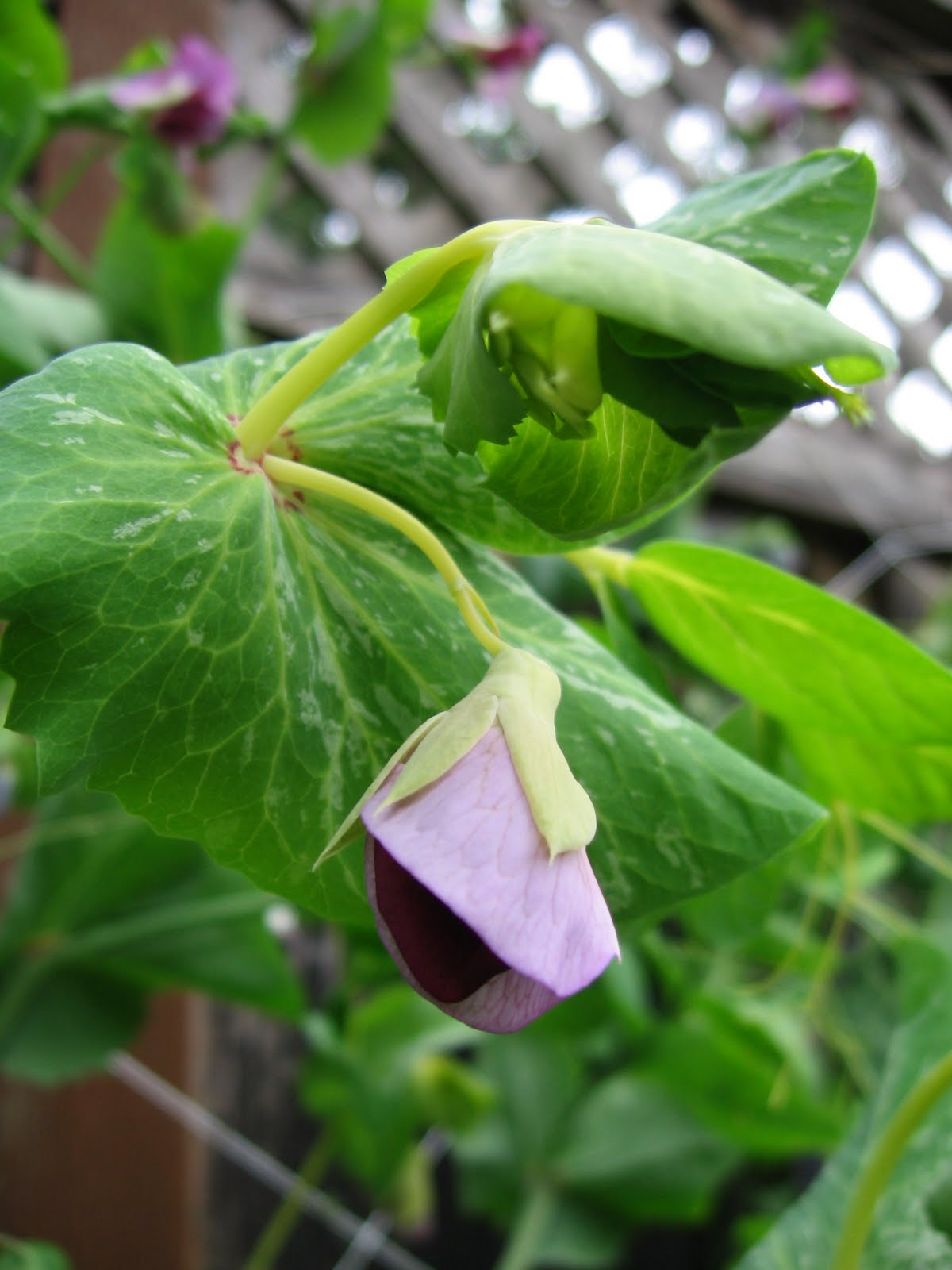
I will take some credit for noticing -- on my own -- that the demure pink blossoms with darker interior petals (there's probably a term for those, too) do not open wide but stay compact like tiny bonnets.


I did not notice that the blossoms change color as they mature, turning light blue with dark blue interior petals. The one pictured above is on the same vine as the pink one shown at the top of this post. It's the next blossom down.


Slightly lower on the same vine a couple of golden pods are starting to emerge. (And notice also the dark Blauwschokker pod lurking in the background.)


Lower still, on the same vine, are pods that could be picked now and eaten as is, like snow peas. We might try some of them in a stir fry, but I think I will wait for most of the crop to fill out as shelling peas.

According to Daughter of the Soil, the Golden Sweet variety is thought to come originally from India. Eventually it -- or something very like it -- appeared in the monastery gardens of Gregor Mendel in 1860s Austria. Yellow-poddedness was one of the traits he worked with in his experiments.


What about the Blauwschokkers? They, too, are putting on a colorful show. Their lovely two-toned pink blossoms are much more dramatic, flaring widely on green stems, cradled by green sepals. These are at the top of a seven foot vine.


Like the Golden Sweet, their blossoms change color as they age. Slightly lower down the same vine, here are a couple of specimens gone blue and limp. They are easy to distinguish from the blue-tinged Golden Sweet by the ruffly shape and the green sepals.


Here are the majestic pods, more purple than blue. These peas are also called Capucijners (Cap-you-sign-ners) after the Capuchin monks who developed the variety in the 1500s. Mendel was not the only one growing pea vines up the monastery walls.

In the Netherlands and other parts of Europe these peas have been a winter staple for centuries. They are used as dry peas to make soup and reportedly produce their own delicious gravy.

I'm sure we will get around to actually eating some of our very promising pea harvest, but for now the colorful display and the interesting back stories will more than suffice to justify the investment of time. I'm just the latest in a long line of people staring at pea vines with admiration and wonderment.

"Thou jewel! Thou star! Thou Golden Sweet! Thou Blue-Podded Blauwschokker!"

Monday, June 21, 2010

Summer Solstice


This photo was taken the morning of the summer solstice, around six a.m. It shows the place on the fence where the rising sun hit, right at the base of the elderberry bush. I guess this is our backyard equivalent of the heel stone at Stonehenge. No revels, here, though, just a quiet sense of honoring the rhythms of time and the paths of light.

Mr. and Mrs. Zuc


Two glorious zucchini blossoms opened at the same time on the same plant on the morning of June 14, a week ago today. The male, pollen-bearing flower is on the left; the female, fruiting flower is on the right.

Close as these blooms are to each other, it still takes a bee to seal the deal and make the magic happen. The pollen has to be brought directly to the large pistil at the center of the female flower (the part that looks remarkably like a bright yellow low-energy use light bulb).

The bee, of course, has no interest in being a zucchini fertility clinic worker; it just wants nectar and pollen for its own hive. But the flower-insect co-evolution contract is set up so that mutual benefit accrues to all involved -- including us!


Seven days after their grand opening both blossoms are shriveled little rags, but in their place is the fine young zucchini pictured above, ready to be harvested on the summer solstice.


Just for contrast, here is a photo of an un-pollinated zucchini, eight days after its attached blossom opened on June 13, all by itself with no other blossoms around. I always used to wonder why some zucchini would be so stunted and simply wither on the plant. Now I know you need both Mr. and Mrs. Zuc to get viable offspring.

For the record: Last year the first zucchini harvest was on June 14, so we are running about a week behind. I don't have a planting-out date for this year because all kinds of things got so busy in May but I think the seedlings got put in later than last year's May 10. Of course, the varieties are different as well (Green Racer last year, Green Bush this year) so perhaps meaningful comparisons are not possible. At any rate, another zucchini season has begun. Hooray!

Sunday, June 13, 2010

Zucchini Blossom!


This morning around 7:00, when I went out to see what garden surprises there might be, I discovered the first zucchini blossom welcoming the day: flared like a trumpet, golden as sunshine, about five inches across. By 10:30 when I went back out it had already collapsed into itself, so there is no photo of that splendid moment.

However, no longer distracted by the giant bloom, I was able to pay attention to the first little zucchini of the season. I assume it is unfertilized as no male blossoms are open, so it probably won't amount to much. But it still has pride of place. First is first.


The plant is a Green Bush zucchini, which I have never grown before. My highly scientific approach is to grab whatever decent looking seedlings are available in the local stores when the elements of time, weather, and opportunity are all in favorable alignment. This year Green Bush was available so that's what we have. It is sizing up beautifully and looks promising.


I planted three seedlings and they are all doing well. One of the other plants is sporting two as-yet-unopened blossoms, one female with tiny zucchini attached and one male on its long thin stalk. Tomorrow morning I will be sure to take the camera on the early morning tour.

Saturday, June 12, 2010

Flower Transition


Not only the lettuce is making a shift from one season to another. The spring displays of flowers are looking seedy -- literally -- and the summer show is just starting.

I stopped wearing socks not only because the weather has warmed up but because my ankles were thick with forget-me-not burrs after every trip outside. No wonder they have spread all over the yard (forget-me-nots, that is, not socks).

The calendula was so ragged and mildewed I finally pulled it out. For some reason it didn't form seeds before going into decline. But there's no time to be sad because the hollyhocks have started blooming.


This incredible blossom greeted me on an early morning inspection tour.


This one opened a day or two later. All of the hollyhocks have the same ancestry: seeds given by our dear friend P. from the plants in her yard. I scattered the seeds three years ago and they have come up on their own since then. Her plants in San Jose have dark red blossoms; in our North Bay yard they bloom pink. To add to the confusion, this is the first year they have shown different shades of pink. Who can fathom the mysteries of plants?


This Candystripe Cosmos was a surprise. It is a self-seeded volunteer from those I grew from Botanical Interests seeds last year. I hope it likes our yard and is the second of many generations.


The self-seeding morning glories are coming back too. The first one, a Grandpa Otts heirloom, bloomed on May 11, several weeks ahead of last year's first on June 7, 2009.

Each day it's a delight to go out and see what new blooms have appeared.