Showing posts with label september. Show all posts

Tuesday, September 8, 2015

Five-Step Drought Busting System


Wow! It really works! On a 100-degree September day, around three o'clock, I took some photos of garden vegetables that were not wilting in the blistering heat. Tomatoes, cucumbers, basil, zucchini -- all were standing tall.


Plants used to wilt noticeably in the hot afternoons even during non-record breaking summers. It was always such a sad sight that I used to avoid the garden during that part of the day. But now, well into what will likely turn out to be the hottest year yet on record here on Planet Earth, my humble veggies are basking and flourishing.

The Five-Step Drought Busting System works.

Although the portentously titled "System" is just a collection of simple practices that many gardeners follow, I believe it is the combination of five techniques that is making a noticeable difference in keeping the plants happy. Here's how it all fits together.

Step One: Add lots of organic matter to the soil, and

Step Two: Don't dig!


Add organic matter and don't dig????? But . . . but . . . how??? Simple. Just layer it on. This approach works just fine for Mother Nature. Go to a forest and take a look at what's going on beneath your feet: you will see layers and layers of leaf litter covering dark, rich, moist loam.

A statistic I've seen quoted frequently states that for every one percent increase in organic matter in an acre of ground, an additional 16,500 gallons of water can be held in the top one foot of soil. That's a lot of liquidity! And all that water stays in the soil.

I once saw a demonstration (most likely in Debra Koonz Garcia's wonderful film Symphony of the Soil) by a scientist who had set up four clear plastic cylinders of different types of dirt. He ran water through the cylinders to show which soil types held water and which did not. Soil with plenty of compost held nearly all the water poured on it and the little bit that trickled through was clear, showing that nutrient-laden silt was not washing away.

Even more convincing is the experience of Paul and Elizabeth Kaiser of Singing Frogs Farm in Sebastopol, California. They use massive amounts of compost on their three acres of vegetables to produce numerous harvests per year. After five years of building soil they have reduced their water use by more than 50% and their ponds and run-off are "almost crystal clear." Tests by experts have shown that their storm water run-off shows no leaching of excess nutrients to pollute waterways, confounding conventional wisdom about heavy use of compost.

The secret to the remarkable results at Singing Frogs Farm may well be the Kaiser's no-till philosophy. The active approach of adding massive quantities of organic matter is balanced by a passive avoidance of tilling or digging. The hands-off dig-free style allows the billions of life forms in rich soil to flourish. An intricately patterned living web holds on to the water and prevents leaching.

Bringing this data down to earth in our backyard means that the summer plantings -- about 100 square feet of ground -- should be holding plenty of moisture and retaining plenty of nutrients after a couple of years of intensively layering on various types of organics:

  • chopped up cover crops such as fava beans and mustard 
  • fallen leaves
  • straw 
  • yard debris 
  • small amounts of manure
  • small amounts of organic fertilizers
  • rock powder (for minerals) 
  • cardboard 
  • newspaper 
  • lots and lots of compost.

The only digging implement used is a trowel to loosen up the top few inches of soil right before planting.


Step Three: Install Drip Irrigation


Drip irrigation delivers a slow steady trickle of water right to the root zone of a plant and is nearly 100% efficient: pretty much all of the water reaches its objective and is not lost through evaporation or run-off. By contrast, overhead watering is thought to be about 50 to 70% efficient. Drip irrigation works even better with rich soil that holds the moisture in place so thirsty roots can make the most of it. Despite all that, until very recently I never used a drip system, preferring to water by hand with a spray nozzle on a long hose. I couldn't face the myriad tiny plastic parts and teeny hoses that have to be meticulously assembled and maintained.

Then I found the marvelous "Snip and Drip" irrigation system from Gardener's Supply. Nice fat soaker hoses with Tinker-Toy sized plastic connectors are so easy to assemble a kindergartner could do it and even a senior citizen has a good chance of success. Included in the package is a length of regular hose. Both the soaker hose and regular hose can be cut with scissors (that's the "Snip" component) so the pieces can easily be customized for a raised bed garden. Sections of regular hose run across the paths and link together the raised beds outfitted with lengths of soaker hose (the "Drip" component). Very sweet! Plus, it can all be disassembled and reconfigured as needed from one season to the next.


Step Four: Make Some Ollas


Oh-yahs, oh yes! Ollas are unglazed clay pots sunk into the ground  and filled with water that will be sought out by the roots of nearby plants. It's an ancient system thought to have originated in Africa, with the first written record coming from the Fan Sheng-chih Shu, a guide for farmers compiled more than two millenia ago in China.

In case you are wondering why an African or Chinese system has a Spanish-sounding name, our modern terminology is derived from the Latin word for "pot," olla, which passed unchanged into Spanish, The word, plus the technique was brought to the Southwest USA by the early explorers and taken up by Native Americans.

It is now re-emerging in our water starved regions of the West. The research is advancing as well, proving the extreme efficiency of a system where every drop of water goes straight to roots that need it and not a single drop is wasted. A good overview of the method (lots of research citations and further reading) is to be found at the Permaculture Research Institute website. 

When I first started using clay pots several years ago I felt like an early explorer myself, trying out something known only to readers of obscure gardening blogs and permaculture websites. Now ollas are to be found at local nurseries and hardware stores or online from a variety of sources. As they are not only amazingly efficient but amazingly pricey, I still make my own from cheap clay planting pots stoppered with rubber corks and lidded with the pot's own overflow dish.

In our summer garden each plant of tomato, zuccini, and cucumber has at least one sunken pot to ensure a reliable supply of water through the heat of the day.


Step 5: Mulch, Mulch, Mulch


The last step in the Five-Step Drought-Busting System is to add a thick layer of mulch such as dry straw which covers the other elements: the rich undug soil holding moisture like a sponge, the soaker hoses tricking water sparingly into the sponge, and the sunken pots of hidden water nourishing thirsty roots directly. A thick mulch helps to keep the whole garden bed moist and prevent the small percentage of evaporation that occurs from the drip irrigation lines and the unglazed clay pot lids that remain above the surface of the soil.

Mulch is almost a religion with some gardeners for very good reasons. In general, it's a good idea to avoid bare soil. Nature abhors a vacuum and Mother Nature abhors uncovered ground.


The final step is to go out on a searingly hot day and enjoy looking at your happy plants!!


Sunday, September 19, 2010

Hollyhock Lore


The hollyhocks along the fence are finally coming into their own. These are the second growth stalks that came up after I cut down the towering (ten or twelve feet) spring flagpoles that were not blooming and had acquired a layer of rust, due to the relentlessly cool weather.

This is a popular gathering spot for all manner of bees. Once, I saw a hummingbird inserting its tiny beak along the base of a partially opened blossom -- not inside the flower but outside. It reminded me of the deft skill of my favorite dental hygienist probing my gums. Not the most poetic image, but it does capture the expert precision of the hummingbird at work. Perhaps there are pockets of nectar hidden in the showy blooms even before they open wide?


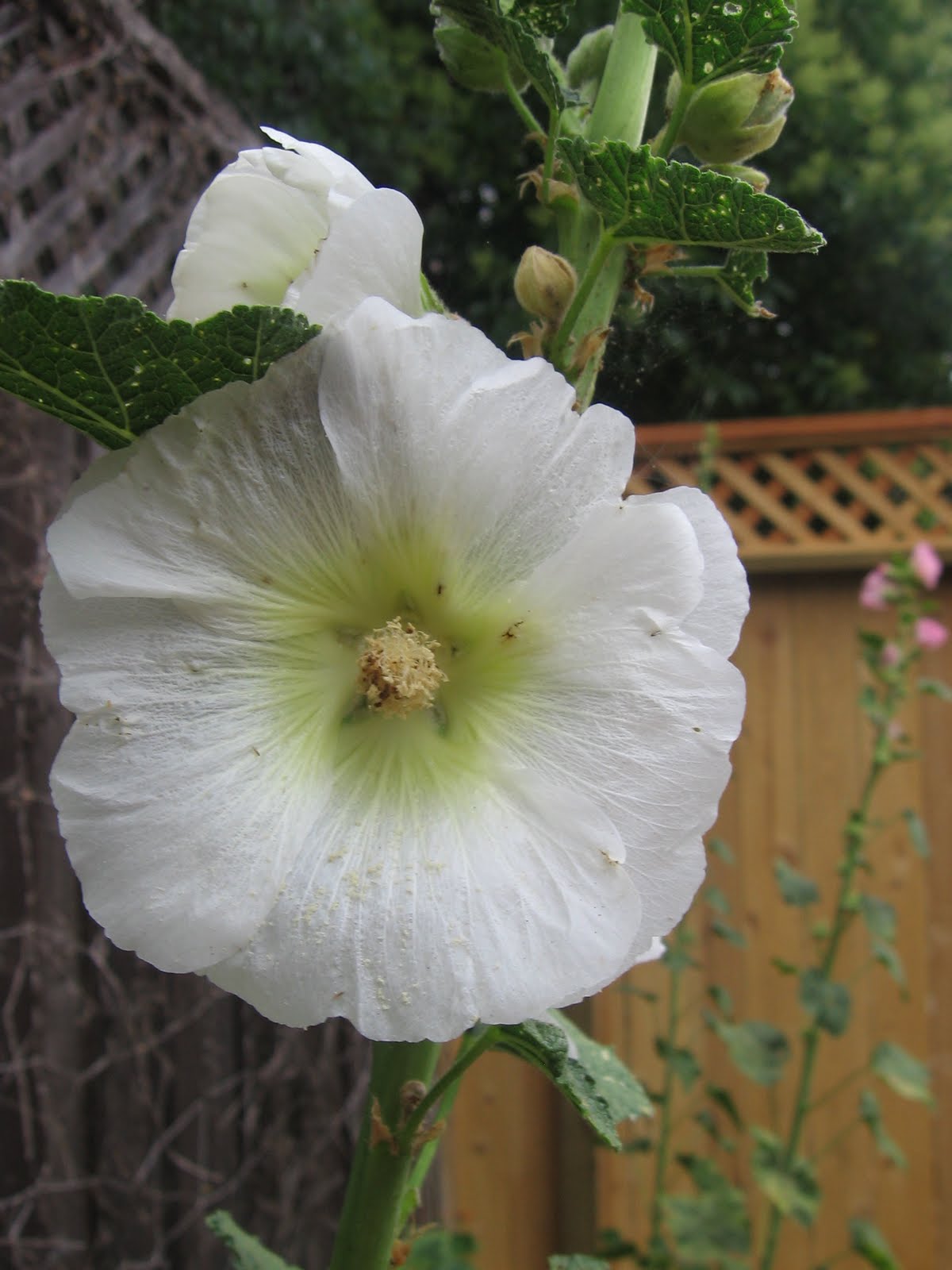
Here's a wide open blossom, a stunning pink banner unfurled to the sun. Rose pink is thought to be the original color of these ancient medicinal plants. The botanical name, Althaea rosea, comes from the Greek "althos" for "healing."

In medieval Europe, a related plant was used to treat horses. Ailing hocks, the part right above the hoof, were wrapped in the leaves. When crusaders came back from the Holy Land, bearing the botanical cousin of this hock plant, the new arrival came to be known as the "holy hock."


The dramatic knob in the center of the blossom contains both stamen and pistils and the plant is self-pollinating. Bees love the abundant pollen so cross-pollination occurs. I have often watched the giddy buzzing things burying themselves in one blossom after another.

Maybe cross pollination accounts for the range of colors that have evolved from the original seeds from plants with dark red blooms given by a friend from the south Bay. They grew in our yard as dark pink at first, then diversified into a range of dark pink to pale pink to white.


Pale pink and white blooms showed up this year for the first time -- the third season since the original planting.

Supposedly the "holy hock" brings good fortune and abundance to homes where it is planted nearby. Planting some certainly brings an abundance of hollyhocks, since they grow back from the base and also produce myriad seeds. In our yard, the row along the fence is well established and seedlings are popping up here and there.

Thursday, September 16, 2010

Feasts of the Season


A feast for the eye; food as art. This is the best example of Eggplant Expressionism I've ever seen: the dynamic, almost careless composition, subtle range of color, and energetic play of light across the textured surface make it a real museum piece. Too bad about that. Roasted Hansel Eggplant and Sun Gold Cherry Tomatoes lasted less than a half-hour.


Tomato Sauce with Fairy Tale Eggplant and Basil, even more colorful and dynamic, was just as short-lived.


Our dining room table has become an art gallery of seasonal creations, fleeting but delicious, showcasing garden-fresh feasts for the eye and the palate almost every night.

There is hardly room on the table to display the artistic creation du jour because the clutter of work-in-progress material hogs the space: bowls of produce, jars of seeds, lables and pens.

But we persevere.


Middle Eastern Still Life. Eggplant caviar (roasted eggplant and peppers with chopped olives), lemon cucumbers with yogurt, humus and pita bread.


Tomato Puff with French Beans. The puff is one of B.s inventions: a kind of Yorkshire pudding creation of eggs, cottage cheese, and cheddar cheese with a little flour. I'll take credit for the Haricot beans. The variety is Nickel and they are a breeze to grow.


Composition in Brown and Beige. There was nothing from the garden in this loaf of rye bread with corriander seeds, but it's worth sharing for sheer artistic merit. (Recipe from Healthy Bread in Five Minutes a Day.)

Monday, September 6, 2010

Farmer's Market Applesauce


Confession: we hardly ever go to the farmer's market even though it's only eight blocks away and happens every Saturday, May through October. Our own backyard yields so much bounty there never seems to be a compelling reason to go and look at other people's produce.

Nonetheless, there we were on a beautiful, sun-drenched Labor Day weekend, wandering the length of the one-block row of pickup trucks backed in along one edge of the main downtown park. (At least that's what I was doing. B. was scouting out the shadiest bench he could find, avoiding the sun out of medical necessity.) In front of each truck were tents shading the tables heaped high with peak-of-the-harvest abundance.

I stopped at a popular table covered with numerous small piles of apples labeled with poetic and unfamiliar names: Honeycrisp, Ginger Gold, Jona Gold. After a brief discussion with the lady in charge about my desire to make some applesauce, I was suddenly the proud owner of a $10 bushel basket filled to the brim with a 30-pound mix of all the organic heirloom apples she was offering -- the rejects she didn't think would sell for the standard $2.50 a pound.

That works out to about 33 cents a pound! An unexpected windfall of apples. We had thought we might be bereft of applesauce this year because we missed the chance to get a box of our favorite Pomo Tierra Gravensteins.

B. and I slowly made our way through the park, carrying the heavy basket between us. When the wire handles started digging into our hands too painfully, we simply put our burden down for a bit and admired the festive scene of vegetables and fruits, bread and cheese, herbs and flowers, sweets and savories ready-to-eat, handicrafts and kids, music and . . .oh, hello! . . people we know.

I couldn't help thinking of one of my favorite lines from Dylan Thomas:

"Oh, I was prince of the apple towns and time let me run, golden in the heyday of his eyes."

At least that's the way I've always remembered it. Here's what it really is:

"Time let me hail and climb
Golden in the heydays of his eyes.
And honoured among wagons I was prince of the apple towns."
(From Fern Hill)

A wagon would have been nice.


With the apples at hand, the prosaic business of making applesauce was simple. I washed them thoroughly, ignoring the blemishes, bruises, and sun scald while admiring how firm and fresh they felt (and only 33 cents a pound!).


Then they were chopped into quarters and all the damaged parts removed. As it turned out, only a very small proportion of the whole biomass had to be removed. There was no need to remove the peels as they would be strained out.


Next, they were cooked gently until soft in a very little bit of water -- as little as possible -- along with a whole cinnamon stick.


Then all the softened apples were run through the mighty Squeezo (aka Vittorio Strainer).


A bushel of apples almost filled this big pot. The task took me about two hours up to this point. The next-to-last step was to wrestle the pot into the refrigerator and let everything cool down for a day or so.


The last step was to spoon it all out into freezer containers and tuck most of it away in the freezer for future feasting, saving some for immediate gratification.

I hardly ever eat sweets, so fresh applesauce with yogurt seems like apple pie a la mode. Mmmmmmm. This farmer's market blend has a lovely mellow flavor, and throughout the year, whenever we enjoy it, it will evoke this golden week-end.

Did I mention the apples were only 33 cents a pound?

Friday, September 25, 2009

Equinox


Journey Round the Sun: September

The crystalline light of a lowering sun
Fills the valleys,
Gilds brown hills gold,
Makes every trembling leaf and blade
A tiny mirror.

Equinox: Earth rides its axis straight.
Night and day see eye to eye.
Morning has teeth: premonitions of frost.
Noon blares hot.
Light and dark are in fleeting balance
While temperature see-saws.

Knowing the portents,
Birds flock for fall flight,
Swallows are gone,
Long-necked geese mark the sky
With directional signs, all pointing south.

We who enter a private autumn
Hear their fading cries
And remember the
Hurrying arrow of time.

Thursday, September 10, 2009

Tomato Extravaganza


By Labor Day, last Monday, the tomato situation was getting critical. It was quite clear that soon there would be tomatoes tucked away onto bookcases (which has happened before) and in the bathroom cabinet (which has not happened so far). The photo above shows everything on hand on Monday afternoon -- mostly Better Boys, lined up from ripest on the left to just-picked, still-slightly-orange on the right.

There are also bowls of Sungolds and the volunteer red cherry tomatoes for snacking and salads, and two demonstration Black Krims at lower right, just to show we are capable of growing heirlooms.


A plethora of Better Boys means it's time to go rummaging in the garage for the mighty Squeezo, the venerable Vittorio Strainer, veteran of many a tomato sauce session of Septembers past. It didn't take long to clean it up from its long hibernation and attach it to the dining room table.

The whole process is so simple. The ripe tomatoes are first rinsed and quartered. (Let the orangey ones sit for another week to ripen up.)


Then all you have to do is fill the hopper with tomato pieces, press them down with the mallet, and turn the handle to push the juicy mass through the screening funnel. Skin and seeds drop out at the end of the funnel while the luscious juice and pulp flows down the trough into a bowl.


The next step is to cook the juice down a bit and package it up in pint size freezer containers as a base for tomato sauce. Take some out in gloomy November or in chilly February and make it into sauce for a vivifying taste of congealed sunlight, a distillate of summertime itself.

Monday, September 7, 2009

Monday Harvest -- Fruits of Our Labor Day

Today is a holiday so I can get this post up on time for the harvest round-up at Daphne's Dandelions.

This week it has felt like the garden is slowing down because most of the plants look middle-aged, a bit like stressed-out parents with too many children. But bedraggled as the plants might be, their progeny is beautiful and plentiful. The peak harvest time continues.

We are pretty much keeping up day to day with eating lettuce, cucumbers, cherry tomatoes, Black Krim tomatoes, an occasional pepper or eggplant. But the heavy producers that need to be processed for the freezer are accumulating. Counter tops are covered with Better Boy tomatoes and there are bulging bags of beans and zucchini in the refrigerator. Not to complain, of course. Abundance is not an obligation but a celebration!

Week of Sunday, August 30 through Sunday, September 6

Sunday, August 30 (This should have been included with last week's portfolio, but I got the days mixed up.)
Above, left to right: one Cochella zucchini; a handful of Kentucky Wonder pole beans; Better Boy tomatoes; lemon cucumbers; volunteer red cherry tomatoes; Blue Lake pole beans.


Tuesday, September 1

Blue Lake pole beans; Better Boy tomatoes; one lemon cucumber; one Black Krim tomato; Green Racer zucchini; Sungold cherry tomatoes.


Thursday, September 3

Red Sails summer lettuce; Better Boy tomatoes


Friday, September 4

Sungold cherry tomatoes; Better Boy tomatoes; Blue Lake pole beans; one Japanese eggplant (first one -- yay!); three Pimientos de Padron; one lemon cucumber; one Black Krim tomato; Green Racer zucchini; volunteer red cherry tomatoes


Saturday, September 5

Better Boy tomatoes; lemon cucumbers; a surprise resurgence of Tavera French haricot beans; lots and lots of Sungold cherry tomatoes; Blue Lake pole beans. Not pictured: another pile of Red Sails summer lettuce, picked before dawn because a certain canine companion just HAD to go out. Prime lettuce picking time.

The Kentucky Wonder beans have pretty much stopped producing -- nothing harvested since August 30. The spider mites got them. But that's a story for another time.