Sunday, September 19, 2010

Hollyhock Lore


The hollyhocks along the fence are finally coming into their own. These are the second growth stalks that came up after I cut down the towering (ten or twelve feet) spring flagpoles that were not blooming and had acquired a layer of rust, due to the relentlessly cool weather.

This is a popular gathering spot for all manner of bees. Once, I saw a hummingbird inserting its tiny beak along the base of a partially opened blossom -- not inside the flower but outside. It reminded me of the deft skill of my favorite dental hygienist probing my gums. Not the most poetic image, but it does capture the expert precision of the hummingbird at work. Perhaps there are pockets of nectar hidden in the showy blooms even before they open wide?


Here's a wide open blossom, a stunning pink banner unfurled to the sun. Rose pink is thought to be the original color of these ancient medicinal plants. The botanical name, Althaea rosea, comes from the Greek "althos" for "healing."

In medieval Europe, a related plant was used to treat horses. Ailing hocks, the part right above the hoof, were wrapped in the leaves. When crusaders came back from the Holy Land, bearing the botanical cousin of this hock plant, the new arrival came to be known as the "holy hock."


The dramatic knob in the center of the blossom contains both stamen and pistils and the plant is self-pollinating. Bees love the abundant pollen so cross-pollination occurs. I have often watched the giddy buzzing things burying themselves in one blossom after another.

Maybe cross pollination accounts for the range of colors that have evolved from the original seeds from plants with dark red blooms given by a friend from the south Bay. They grew in our yard as dark pink at first, then diversified into a range of dark pink to pale pink to white.
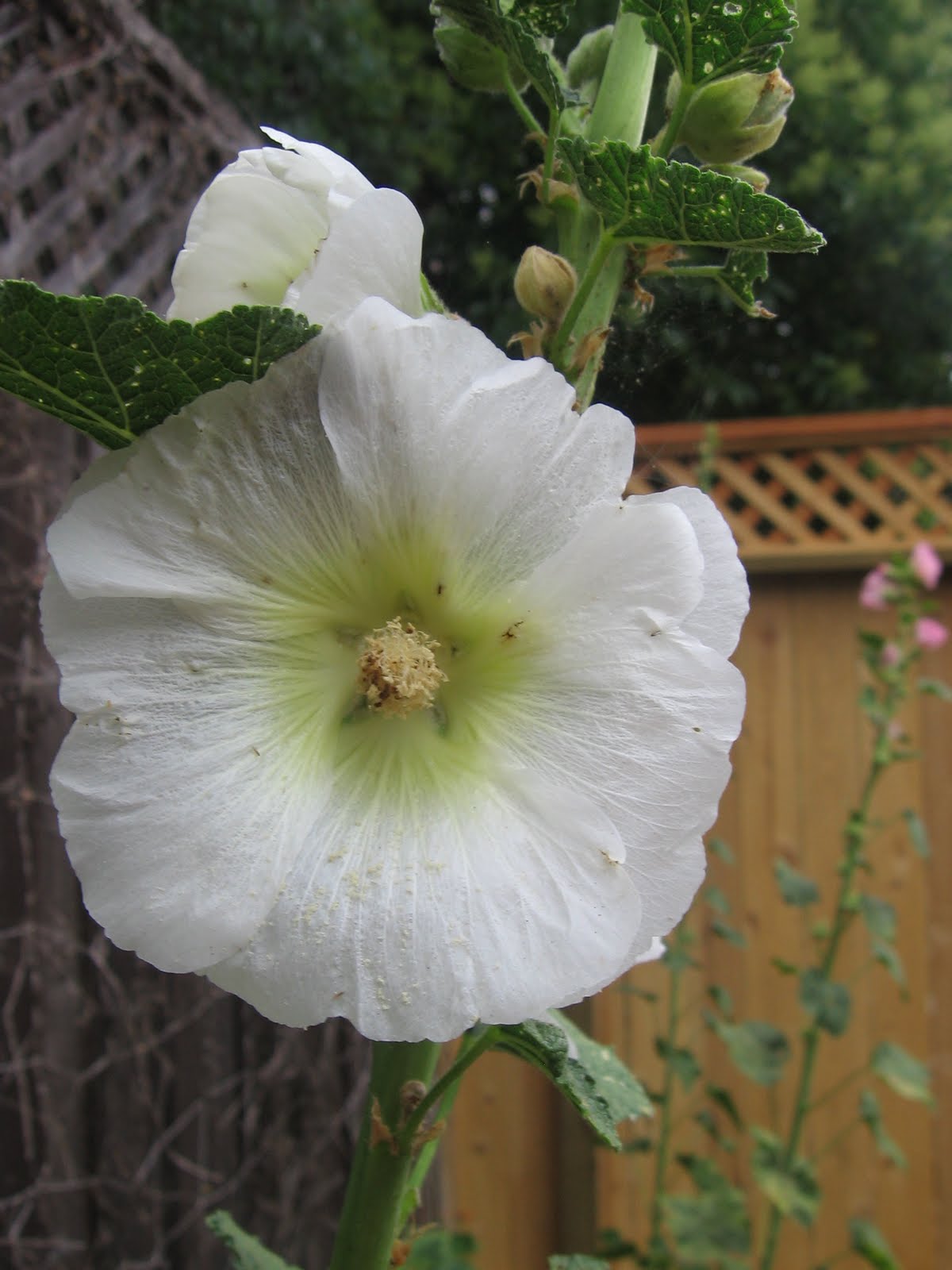


Pale pink and white blooms showed up this year for the first time -- the third season since the original planting.

Supposedly the "holy hock" brings good fortune and abundance to homes where it is planted nearby. Planting some certainly brings an abundance of hollyhocks, since they grow back from the base and also produce myriad seeds. In our yard, the row along the fence is well established and seedlings are popping up here and there.

Thursday, September 16, 2010

Feasts of the Season


A feast for the eye; food as art. This is the best example of Eggplant Expressionism I've ever seen: the dynamic, almost careless composition, subtle range of color, and energetic play of light across the textured surface make it a real museum piece. Too bad about that. Roasted Hansel Eggplant and Sun Gold Cherry Tomatoes lasted less than a half-hour.


Tomato Sauce with Fairy Tale Eggplant and Basil, even more colorful and dynamic, was just as short-lived.


Our dining room table has become an art gallery of seasonal creations, fleeting but delicious, showcasing garden-fresh feasts for the eye and the palate almost every night.

There is hardly room on the table to display the artistic creation du jour because the clutter of work-in-progress material hogs the space: bowls of produce, jars of seeds, lables and pens.

But we persevere.


Middle Eastern Still Life. Eggplant caviar (roasted eggplant and peppers with chopped olives), lemon cucumbers with yogurt, humus and pita bread.


Tomato Puff with French Beans. The puff is one of B.s inventions: a kind of Yorkshire pudding creation of eggs, cottage cheese, and cheddar cheese with a little flour. I'll take credit for the Haricot beans. The variety is Nickel and they are a breeze to grow.


Composition in Brown and Beige. There was nothing from the garden in this loaf of rye bread with corriander seeds, but it's worth sharing for sheer artistic merit. (Recipe from Healthy Bread in Five Minutes a Day.)

Monday, September 6, 2010

Farmer's Market Applesauce


Confession: we hardly ever go to the farmer's market even though it's only eight blocks away and happens every Saturday, May through October. Our own backyard yields so much bounty there never seems to be a compelling reason to go and look at other people's produce.

Nonetheless, there we were on a beautiful, sun-drenched Labor Day weekend, wandering the length of the one-block row of pickup trucks backed in along one edge of the main downtown park. (At least that's what I was doing. B. was scouting out the shadiest bench he could find, avoiding the sun out of medical necessity.) In front of each truck were tents shading the tables heaped high with peak-of-the-harvest abundance.

I stopped at a popular table covered with numerous small piles of apples labeled with poetic and unfamiliar names: Honeycrisp, Ginger Gold, Jona Gold. After a brief discussion with the lady in charge about my desire to make some applesauce, I was suddenly the proud owner of a $10 bushel basket filled to the brim with a 30-pound mix of all the organic heirloom apples she was offering -- the rejects she didn't think would sell for the standard $2.50 a pound.

That works out to about 33 cents a pound! An unexpected windfall of apples. We had thought we might be bereft of applesauce this year because we missed the chance to get a box of our favorite Pomo Tierra Gravensteins.

B. and I slowly made our way through the park, carrying the heavy basket between us. When the wire handles started digging into our hands too painfully, we simply put our burden down for a bit and admired the festive scene of vegetables and fruits, bread and cheese, herbs and flowers, sweets and savories ready-to-eat, handicrafts and kids, music and . . .oh, hello! . . people we know.

I couldn't help thinking of one of my favorite lines from Dylan Thomas:

"Oh, I was prince of the apple towns and time let me run, golden in the heyday of his eyes."

At least that's the way I've always remembered it. Here's what it really is:

"Time let me hail and climb
Golden in the heydays of his eyes.
And honoured among wagons I was prince of the apple towns."
(From Fern Hill)

A wagon would have been nice.


With the apples at hand, the prosaic business of making applesauce was simple. I washed them thoroughly, ignoring the blemishes, bruises, and sun scald while admiring how firm and fresh they felt (and only 33 cents a pound!).


Then they were chopped into quarters and all the damaged parts removed. As it turned out, only a very small proportion of the whole biomass had to be removed. There was no need to remove the peels as they would be strained out.


Next, they were cooked gently until soft in a very little bit of water -- as little as possible -- along with a whole cinnamon stick.


Then all the softened apples were run through the mighty Squeezo (aka Vittorio Strainer).


A bushel of apples almost filled this big pot. The task took me about two hours up to this point. The next-to-last step was to wrestle the pot into the refrigerator and let everything cool down for a day or so.


The last step was to spoon it all out into freezer containers and tuck most of it away in the freezer for future feasting, saving some for immediate gratification.

I hardly ever eat sweets, so fresh applesauce with yogurt seems like apple pie a la mode. Mmmmmmm. This farmer's market blend has a lovely mellow flavor, and throughout the year, whenever we enjoy it, it will evoke this golden week-end.

Did I mention the apples were only 33 cents a pound?

Tuesday, August 31, 2010

Picking up a Six Pack . . . of Lettuce


All the lettuce is going to seed and we are in a lettuce emergency. No recourse but to run out for a six pack of seedlings. This is a "summer salad bowl mix." It looks promising but requires patience and deferred salad gratification.


Meanwhile, seedlings of seeds gathered from Bronze Arrowhead, Forellenschluss, and of course Black Seeded Simpson are developing. They were planted August 13, but not in time to bridge the gap. We have to (sob) buy lettuce at the store.

Monday, August 30, 2010

Our Cornucupia Runneth Over


Pictured above is the garden produce we had on hand as of 4:30 Sunday afternoon, August 29.

Clockwise from the top are:

Assorted chard volunteers: Lipstick, Biondi di Lyon, Rainbow
Cherry tomatoes: Sungold and Yellow Pear
Tomatoes: Early Girl, Japanese Black Trifele, Constoluto Genovese
Eggplant: Hansel
Zucchini: Green Bush
Pole beans: Kentucky Blue
Climbing squash: Trombetta di Albenga
Bush beans: French Haricot/Nickel

In the center:

Cucumbers: Armenian, Lemon

Since then more tomatoes and cucumbers have been harvested.

All of the zucchini and chard plus two of the trombetta squash (the long snaky green things on the left) went into a big batch of green soup for the freezer.

We've given away some of the tomatoes, eggplant, cucumbers, and beans.

We eat tomatoes and cucumbers in salad every night.

The French beans make a wonderful side dish, gently steamed and served with some orange zest and butter.

The tomatoes and eggplant cook up into a showstopper of a pasta sauce.

I plan to try freezing some of the Kentucky Blue beans, just a small batch to see if it works better than last year's experiment.

We need to give away more tomatoes, eggplant, cucumbers and beans . . . .

Sunday, August 29, 2010

Pear Tarte Tatin


I had to move fast to get a photo of this stunning pear tart because it wasn't around for long. Another culinary coup by B., from the book I wisely got for him: Healthy Bread in Five Minutes a Day.

If we were harboring any doubts at all about the pears -- "True, the tree doesn't need much care but it's a hassle trying to pick them all at once and store them just right . . ." -- all quibbling is now forgotten. In fact, the pears are so delectable in this dish they may well be some kind of cooking or canning variety. The tree is pretty old. Does it date from an earlier time when canning was more routine?


The making of the tart is uncomplicated, especially if you have the brioche dough already made up and resting in the fridge (and especially if someone else is making it!).

Butter and sugar are melted in an iron frying pan, with some whole spices (cinnamon, star anise, cloves) thrown in. Then peeled and quartered pears are arranged on top. When the syrup has caramelized, the rolled out whole-wheat brioche dough is laid over everything and gently poked down around the edges. The whole thing goes in the oven. When done it gets inverted onto a plate and served warm. Heavenly.

A toast to the Tatin (ta-TAN) sisters who ran a small hotel in rural France at the end of the 19th century. The one who did the cooking -- some say Caroline, others say Stephanie -- came up with an upside down apple tart that drew people in droves. Its fame spread to Paris, from where spies were dispatched to procure the recipe. (The French take these matters seriously, so a bit of culinary espionage doesn't seem surprising.) Tarte Tatin is still on the menu at the little Tatin Hotel and has been on the menu of the Michelin ranked four-star Paris restaurant, Maxim's, for years.

Hopefully pear tarte tatin de la maison will be on our menu for a long time to come.

Saturday, August 28, 2010

The Umbrella Family


All over the backyard tall swaying clumps of Queen Anne's Lace are going to seed, thickened blossoms drooping earthward with their load of raspy pips.

About three years ago, along a country lane near the coast, I gathered a lot of seeds from these ubiquitous wildflowers and flung them around in our yard. They are biennials, evidently, and take some time to get going, but once established have no trouble holding their own and might even take over if not restrained.

Despite invasive tendencies they are welcome here because of their delicate lacy beauty at all stages of development and their ability to attract beneficial insects like lady bugs and tiny wasps.

Legend has it that someone named Anne known for her lace-making skill -- perhaps Good Queen Anne of England or Saint Anne, the mother of Mary and patron saint of lace-makers -- pricked her finger while making her famous lace. A single drop of blood fell on her handiwork and is memorialized in the tiny purple floret found at the center of some of the doily-like blossoms of her namesake flower.

Whatever the story may be, our wildflower "meadow" is an important part of the garden.


A close cousin of Queen Anne's Lace is the fennel that has been growing wild in this yard since before we moved in almost twenty years ago. Several stands of eight foot tall hollow stalks are bending under the weight of their airy grey-green disks of seed.


In one corner of the yard a lone parsley plant stands tall, offering up small plates of tiny brown seeds not heavy enough to bend the thin stalks.

Parsley, fennel, and Queen Anne's Lace are the current local representatives of the huge family of umbelliferae, a term derived from the same root as "umbrella" -- perhaps, and this is just a guess, because of the shape of the flowers. The family includes carrots, celery, cilantro, and the dread poison hemlock. Don't ever mistake the hemlock plant for wild carrot, children.

I plan to gather some parsley seed for planting next year and let the other plants come up where they will, within reason of course.