Sunday, June 12, 2011

First Zucchini Blossom of 2011


Updated below, 6/27/2011

Ta-da! Somehow it's always a surprise to find the first zucchini blossom of the season flaring like a golden trumpet in the morning air.

This is a female flower waiting hopefully for pollination, and, indeed, there is a bee at lower left. The bee will get what it needs (nectar, if not pollen), but this first bloom of a Cocozelle seedling from Natural Gardening is all alone. Even hand pollination by a willing gardener won't work because no male flowers have opened yet and zucchini blossoms seem to last only a day. By tomorrow this proud beauty will be drooping, limp, and shriveled.

Nonetheless, the official trumpet blast has sounded (in my head) and summer has begun.


Here's a side view, with a baby zucchini ready to go. It won't grow much and won't be harvestable but it has played a role in announcing the season.


Combing through blog posts from previous years, I gathered some comparative data on zucchini plantings for the past three years:

Seedlings planted:

2009 May 10 (Green Racer)
2010 Not sure, but later than May 10 (Green Bush)
2011 May 8 (Cocozelle, Zephyr)

First blossom:

2009 June 8
2010 June 13
2011 June 12

First harvest:

2009 June 14
2010 June 21
2011 We'll see Update: 6/27/2011: First harvest occurred June 25

Empirical generalization: Get the seedlings in the ground by the second week of May, expect the first blossom by the second week of June and the first harvest by the third week of June.

The harvest can't come too soon for me because I'm down to about ten containers of this winter's green soup in the freezer. It's time for the summer version!

Friday, June 3, 2011

People Who Stare at Pea Vines


Back in March, I fell prey to two lovely packets of exotic peas from The Baker Creek Seed Bank in downtown Petaluma: Golden Sweet and -- wait for it -- Blue-Podded Blauwschokkers (which sound to me like some kind of Shakespearean insult: "Thou knave! Thou cur! Thou Blue-Podded Blauwschokker!").

On March 14 I planted the seeds in two rows along the northwest fence and hoped for the best. Peas have never been a dependable crop for me.

They have done splendidly! The lingering cool, wet weather this spring has been hard on the summer seedlings of tomatoes, peppers, and eggplant but the peas are loving it. Some of the vines are over six feet tall. As of early June, the Golden Sweet are producing myriad pale lemon pods, punctuated by a few dark-blue Blauwschokkers here and there.

There wasn't much information on the seed packets about these strikingly beautiful varieties so I went searching on the internet. One discovery was a delightful blog -- Daughter of the Soil -- by an amateur pea-breeder who fits my stereotype of the English gardener as someone with a day job and an ordinary yard (in terms of size) whose passion for plants soars to a dizzying level of horticultural wisdom. After reading her post on her meticulously-observed vines of Golden Sweet I had to run out to the yard and take a much closer look at my own vines.

Why hadn't I noticed the delicate golden color of the stems holding the blossoms, or marveled at the pale gold sepals and the subtle splash of red at the base of the leaf axils? (One reason could be that I did not know what "sepals" and "axils" are. Now that I have the labels I am empowered to see what is right in front of me.)

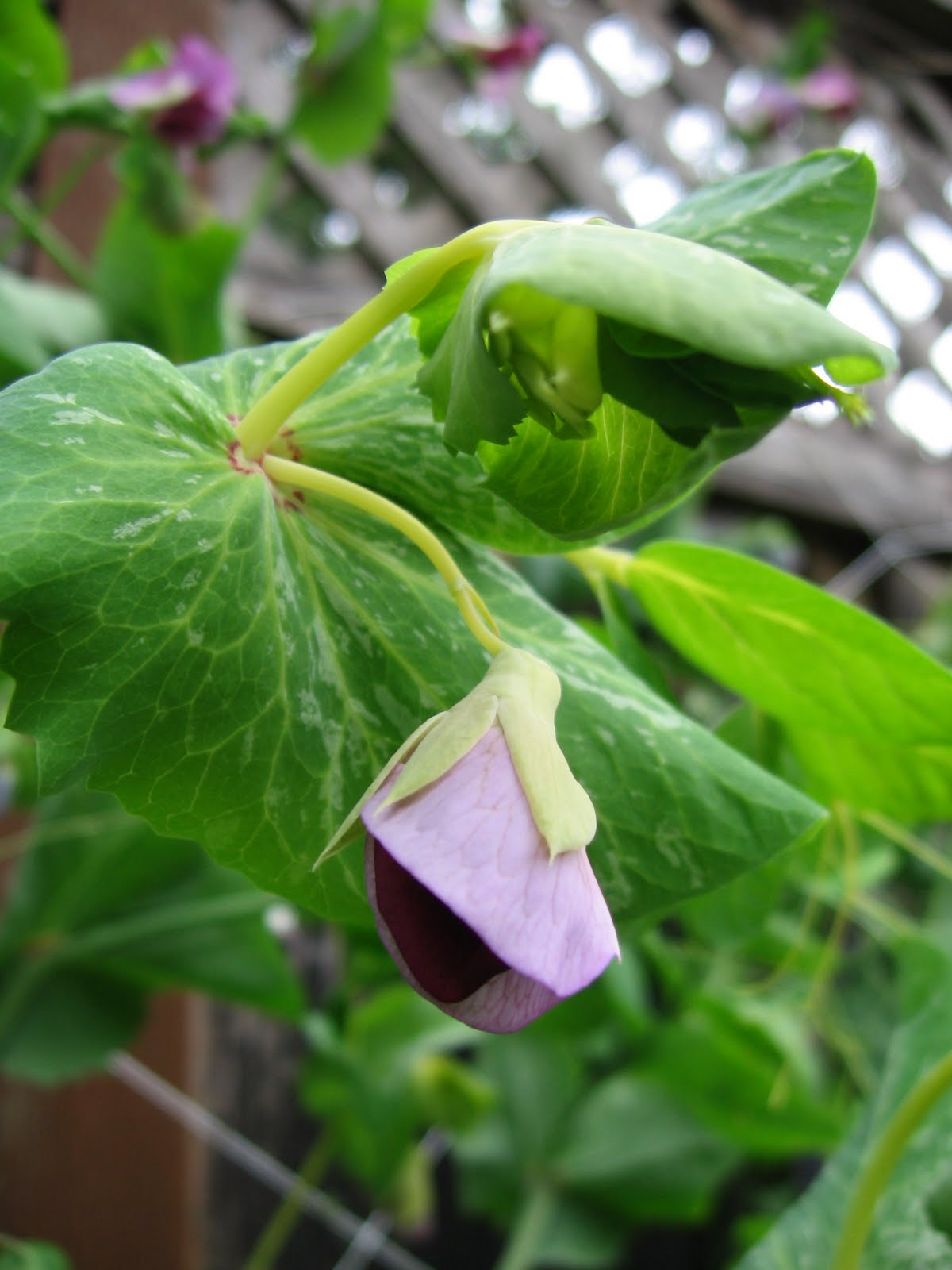
I will take some credit for noticing -- on my own -- that the demure pink blossoms with darker interior petals (there's probably a term for those, too) do not open wide but stay compact like tiny bonnets.


I did not notice that the blossoms change color as they mature, turning light blue with dark blue interior petals. The one pictured above is on the same vine as the pink one shown at the top of this post. It's the next blossom down.


Slightly lower on the same vine a couple of golden pods are starting to emerge. (And notice also the dark Blauwschokker pod lurking in the background.)


Lower still, on the same vine, are pods that could be picked now and eaten as is, like snow peas. We might try some of them in a stir fry, but I think I will wait for most of the crop to fill out as shelling peas.

According to Daughter of the Soil, the Golden Sweet variety is thought to come originally from India. Eventually it -- or something very like it -- appeared in the monastery gardens of Gregor Mendel in 1860s Austria. Yellow-poddedness was one of the traits he worked with in his experiments.


What about the Blauwschokkers? They, too, are putting on a colorful show. Their lovely two-toned pink blossoms are much more dramatic, flaring widely on green stems, cradled by green sepals. These are at the top of a seven foot vine.


Like the Golden Sweet, their blossoms change color as they age. Slightly lower down the same vine, here are a couple of specimens gone blue and limp. They are easy to distinguish from the blue-tinged Golden Sweet by the ruffly shape and the green sepals.


Here are the majestic pods, more purple than blue. These peas are also called Capucijners (Cap-you-sign-ners) after the Capuchin monks who developed the variety in the 1500s. Mendel was not the only one growing pea vines up the monastery walls.

In the Netherlands and other parts of Europe these peas have been a winter staple for centuries. They are used as dry peas to make soup and reportedly produce their own delicious gravy.

I'm sure we will get around to actually eating some of our very promising pea harvest, but for now the colorful display and the interesting back stories will more than suffice to justify the investment of time. I'm just the latest in a long line of people staring at pea vines with admiration and wonderment.

"Thou jewel! Thou star! Thou Golden Sweet! Thou Blue-Podded Blauwschokker!"

Sunday, May 29, 2011

Nitrogen Fixing Nodules


The fava bean forest got cleared out today to make room for tomatoes. When I pulled up the towering plants I was glad to see that the root clumps are festooned with clusters of nitrogen-fixing nodules. That means that these fava plants, like all hard-working legumes, invoked their magical powers of pulling nitrogen out of the air and storing it in tiny sacs strung along the root systems.

Actually, the whole story is more complicated. The fava roots exude sugars into the soil to attract a particular type of bacteria which attach themselves to the roots. These bacteria are able to convert nitrogen from the air into a form that the plant can use. What the plant can't use right away is stored in the nodules. (I don't really understand this part. How does the nitrogen get to the bacteria way down on the roots?)


Here are the sturdy stalks and root clumps ready for the compost pile. If I were able to leave all this material in the bed and dig it under so it could break down right in place, the nodules would enrich the soil with their stored nitrogen.

Also, if I had dug in the plants before they formed their ample harvest of beans, there would have been lots more stored nitrogen and lots more enrichment. Unfortunately, none of these "ifs" are going to benefit the tomato seedlings which need to go into this bed right away.

But the extra nitrogen won't go to waste and will eventually make its way back to the garden as compost.

Meanwhile, here's a link to a great little video where a couple of enthusiastic agricultural scientists explain nitrogen fixation on soybeans. After listening to these guys, you just can't help rooting for roots! Yay roots!

Monday, May 23, 2011

Tomato Guild


The permaculture concept of planting in communities or "guilds" has intrigued me ever since I first learned about it. Today I put together a permaculture-for-dummies installation including tomatoes (the tomatoes were already there) and a few of the beneficial companions said to enhance their growth: marigolds, basil, parsley, and nasturtiums. Whether the purported mutual benefits are science or merely lore, I do not know, but it makes an attractive grouping and I look forward to seeing how it fills out.

Here are the members of this guild, nestled together in a nine-foot-square raised bed:

1. Better Boy hybrid seedlings from Garden Crossing mail order nursery (Better Boys, B.'s favorite, are getting harder and harder to find. This is the first time we had to resort to online shopping to locate some.) The tomatoes are the lead plant in the guild. These were planted out May 9.

2. Queen Sophia marigold seedlings from Natural Gardening. The roots deter nematodes.

3. Genovese basil seedlings from Natural Gardening. Who could imagine tomatoes without basil! It's said to improve flavor not just in the kitchen but in the garden too. The flowers attract beneficial insects. It's edible. Being pesto lovers, we grow it as a crop in its own right. B.'s most frequent comment on the garden: "Not enough basil!"

4. Italian Flatleaf parsley seedlings from Natural Gardening. I'm not sure what parsley does but it's always on the guild lists for tomatoes. Edible.

5. Moonlight nasturtium seeds from Renee's Garden. Nasturtiums deter pests, draw beneficial insects, and are edible.

As I understand it, a true guild is based on perennials and ideally starts with trees, but hey, you garden with the plants you have, with the materials at hand, and with the time available. I've discovered that the best way to learn new things in the garden is to start some small scale experiments and see where they lead.

Tucked in with all the seedlings and seeds in this bed are two sunken clay pots filled with water and covered with the pot's own drip dish turned upside down to form a lid. This was an experiment from several year's back that has yielded good results. The pots provide a steady water supply close to the root zone as the water slowly seeps through the clay walls, responding to the moisture level in the surrounding soil. I think the plants like this system because when I pull the pots out at the end of the season the hole is lined with a thick netting of pale roots.

Here's hoping this tomato installation becomes a happy little cul de sac in the larger garden community.

Friday, May 13, 2011

In Praise of the Elder Mother


The Elderberry bush is starting to bloom. There are clusters of tiny, ivory-colored florets dotting its voluminous dark green surface.


Friday the 13th is a good day to pay a tribute to the Elder Mother, since both the day and the bush represent ancient earth powers which have been made malevolent for reasons too deep to speculate on here.

Friday is "Frigga's Day," the Teutonic goddess of love, marriage, and fertility. And 13 is not an unlucky number in the old reckoning of goddesses, since there are 13 moon cycles in one journey round the sun -- each 28 day moon cycle evoking the normal menstrual cycle, also, of course, closely linked to fertility.

The lore surrounding the Elderberry bush seems to come mostly from Europe, where peasants were careful not to arouse the ire of the rather cranky Elder Mother by clipping her branches without a really good explanation. In a well tended hedgerow, Elderberry bushes were allowed to sprawl, and were considered places of mystery -- an opening to other dimensions. If you fell asleep under an Elderberry bush on Mid-summer's night you might well see faeries and elves celebrating.

And the most powerful and dangerous wand in the Harry Potter saga is the Elder Wand, made from a branch of the Elderberry.

Personally, I prefer a practical, modern approach and look upon the attractive shrub in our backyard as the Western Blue Elderberry, Sambucus cerulea, with beautiful flowers and dark blue berries that draw the birds. I have no intention of falling asleep under there, especially since C. is fond of that spot for his doggie ablutions.

However, I do let it grow unchecked, and I do find it very interesting that the rising sun of the summer solstice hits the fence right where the Elderberry bush opens its curved branches, forming an entrance to the mysterious green cave of light underneath.

Sunday, April 10, 2011

Fava Bean Eco-System


The fava beans are reaching out for the sky with their graceful fans of leaves and elegant blossoms with black accents. Two adjacent beds of seedlings from Cottage Garden Nursery, which were planted out last fall on October 3, are now eight feet and over -- even subtracting the ten inch height of the beds.


The towering stalks form a little forest eco-system all their own, with some volunteer chard sheltering on the shady forest floor layer, most of the blossoms and maturing beans in the understory, and the tenderest new leaves -- so good in salads -- forming the canopy.


Here are the understory beans, starting to size up.


The understory seems to be very popular with all manner of insects -- such as this Common Darter Dragonfly. (Nothing common about it; it's the only one I've ever seen in this garden, which is swarming with dragonflies. I had to do some Web sleuthing to find out what it's called.)


Another mystery insect I was not able to identify: these weird beetles with dramatic African-shield-like markings. Dozens of them can be found scurrying at eye level among the stalks and leaves in the morning sun.


And here's the first sighting of the hornet queen, from March 6. She too seems to favor the mid-level fava forest.


It was almost reassuring to find a common, everyday, garden-variety ladybug sunning herself on a leaf.


And a regular honeybee browsing the blossoms.

B. sometimes wonders why I grow favas at all, because we have only managed to make a meal of them once. I don't dig them under as a cover crop before they form beans, which is the most efficient use of favas as soil enrichment. I let them go full cycle with a fine full crop of fat pods but then get overwhelmed and can't follow through with the laborious processing required to extract the delicate gourmet beans. As I said, that happened once.

I guess I grow them just to watch the show. Well worth it.

Friday, April 1, 2011

Fools Rush In and Plant Potatoes


Usually we try to follow the handy rule of thumb: Plant your potatoes on St. Patrick's Day (March 17). It provides something to aim for and has a certain poetic appeal. I don't think I've ever hit the day exactly but we generally manage to get a few tubers under the dirt by the end of the month. My own rule of thumb is: Plant on St. Patrick's Day (i.e. in March) and have potato salad for the 4th of July.


This year there was so much rain in March that the backyard was as soggy as an Irish bog. (See Lake Chard pictured above.) I had almost decided not to bother with potatoes at all.

Then, on a rainy afternoon, I came across some seed potatoes at the new Baker Creek store -- the Seed Bank -- in downtown Petaluma. Sprawled across the splendid marble floor of what actually was a bank a few years back were some burlap bags of Red Lasoda and Small Carola from David Little's farm near Tomales. I weighed some out and brought them home.

It wasn't hard to set up a couple of containers, fill the bottoms with a layer of potting soil, and press the potatoes into the soil.

I hope there's no significance to the fact that the potatoes were planted on April Fool's Day, not St. Patrick's Day. I guess we will find out by the 4th of July.