Sunday, August 29, 2010

Pear Tarte Tatin


I had to move fast to get a photo of this stunning pear tart because it wasn't around for long. Another culinary coup by B., from the book I wisely got for him: Healthy Bread in Five Minutes a Day.

If we were harboring any doubts at all about the pears -- "True, the tree doesn't need much care but it's a hassle trying to pick them all at once and store them just right . . ." -- all quibbling is now forgotten. In fact, the pears are so delectable in this dish they may well be some kind of cooking or canning variety. The tree is pretty old. Does it date from an earlier time when canning was more routine?


The making of the tart is uncomplicated, especially if you have the brioche dough already made up and resting in the fridge (and especially if someone else is making it!).

Butter and sugar are melted in an iron frying pan, with some whole spices (cinnamon, star anise, cloves) thrown in. Then peeled and quartered pears are arranged on top. When the syrup has caramelized, the rolled out whole-wheat brioche dough is laid over everything and gently poked down around the edges. The whole thing goes in the oven. When done it gets inverted onto a plate and served warm. Heavenly.

A toast to the Tatin (ta-TAN) sisters who ran a small hotel in rural France at the end of the 19th century. The one who did the cooking -- some say Caroline, others say Stephanie -- came up with an upside down apple tart that drew people in droves. Its fame spread to Paris, from where spies were dispatched to procure the recipe. (The French take these matters seriously, so a bit of culinary espionage doesn't seem surprising.) Tarte Tatin is still on the menu at the little Tatin Hotel and has been on the menu of the Michelin ranked four-star Paris restaurant, Maxim's, for years.

Hopefully pear tarte tatin de la maison will be on our menu for a long time to come.

Saturday, August 28, 2010

The Umbrella Family


All over the backyard tall swaying clumps of Queen Anne's Lace are going to seed, thickened blossoms drooping earthward with their load of raspy pips.

About three years ago, along a country lane near the coast, I gathered a lot of seeds from these ubiquitous wildflowers and flung them around in our yard. They are biennials, evidently, and take some time to get going, but once established have no trouble holding their own and might even take over if not restrained.

Despite invasive tendencies they are welcome here because of their delicate lacy beauty at all stages of development and their ability to attract beneficial insects like lady bugs and tiny wasps.

Legend has it that someone named Anne known for her lace-making skill -- perhaps Good Queen Anne of England or Saint Anne, the mother of Mary and patron saint of lace-makers -- pricked her finger while making her famous lace. A single drop of blood fell on her handiwork and is memorialized in the tiny purple floret found at the center of some of the doily-like blossoms of her namesake flower.

Whatever the story may be, our wildflower "meadow" is an important part of the garden.


A close cousin of Queen Anne's Lace is the fennel that has been growing wild in this yard since before we moved in almost twenty years ago. Several stands of eight foot tall hollow stalks are bending under the weight of their airy grey-green disks of seed.


In one corner of the yard a lone parsley plant stands tall, offering up small plates of tiny brown seeds not heavy enough to bend the thin stalks.

Parsley, fennel, and Queen Anne's Lace are the current local representatives of the huge family of umbelliferae, a term derived from the same root as "umbrella" -- perhaps, and this is just a guess, because of the shape of the flowers. The family includes carrots, celery, cilantro, and the dread poison hemlock. Don't ever mistake the hemlock plant for wild carrot, children.

I plan to gather some parsley seed for planting next year and let the other plants come up where they will, within reason of course.

Friday, August 27, 2010

Pears and Lilies as Seasonal Markers


The first ripened pears of 2010 dropped off the tree on August 16, in concert with the opening of the pink lilies growing at the base of the pear tree.


These two plants are good seasonal markers because their annual cycles are entirely in the hands of Mother Nature. The timing of the first zucchini blossom, for example, is affected by when I manage to get the plants into the ground but the pears and the lilies are on their own recognizance.

Last year, the first pears dropped on August 7 and the lilies started blooming on August 11. Thus, I conclude that the summer of 2010 is running about a week behind 2009, at least in our backyard. This is not as drastic as the two to three week delay of ripening that is plaguing the grape growers of our region, according to newspaper reports.

During most of this summer the temperature has hovered in the low 70s under persistent foggy skies. Nonetheless, our little micro climate is evidently not greatly affected, apart from our grumbling that it just doesn't seem like summer. The grumbling stopped entirely earlier this week when local temperatures shot up well over 100 for a few days. Now we are back to low 70s with no complaints!


One thing that is just the same as last year: Blackie the cat showed up to have her portrait taken with the first gathering in of pears. A remarkable coincidence, actually, because it's not like she's always sitting on the bench waiting for the paparazzi. Maybe she feels the pears and the August light set off her dusky fluffiness.

This photo is from August 16 because as soon as I saw the two pears on the ground I picked everything within reach. Pears should not ripen on the tree but should be picked when ready and stored in a cool place.


Here's what the lilies look like now, reaching their peak of bloom and just staring to wilt.


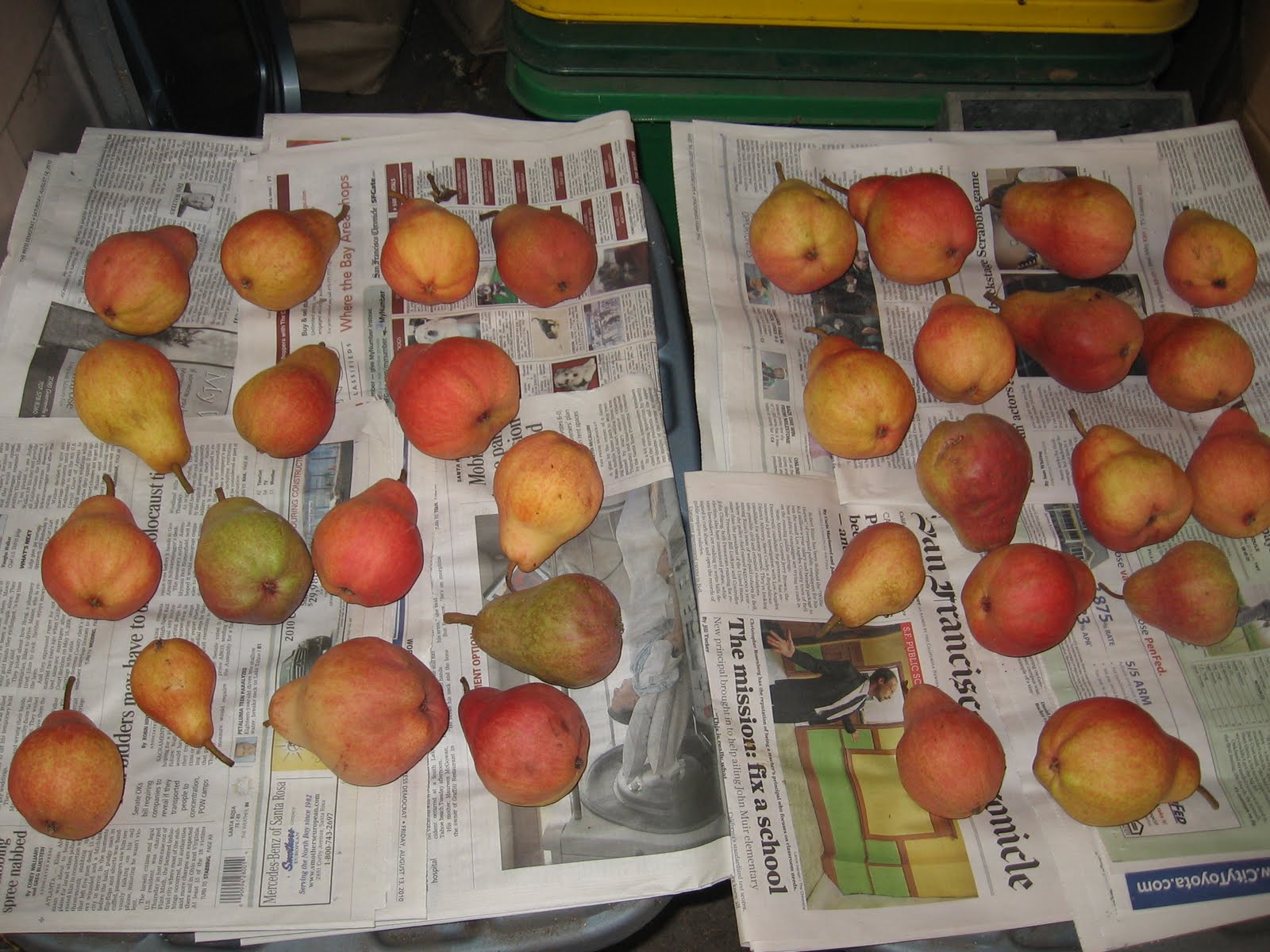
Here are the pears, laid out in the garage. A lot of them are already mushy, perhaps due to the blast of heat this week.

We are learning that the pear season is short and you have to move fast. Pears need to be picked all at once as soon as the first one drops, then stored right away and kept cool. They should be eaten a little bit before they feel ripe. I think they must ripen from the inside out, because when the outside seems perfect they are brown and mushy at the core. The ones that are golden with a rosy blush but still hard to the touch are the ones to go for.

Saturday, August 14, 2010

Volunteer Potatoes


Here's the harvest of All Blue potatoes. It's the second year in a row these plants have come up on their own. It's gotten so I expect to see them come back. Hi fellas!


An unexpected guest was this vigorous volunteer potato plant spilling out of the compost bin.


Here's the whole harvest. I don't usually turn the compost, but it was worth it this time to unearth the treasure. And, as a bonus, the compost will be riper for spreading on fall beds.

These potatoes are clearly fingerlings of some kind. The leaves looked quite different from the Russian Bananas, with extra small lobes that made them appear ruffled. I think I recall some small packages of French fingerlings that sprouted and got tossed. Welcome back!

Friday, July 30, 2010

One Day's Harvest


All this came out of the garden today:

Assorted lettuces: Black Seeded Simpson, Red Sails, Endive
Cucumbers: Armenian (just one), Lemon
Zucchini: Green Bush
Tomatoes: one little Early Girl
Peppers: Ace
Beans: Kentucky Blue (pole beans)
Plums: yellow and red (don't know the varieties)
Chard: assorted volunteers

Thursday, July 22, 2010

Mr. Potato Head: The Sequel


Ahhh, the best laid plans . . . .

The second Mr. Potato Head, it must be said, is disappointingly similar to his progenitor. What that means is that the whole crop of Russian Banana Fingerlings isn't dramatically bigger than what was put in ground to produce it!


And here is the entire crop of Yukon Gold potatoes.

What went wrong? It's hard to know for sure, but I did notice that in both potato containers the spuds grew only in the bottom layer of loose, rich dirt. Perhaps adding the layers of straw was not a good idea. The straw ended up getting packed in pretty tight and may have reduced air circulation. Next year I will try filling the containers only with soil and compost.


But there was still enough to bring to the table. Putting both crops together yielded just enough potatoes for our Fourth of July mini-feast of deviled eggs, fruit salad with yogurt, veggie burgers with garden lettuce and -- ta da! -- potato salad.

Looking back to April when I was calculating Days to Maturity and planning future menus, it's clear that nothing is guaranteed:

April 23: "So I'm anticipating a Yukon Gold potato salad in early June, ten weeks from planting time in late March, and, about five weeks later, in mid-July, one of B.'s fabulous potato pizzas made with Russian Banana Fingerlings."

Here's what really happened:

The early season Yukons (70 to 90 DTM) were harvested on July 3, 97 days after planting, a week longer than the maximum expected growing time.

The late season Fingerlings (105 to 135 DTM) were harvested earlier, on June 27, 91 days after planting, which is two weeks less than the minimum expected growing time.

I harvested when the plants were yellowed and falling over. There were hardly any immature potatoes in the containers, so waiting longer would not have made a difference.

As I said, the best laid plans . . . .

Saturday, July 3, 2010

Visualize Whirled Peas


Pictured above is my share of the entire pea harvest. Peas Alfredo is very easy to put together -- at least in my opinion, not having been the one to do it. I did cook the peas, though. They just need a minute or so in water that is boiling enough to move them around. Whirled peas -- get it?

Then cooked pasta is coated with the rich cheesy Alfredo sauce, the peas are ladled out on top, and voila -- a delicious concoction that truly could contribute to harmony among nations, if only there were more of it. Fortunately, there were only two of us at dinner.


The entire pea harvest consisted of one cup of nicely sized Caseload Shelling Peas. Well worth it, to my mind, especially since this is the first ever genuine pea harvest our garden has ever produced -- after years of trying. My half-cup share felt like a personal breakthrough. Next year: two cups!


Here's the pea patch on June 13. This is pretty much the whole show. There wasn't a lot, but each nice fat pod yielded five or six nice fat peas.


This seedling, a couple of inches tall, was photographed on April 14. The peas were planted on March 19 and harvested on June 14, so Days to Maturity was about three months or 90 days.

At the time of planting I remember thinking it was too late for peas but I was wrong because this crop -- if "crop" is not too grandiose a word for one cup of peas -- has been the most successful we've ever had.

Was it the unusually cool spring? Did planting late mean the ground was warmer and the seeds didn't rot? Were conditions just right to enable the little seedlings to grow fast enough to outpace the night critters that like to shear them off at ground level?

Whatever the magical convergence of variables happened to be, we are grateful.