Saturday, November 19, 2011

Lemon Renaissance


The little potted Meyer lemon tree is finally coming into its own. There is a noticeable difference this season in size and abundance.

We acquired it by mail order in February 2009. It arrived in a cardboard box with the largest quantity of Styrofoam pellets I've ever encountered. It seemed to take forever to scoop them out and slowly uncover the tiny tree with two huge yellow lemons dangling like gaudy oversize earrings from twigs that could barely support them.

We gathered about five lemons the first year which I picked too soon in my eagerness, and none the second year because they kept falling off while still dark green and the size of a fingernail.

Whence this bumper crop? Maybe the time is right; it does take fruit trees a while to get going. Or perhaps it's the effects of compost tea and rock powder.


Each winter it needs protection from the frost. I've been watching the weather carefully and covering it sometimes when the forecasts skirt too close to 32 degrees. We've had no freezes yet. Will the lemons keep ripening even when frost-kissed? The label says it produces flowers and fruit year round in USDA Zones 9 and 10. We are Zone 10 so here's hoping for a Christmas harvest. B. says just to be safe we should bring it inside and make it into our Christmas tree. For one thing, it's already decorated!

Thursday, November 17, 2011

"Barnival" at Green String Farm


There's another crop of interns at Green String Farm. Last Saturday they put on their community event, so after I filled my cloth bags with lettuce and potatoes from the farm store -- there's no gardener's guilt in buying produce here to supplement our home-grown fare -- I wandered out to the "Barnival." This event was aimed at little kids so all the big kids were in costumes. Or maybe it was the lingering influence of Halloween, which is an over the top event in these parts.

Passing up the cider press (too much sugar) and the petting zoo (too crowded) I found myself at the transplant booth. Two interns (secretly dubbed by me as Sam Gamgee and Galadriel in honor of the little box of magic dirt that Galadriel bestowed on Sam) were giving away lettuce seedlings to any children who would do the transplanting themselves, right there at the booth. They kindly made an exception for a senior citizen.

With Butter lettuce seedling in hand (and secretly promising to do justice to this magic dirt), I continued my journey and found myself in the cavernous old barn which was lending its name to the event. The last time I was here, in August, this was a lecture hall. Now it was transformed into a huge storage area for the storable crops.


Admiring the ample bins of winter squash, threshed grain, and potatoes, I was glad all over again about discovering this local cornucopia. Well done, winter interns.

Monday, November 7, 2011

In Which I Discover an Ootheca


I was quietly watering the newly installed bed of fava bean seedlings that runs in a narrow strip along the back fence, when I noticed an odd protuberance from one of the fence boards. Our neighbor put up the fence just a few months ago so it still has the blond coloring of unfinished lumber. The strange little outcropping was the same color as the wood and could easily have been a knot hole or imperfection, but something about it made me look closer. It reflected light with the subtle luminosity of something alive.

To the touch it felt delicate and vulnerable -- not like wood at all, more like very fragile Styrofoam. Oval, about an inch long, with fine ridges and a large ridge down the middle like a zipper, it was firmly attached to the fence. Ahh, a new backyard mystery. What could it be?

Touching it triggered some long dormant memory of the praying mantis egg cases we kids used to find back in Virginia, along with a comical image of my mother flapping a dishcloth at swarms of tiny mantis nymphs that had just hatched out in our kitchen, hanging in wiggly green streamers from the cupboards and window ledges. We never found the egg case or figured out how it ended up in the kitchen. Clearly, an egg-laying mantis is resourceful.

The egg cases of memory were rounded and usually discovered adhering to a twig. This modern California version felt the same but looked quite different. Perhaps mantis resourcefulness includes adapting the shape of the egg case to the available surface.

On the hollyhocks only a few feet from the spot on the fence, I had recently seen a large pale green mantis with characteristic folded front legs, elongated body, narrow triangular face and bulbous eyes. The first one I had ever seen in this yard, it was gone by the time I came back with a camera.

On the internet it didn't take long at all to find photos of mantis egg cases that look exactly like the mystery object. As a bonus, I acquired a new word and a bit more insight into the whole process. The case is called an ootheca from the Greek roots for "egg" and "purse" or "pouch". It's the kind of word that carries a built in exclamation. "Ooooh, look at that, an ooooootheca!"

The mama mantis extrudes a lot of soft foamy goo to enclose her eggs. The goo hardens and becomes the ootheca, which keeps the brood safe through the winter until spring comes and hatching occurs. Evidently she can do this several times, so I am keeping my eyes open!!


Saturday, August 27, 2011

A Sad Story of Spider Mites


Years ago I saw an episode of the X-Files in which Scully and Muldur were dispatched to the Pacific Northwest to investigate the mysterious disappearance of several forest rangers. After the discovery of mummified remains and the usual series of nail-biting close-calls, the culprits were revealed to be clouds of tiny, alien, insect-like creatures descending from the tall evergreens to engulf unwary passers-by in cocoons of gossamer webbing. Once engulfed, the hapless victims were slowly relieved of their vital juices until nothing was left but a dessicated husk.

Something similar is happening in our garden this summer. Not to worry: we haven't lost any friends or family members. So far, thank goodness, the only victims are the beans and the zucchini.

I know it's just spider mites, not an alien invasion, but there is a sense of helpless horror in seeing the bean vines covered in webbing and slowly succumbing to a lethal infestation.


The whole crop of Kentucky Blues is a lost cause. They've been watered well and sometimes I follow the standard advice to hose them down to wash away the minuscule mites. It hasn't done a bit of good.


The first sign of trouble was a tell-tale stippling on the leaves. The mites -- not insects, but arachnids related to spiders and ticks -- live in colonies on the undersides of leaves and stick their mouth parts like little straws right into the cells of the leaves and suck them dry.

We've had this problem before but not so severely, just some spotting here and there. This year the leaves are so thoroughly stippled they change color and slowly dry out before dropping off.


The Green Bush zucchini, which was on its way to a very productive season, has been stopped in its tracks. The oldest leaves are dying and the new young leaves will no doubt get paler and paler before perishing like those unfortunate rangers in the fictional forests. Where are Scully and Muldur when you need them!


It's hard to believe that a creature barely visible to the naked eye can do such damage to the huge zucchini leaves, not to mention the entire bean crop. But in good times, such as the hot dry days of a California summer, a spider mite can go through its whole life cycle in a week. The population explodes exponentially. When one plant can no longer support the horde, the female mites float on a strand of webbing to a new adjacent plant with its as yet unmolested leaves. And, to make things worse, they can overwinter in mild areas like ours, ready to come right back next season as soon as conditions are right.

I can't quite remember what Scully and Mulder did to save the day -- I think it had something to do with shining bright lights on the alien beings, who only appeared in the dark of night. But something needs to be done.

My plan is to try compost tea and rock powder. Build the soil; save the plants. We'll see.

Friday, August 26, 2011

Better Boy!


Strike up the band! Sound the horn! Beat the drum! Notify the press! Our backyard is fiiiiiinally yielding some ripe tomatoes. Well, one, single, glowingly ripe Better Boy tomato, to be more exact, on this happy summer day of August 26, 2011.


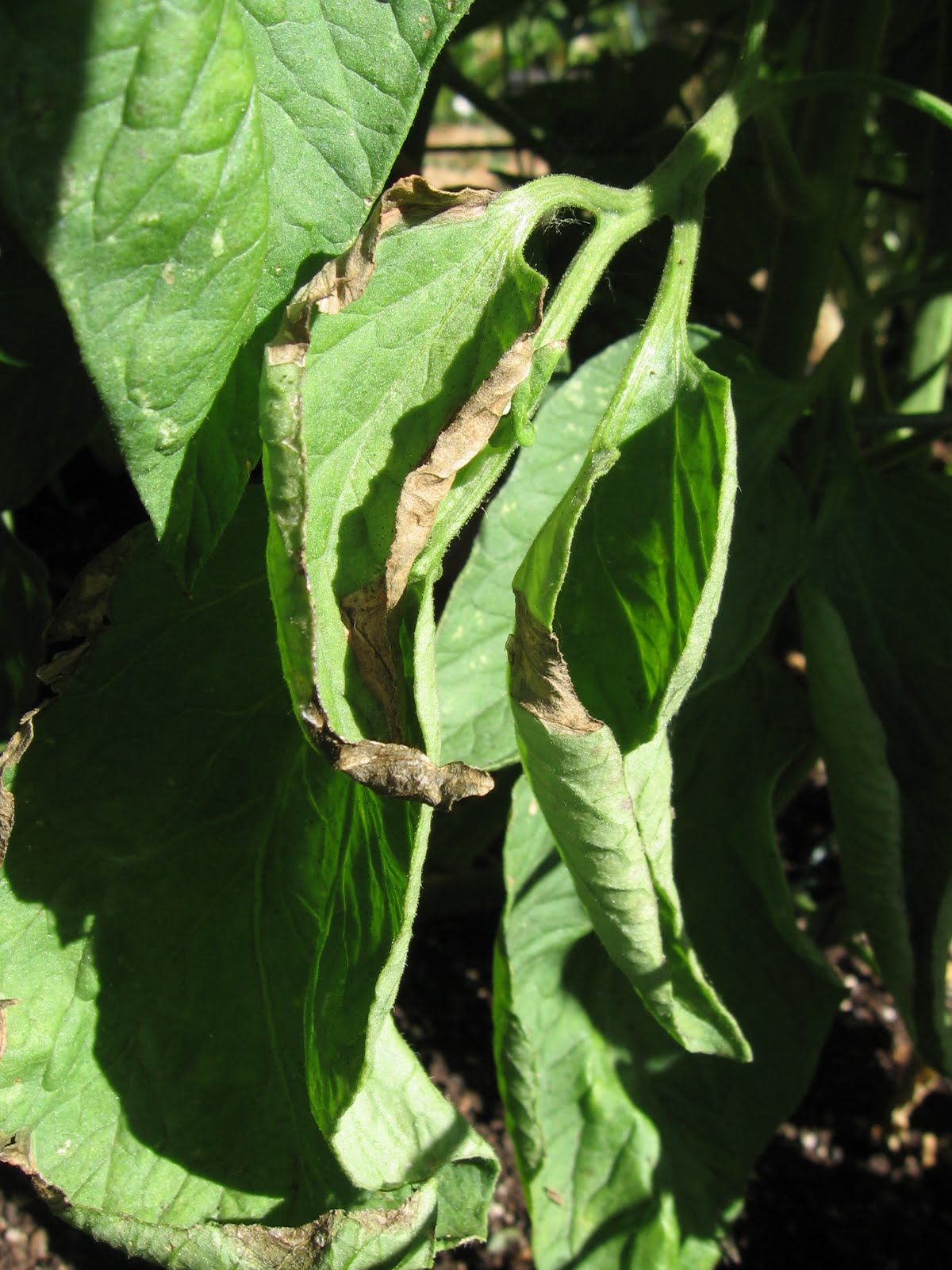
I planted out two Better Boy seedlings on May 9, so it has been a long wait. The plants, with abundant round green fruit, have grown to the top of the eight foot support poles and are poking through the roof trellis. As VFNT hybrids (i.e resistant to verticillium wilt, fusarium wilt, nematodes AND tobacco mosaic virus) they are looking pretty good -- although there are a few brown spots on the lower leaves and some leaves are thickened and curled into themselves.

For years, these have been our workhorse must-have tomatoes. They are harder to find now because of the craze for heirlooms, but I did manage to locate a mail order online nursery in the Midwest (Garden Crossing) that carries them. B. insists on them, and, indeed, they have provided us with many a year of abundant harvests for freezer tomato sauce that gets us through the winters (ah, the grueling Northern California winters).

Better Boys were developed many years ago by a former employee of Burpee, John Peto of PetoSeed. He took with him from Burpee some seeds of a large pink beefsteak variety called Teddy Jones -- which had been one of the parents of the hybrid Big Boy -- and used them in developing his own new hybrid. So I guess the idea is that Better Boy is better than Big Boy, or something like that. Better Boy is -- or was -- a very popular variety with home gardeners and has a place in the Guinness Book of Records as the most productive: one plant yielded 342 pounds of rich red lusciousness.

From the Burpee web site I learned some more factoids about tomatoes in general: They originated in the Andes Mountains of South America and spread throughout Central America and into Mexico. In the sixteenth century they were found by the invading Spanish growing in Aztec king Montezuma's garden. The Spanish brought them back to Europe and the rest is history, some of it occurring in our backyard.

Muchas gracias!!!


Sunday, August 21, 2011

Green String Farm


Green String Farm nestles against the leonine flanks of Sonoma Mountain in the southeastern corner of Petaluma. It is just a short drive down the highway, right where Adobe Road takes a sharp curve east through the hills.

I can't remember exactly how I stumbled on this local treasure. It was recently and it was on the Internet, of course, venue for most of my explorations these days.

Searching for something or other about sustainable agriculture I followed a series of links which ended up at a Web site with news of unexpected riches right here in southern Sonoma County. Green String Farm and Green String Institute have been operating for nearly a decade and co-founder Bob Cannard has been an icon of the organic movement -- a famed purveyor of highest quality vegetables and fruits to Alice Waters herself -- for more than thirty years.

This was all totally new to me, local gardener for lo these thirty-four years.

I didn't waste any time in checking out this new-found cornucopia. As it happened they were having an open house so I was able to get the whole story in person.

First off, the farm store deserves a mention. Open throughout the year, summer and winter, every day except major holidays, it offers up heaps of "Beyond Sustainable" produce along with eggs, cheese, and dried and canned items produced on site -- all for affordable prices. Part of the farming philosophy that shapes this enterprise is the intent to grow good food at reasonable cost for local markets. No shipping pricey organic fare for thousands of miles.

Wonderful, I thought, as I wandered through the charmingly rustic open air displays admiring baskets of bright red cherry tomatoes, piles of dark green zucchini, bins of golden peppers: If it's good enough for Chez Panisse, it's good enough for us home folks.


Along with its fabulous food, Green String Farm is also growing a new generation of organic farmers. That's where Green String Institute comes in. The open house was put on by the most recent crop of farm interns: an eager band of young people who had been selected to spend three months living and working on the farm while attending daily lectures by Bob Cannard about his unique approach to farming. The Institute, too, operates year round. There are new groups of interns coming in each season -- summer, fall, winter, spring -- and each group plans and organizes an event for the local community.


So, on a late August Saturday, with the sun beating down out of a cloudless blue sky, I went from booth to booth getting a crash course in "natural process farming." One of the interns demonstrated a very simple set-up for brewing compost tea in a five-gallon bucket full of water. With just a small amount of compost starter suspended like a tea bag, a little molasses, a pinch of flour, an air pump and a bubbler, you can launch an aerobic process for growing lots and lots of micro-nutrients that will give your plants a power diet.


There were other booths describing soil biology and plant health, the importance of adding igneous rock powders to boost soil minerals, and mug shots of all the different types of crucial soil critters. The displays and demonstrations were clearly aimed at encouraging us to try out the Green String methodology in our own gardens. It was like a science fair of smart motivated kids all presenting different aspects of the same experiment.


An intern led a tour up the hill and out into the wide summer fields dotted with fruit trees and patterned with long dark rows of vegetables. We got to see where the cherry tomatoes, zucchini, and peppers had come from.

Our group seemed even more interested in finding out where the interns had come from. The guide, an eighteen-year-old college graduate from Florida, patiently answered lots of personal questions: Are you going to be a farmer? Yes. What are you doing after this program? I'm staying on here to do some research. Are you a brainiac? Hmmm, if you say so. . . . Look over here at this nice field of chard . . . .

Interns come from all over the country (e.g. Florida, Michigan) and from other countries (e.g. Serbia) to spend three months living together in an old farmhouse, planting, tending, and harvesting the crops, running the store, and studying natural process farming as a business as well as a labor of love.

(People, there might be some hope for our common future if the cool careers are now out in the fields rather than on Wall Street.)


Some of the fields looked like what you would expect on a farm. But these were in transition and not fully representative of the "natural process" approach.


A cabbage patch gave a better idea of the technique. It looked like a weed patch, overgrown with tall seeding heads of what is in fact a companion cover crop that will be left to mature in place and eventually die back to form a thatched ground cover.

The field seemed alive, rustling with subtle motion. Suddenly a flock of birds swooped up out of the weeds to swirl and twitter in the air and then settle back down for more feasting on the plentiful seeds. The cabbages seemed almost like an afterthought, tucked in among the natural pasture. The principle is: A crop for the people, a crop for the soil (and the birds, and the insects). This is how Mother Nature does it, with plenty to go around.


A large field of tomatoes was even more striking -- it looked like it was made up of long tidy rows of weeds. You couldn't see the tomatoes at all until you were right on top of them.


The plants were not staked and sprawled along the ground amidst the weeds. The tomatoes will go to the farm store, the weeds will die in place and be dug back into the ground to enrich the soil. The argument is that this approach builds a complete, thriving soil biology which supports healthy plants with complete nutrition and full flavor.


The highlight of the day was listening to Bob Cannard talk about healthy soil and healthy plants. A tall, intense man in well-worn jeans and work boots, he strode into the capacious old barn filled with folding chairs, running his hands through short spiky grey hair. Completely covered with a fine film of dust, he seemed to have materialized out of the earth itself.

"OK, where do you want to start?" Barely waiting for the first tentative question from the group he launched into a long rambling discourse describing the natural processes that build soil wherever Mother Nature has a free hand. It all starts in the mountains with the rushing freshwater streams that gather up particles of rocks, plant debris, animal remains -- whatever is there. The streams bring this rich brew of "mountain tea" down into the flat lands where unencumbered annual flooding spreads it out and deposits the nutrients into the soil. That's the way it used to be everywhere.

But human activity has put streams underground and interfered in thousands of ways with natural soil fertility; so the farmer or gardener has to make up the difference by supplying the missing nutrients. Hence, natural process farming.

With words and ideas tumbling out almost faster than he could articulate them, his talk began to seem like one the roiling bubbling streams he was describing.

Here's a small sample from my scribbled notes, which are cryptic clues to a wholly integrated philosophy I as yet see only pieces of:

Use igneous rock powder from quickly cooled volcanic rock -- has 80 essential elements. Is para-magnetic, not di-magnetic or magnetic, which are low energy. (???) Supplement with calcium, also sulfur, which are lost in steam from hot lava.

Plants are meat eaters, consume bacteria protein, protoplasm.

"Fixed air" is what the plant fixes out of the air into its body, source of carbon. (?)

Too much nitrogen means a plant drunk, on crack -- a weak, sick, fat, "water-body" plant that attracts pests and disease. Natural process farming is very low nitrogen method.

Majority of soil food comes from cover crops. High diversity. (?) Allow them to come to fruition, produce their "seed babies" and die of mature contentment. Over time this develops a unified soil culture.

The gist of it all is that foods grown on soils alive with the full spectrum of nutrients are incredibly tasty and maximally nourishing.

When his time was up, he invited everyone present to stop by the farm store on the way out and pick up a free basket of cherry tomatoes. If there was any chance I hadn't been convinced by the speech, one mouthful of a little bright red cherry bomb of flavor exploding across my palate closed the deal.

What I took away from the day is that natural process farming tries to replicate Mother Nature's own methods of soil replenishment through compost tea, rock powders, and cover crops left to decompose in place.

I can hardly wait to try some of it in my own backyard. Even with no eager interns on hand to do the heavy lifting it can't be terribly arduous to sprinkle compost tea and rock powder on everything and throw out some seeds for cover crops. And, to fill in the gaps for what our yard doesn't manage to produce, it's really good to know that just down the road is an all-year every-day farm stand.

Sunday, August 14, 2011

Grafted Tomatoes: An Update


It's mid-August: time to check in with the experimental, grafted heirloom tomatoes. They have almost caught up with the hybrids, which were set out three weeks earlier (May 9 versus May 29). The Japanese Black Trifele plant is the most robust, vining upwards nearly to the top of the six-foot support poles.


The hybrids, for their part -- one Sungold and two Better Boys -- are filling out their eight-foot support tee-pees and have nearly reached the trellis roof. (And I must say that the tomato-guild assortment of companion plants at their base has done well too, forming a living mulch of basil, parsley, marigolds and nasturtiums that glows with variegated shades of green, orange, and yellow in the bright summer light.)


If all the pear-shaped fruit hanging on the Black Trifele plant ripens, we will have the best harvest ever of this smokey-flavored heirloom tomato with its rich, buttery texture. That alone would make the experiment worth the extra cost and effort!


Although there are some minor dead spots along the edges of a few lower leaves, so far this Black Trifele is the most successful heirloom we have grown.


The San Marzano Gigante 3, an Italian paste tomato with a portentous name, is also doing just fine, thank you -- festooned with long, pointed fruit, some of them almost as gigante as my hand.


The lower San Marzano leaves have a fair amount of the brown spots along the edges that appear sooner or later on all the tomato plants we have ever tried to grow in this garden. Eventually the whole leaf turns brown and shrivels up. So far it's hardly noticable unless you peer worriedly into the tangle of marigolds, basil, etc., at the base of the plant -- which of course I do constantly.


Big Beef is also looking good with clusters of mid-size green fruit. This is one of the varieties being tested by Amy Stewart of Garden Rant, and other garden bloggers as well, in controlled trials matching the performance of grafted versus non-grafted versions of the same variety. The preliminary results seem to be encouraging overall, although Amy's right in wanting to wait for the actual eating of the harvest as the last and final measure of success.


Meanwhile, I continue to peer anxiously at browning leaves, my personal measure of tomato perfection or lack thereof. The Big Beef plant has some dead branches but they are at the base and don't seem to be spreading upward in any great hurry.


Brandywine is another story. There are just a few small fruits on a stunted plant that has stopped growing at about three feet in height.


Whole branches are dying off completely. It started on the larger, upper leaves, some of which turned brown all at once and then shriveled. No slow spotting on the edges of lower leaves. No need to peer into the undergrowth. It's a major problem right out in the open. I've never seen this before and I sure hope it isn't contagious! I will remove the whole plant and hope for the best.

Three out of four ain't bad.