Showing posts with label march. Show all posts
Saturday, March 2, 2013
Tuesday, March 20, 2012
Freesias in the Rain
A miracle of water has been falling out of the sky! We have had currents in the gutters, rushing streams, fallen blossoms pasted to the sidewalks, and in the backyard, plants bent down with the weight of accumulated moisture. In the middle of this happy hulabaloo the first freesias of the season quietly opened up their golden throats and took a gentle drink. I photographed them the morning of March 13 after several days of rain with more rain following.
Saturday, March 19, 2011
Kale Chips?
Am I the last one to hear about these? Have they entered the mainstream while I wasn't paying attention? Are they being sold at ballparks? Kale chips are really, really good: light, crunchy, oven-dried flakes of flavor. And so easy to make.
I first learned about them from a friend who was visiting the garden. Noticing the rather spindly stand of dinosaur kale (also known as Tuscan kale, lacinato kale, black kale, etc., etc.) she asked if I had ever made chips. When she described the simple process I resolved to try it out.
First, of course, you get your hands on some kale. (Any kind will do.) I gathered a big bunch and washed it carefully, checking for earwigs, tiny slugs, aphids -- the usual routine of the organic gardener.
A brief whirl in the salad spinner takes excess water off fast.
Stripping the leaves from the thick stem and central rib goes fast too. Pick up a leaf, hold the stem end firmly in your right hand (if you are right-handed), grasp the base of the leaf lightly with your left hand, then pull hard with your right hand. The leaf should rip right off. If some of the leaves border the stem all the way down to the base -- common for dinosaur kale -- just peel the two sides back a bit and proceed as described.
Now you have a nice pile of dark green ribbons. Cut them into smaller pieces.
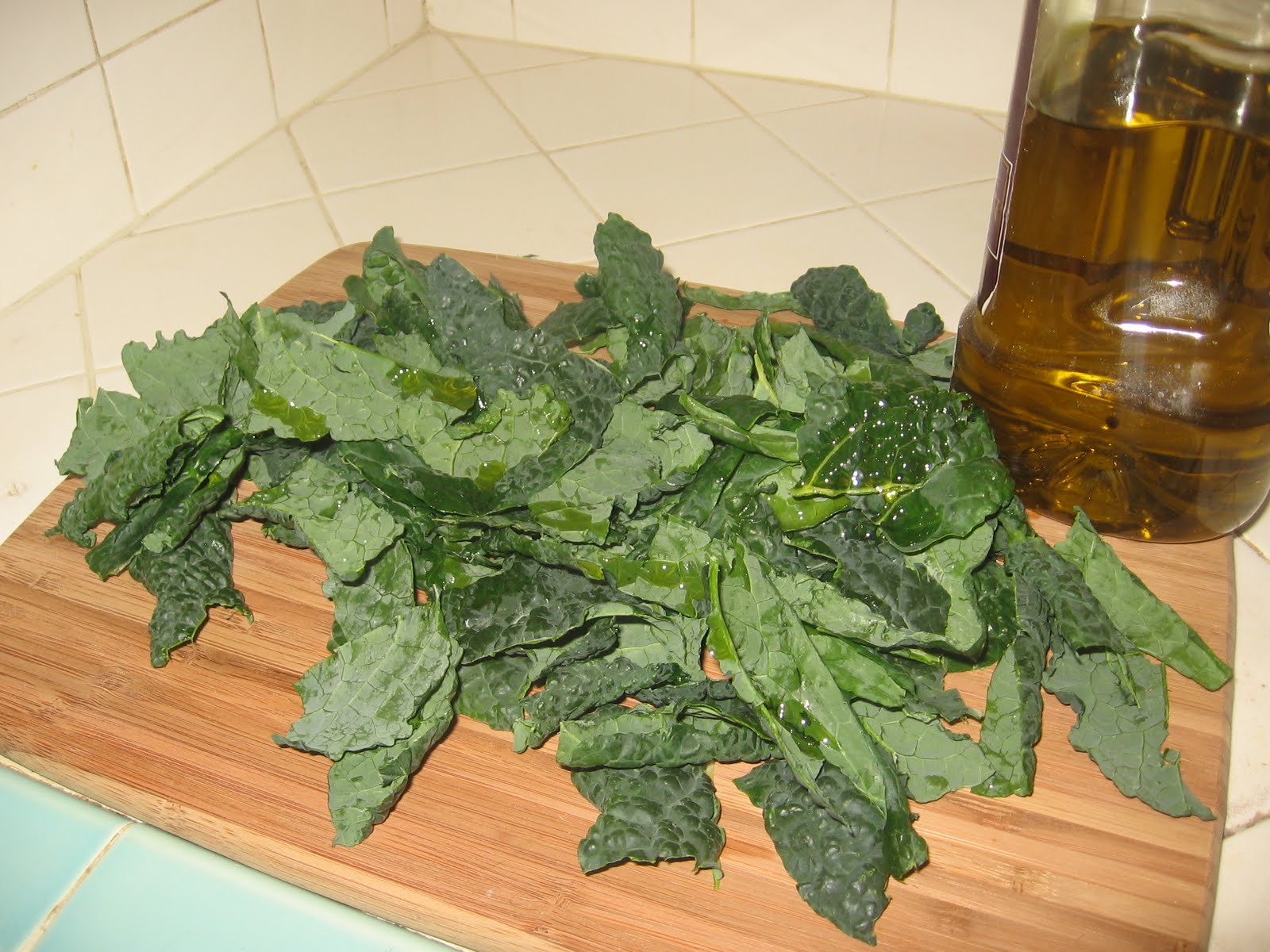
Drizzle some good olive oil over the pile.
Put it all in a brown paper bag and shake gently until all the pieces are lightly coated with oil.
Coat a cookie sheet with oil and arrange the kale pieces in the pan in a single layer.
Grate up some fresh parmesan cheese and sprinkle lightly over the kale pieces.
Put the pan in a slow oven for 10 to 15 minutes. It might take some experimentation to get the temperature and timing right. I followed an online recipe that asked for 15 minutes at 375, which turned out to be too long and too hot. I pulled the pan out after seven minutes because some of the pieces were clearly overcooked and turning an unappetizing color. Nonetheless, they were crackly and delicious.
If you want to hear how crunchy kale chips can be, take a look at this charming video at katheats.com. Kath used a different type of kale and a slightly different approach but the general idea is the same:
http://www.katheats.com/favorite-foods/kale-chips
"Eat your greens" has a whole new meaning.
UPDATE 5/19/11: OK, today is May 19. I was cleaning out the refrigerator and way at the back of a bottom shelf found the container of kale chips with a few left at the bottom. Two months later they are still crunchy and still tasty. Is this a way to preserve the crop?
Monday, March 7, 2011
Eat the Yard Update: A Touch of Rosemary
Our Eat the Yard Challenge began on New Year's, 2010: A resolve to eat something from the yard every day, even if only a sprig of parsley or a twig of thyme or rosemary. (Our little rosemary bush is shown above.)
I guess it has to be admitted that it's really my Challenge, since the participation of others who might be mentioned has consisted mostly of bemused tolerance. But never mind about that. At least the eating is shared, if not the fretting about what's ready to harvest and what could be part of a meal.
The Challenge was pretty successful -- in 2010 there were about ten days where the standard was not met. And it has continued successfully into 2011. So far there has been only one day when our garden did not contribute to our dinner. We got stuck in San Francisco during rush hour and had to eat out, a rare occurrence.
It's become a way of life to eat the good food of home, some of it grown by yours truly, most of it cooked by others who might be mentioned.
These roasted veggies were served March 3. Before roasting they were coated with olive oil and sprinkled with crushed rosemary leaves, gathered shortly before use. Bon appetit!
Sunday, March 6, 2011
The Return of the Queen
She's baaaaaaack! Well, not the same "she," of course, but I don't see any difference between the hornet queen of 2011 and her predecessors from whom I have learned a wary respect for all their kind.
Most likely she was born and raised in last year's nest under the towering Deodar Cedar in the front yard. After her mating flight in the fall she, and other fertile females, found a safe place to wait out the winter months, each in their lonely hideaway. These future queens were the only survivors from the teeming hornet metropolis dug into the sheltering roots of the big tree.
All summer long I could watch the busy comings and goings from a safe vantage point in the driveway, grateful that the nest was in a protected place where I would not stumble upon it -- unlike previous years. For instance, there was the year the nest was behind the living room wall, with buzzing hornets slowly chewing their way into the house. When we saw little feelers waving around next to the light fixture there was no choice but to call for help. We were rescued by a knight in grungy coveralls from Luck of the Irish Bee Service, who did noble battle for the better part of a day. That year the nest met an early demise but the species was unaffected because they were back again in fine form the following spring.
Now that it's spring again, here is a new queen foraging for food on her own. As yet, there is no crowd of loyal hornet subjects to meet her every need. She has to build the first small nest herself, chewing up wood into paper mache to make sculpted cells for holding larvae and graceful curving walls to keep everything together. And until the worker hornets hatch out she has to do the grocery shopping too.
She will eat nectar herself, I believe, and catch bugs for the hungry larvae back home. If the link below works, you can hear the sound that hungry larvae make scratching on the sides of their cells (a little creepy but also kind of thrilling):
http://www.vespa-crabro.de/larve.mp3
This link goes to the main Web site with everything you ever wanted to know about hornets but were afraid to ask:
http://www.vespa-crabro.de/hornets2.htm
Hornets are great for the garden because they catch so many insects. In Europe, the European hornet is a protected species. So I am very glad to see the return of the queen. I just need to know where that nest is!
Wednesday, March 31, 2010
The Pear Tree is Blooming!
The plum blossoms are gone now and the plum trees are leafing out. But the second wave of bloom is making a dramatic display: our pear tree (see above), an old apple tree down the block, in neighbors yards tulips like huge Easter eggs on sticks, the cruel lilacs, mingling memory and desire, and the dramatic wisteria draped across entryways and fences. Some people, such as Michele Anna Jordan, regard wisteria as a favorite harbinger of spring, but I'm sticking with January's fields of golden mustard and February's plum blossoms. To me, spring is well along into chapter two.
Sunday, March 28, 2010
Mr. Potato Head
Finally! Some potatoes went into the ground today. The smiley faced Mr. Potato Head is a basket of Russian Banana Fingerling potatoes.
Planting in containers is the only way I've found to foil the gophers who are capable of taking most of a crop. I think that is what must of happened to the Gro-Bed full of All Blue potatoes in 2008. Last year's crop consisted of the volunteer remnants which came up on their own, an unexpected treat, and provided enough to accessorize a couple of meals.
Usually we try to plant potatoes on or near St. Patrick's Day -- an old Irish custom so I'm told. In past years, when we planted by St. Patrick's Day we had ingredients for Fourth of July potato salad. Since our potato endeavors are strictly a boutique operation, usually there's enough for a good-sized salad but not much more.
My brother back in Virginia, who is a farmer at heart although he too has only his yard, sent me some photos of his potato patch last year: a long lush row of perfectly hilled plants, complete with tiny granddaughter and friend digging out the treasure trove.
So far this year we have the basket of Russians and a container of Yukon Golds. They came from David Baldwin at Natural Gardening, who is always a pleasure to buy from and is about as local as you can get -- although it's a national mail-order company. (I always feel pleased when I plan ahead enough to actually order something on time.)
And potatoes are so much fun to grow. I like every stage of the process. Burying the seed potatoes like secret treasure, waiting for the first sturdy shoots, covering the stems with successive layers of compost and straw, enjoying the flowers, and at last the payoff: groping around in the dark, rich soil for the satisfyingly solid, rounded spuds.
Friday, March 26, 2010
Homage to Cruciferae
There are striking similarities among the broccoli, kale, and arugula plants, all flourishing right now in our backyard. The sibling resemblances should not come as any surprise since they are in the same family, the Cruciferae, also known as Brassicaceae (that is how it's spelled -- I checked). Personally, I think of them as Cruciferae. For one thing, it's easier to pronouce.
They are also in the same sub-group or genus within this huge family. The genus is known as the brassicas. It contains more important agricultural and horticultural plants than any other genus. (Isn't Wikipedia wonderful?) There are your cabbages, your turnips, your brussels sprouts, your kohlrabi, cauliflower, broccoli, mustards, on and on, and that's just the vegetables. A farmer's market of cousins.
Above is Purple Sprouting Broccoli, doing its thing. From this plant we eat the buds.
Here is Dinosaur Kale, also putting out buds and looking a lot like sprouting broccoli. But in this case the appearance of these sprouts means the plant is past its prime (from our perspective) and going to seed. The prized leaves will lose flavor as the plant puts its energy into budding, flowering and seeding.
Here is the lovely blossom of the Dinosaur Kale. The name Cruciferae comes from the four-petaled flowers in the shape of a cross that are a stable characteristic across the entire family of hundreds of sub-groups.
And here are arugula blossoms, also cruciferous. This plant has a nice bud stalk. Would it be good to eat, like broccoli? And what about the Dinosaur Kale buds?
We are very conventional and eat only the customary parts of each of these plants. There is more than enough as it is. But it's nice to know the family tree all the same.
Monday, March 22, 2010
Fava Bean Envy
While driving through town, I noticed a front yard vegetable garden with fava beans about five feet tall, complete with blossoms. And in the community garden that abuts the nature area where C. and I take our weekly rambles, there are some almost as tall. Back home, the seeds I planted on February 28 are just starting to come up, only a few inches high so far.
I do admire those tall beautiful fava bean plants in other people's gardens. Although, if envy is in order, I am most envious of my own plants from last year. In the fall of 2008, I happened to see some seedlings at a local nursery and bought them as a cover crop, having read somewhere that that's how they are used. The label said they were "Windsors."
By spring they were eight feet tall and thriving. The photo is from March 21, 2009, a year ago precisely. The tall plants at the back are the favas. Rather than dig them in I let them keep growing to see what they would do. It was the first time I'd grown favas so I was curious.
It was quite a show. They put forth an abundance of astonishing white blossoms, pale lavender at the base with black polka dots on the main petals. The flowers were swarmed by fat bumblebees. Maybe the dots are supposed to look like bumblebees and create the appearance of a crowd, just as a restaurant likes to look crowded to attract more patrons.
The blossoms gave way to enormous green pods filled with large shapely seeds. Eventually, when the beds were needed for summer plantings, I uprooted everything and put it on the brush heap. There was way too much biomass for the compost bin.
We'll see what happens this year with a spring planting. The seeds are also Windsors, which, as it turns out, is an eating variety. If these plants make it to the harvesting stage, we can try eating the beans; if not, more biomass. The seed packet says they can be planted in early spring "when the crocus emerge" and that's what I did, so hopes are high.
Friday, March 19, 2010
The Eatin' o' the Greens
As long as we are in St. Patrick's Day mode, it's worth saying a word or two about the spring tonic version of green soup, which is very very green. The summer version is mostly zucchini, a light concoction with fairly good crowd appeal. The spring version is for true believers only -- mostly kale and chard with whatever broccoli shoots can be gleaned.
I made some recently and have been enjoying the results for lunch. This never gets served at dinner because the Army surplus color of the soup is a little off-putting for some.
Above is an array of kales: Siberian, Redbor, and Lacinato (also known as Tuscan, Black Tuscan, or Dinosaur kale -- for obvious scaly reasons), and also a few shoots of Purple Sprouting and Romanesco broccoli. For connoisseurs of green, this is a delight for the eye. For connoisseurs of green soup, a delight for the palate.
In the last couple of weeks of warmer weather, the chard has been sizing up. There is more than enough anytime we need it. I can't keep track of the varieties any more because it comes up as it pleases and I move the seedlings around wherever a good spot opens up. The palest leaves are most likely Bionda de Lyon. But once it's harvested and headed for the soup pot it's all just yard chard.
There is one bed of Rainbow Lights chard planted from nursery starts that contributed to this batch. The photo captures only part of the spectrum which ranges farther into shades of red and orange.
The soup-making process is the same as for the summer version (see "Zucchini Factory," June 30, 2009, for description of process). But it's not the same soup -- the spring tonic version is so muscular I felt like the pot might get down off the stove and start doing one-handled push-ups.
Here's the final mixture, after blending. Intimidating for some, thrilling for others.
Anything extra goes in the freezer. There is still some summer soup left in there and now there will be plenty more until the zucchini starts coming in in a few months. The eatin' o' the greens goes on all year.
Wednesday, March 17, 2010
Happy St. Patrick's Day!
In honor of the green, here are the shamrocks by the kitchen door. We had some in salad tonight -- our minor observance of the day. This is actually just some wild oxalis, sour grass, that opportunistically took over this pot and the little plot it sits in. Actually, no-one really knows what the true shamrock might be, according to an article I read in a doctor's waiting room, in an glossy Irish horticultural magazine. Too bad I had to leave it behind before finishing the article.
But here's the gist of it: researchers sent out requests all over Ireland for people to mail in samples of the real and true shamrock. They got a variety of different plants, all having the tri-partite leaves that St. Patrick legendarily used to explain the Trinty. Many of the plants were in the oxalis family, so I rest my case. The true shamrock is the one growing right outside your door.
Another green tribute -- the velveteen hills of Sonoma County, dotted with live oaks. This vista is in walking distance of our house. The new grass has that dizzying green-gold light of early spring.
Thursday, March 4, 2010
More Backyard Blooms
The plum blossoms are at their peak, spilling over the yard like a breaking wave. I read once somewhere that Native American peoples named months -- called "moons" in their lunar-based calendar -- after the most important natural feature of the season. I always think of March as the Moon of Plum Blossom Rain. The neighborhood sidewalks are covered with the litter of petals, pink and white, and the backyard is decorated with white confetti floating through the air and landing everywhere.
They float over the garden paths, thick with blooming forget-me-nots.
They drift past the surprise crocus. (Several years ago I planted some in the two clay herb bowls that R. gave me. They never bloomed after the first year. H. showed me how to do close-ups with my camera but the batteries ran out and I wasn't able to capture the open blossom with its yellow center, welcoming the day. Nice close-up though!)
Many plum petals land on the arugula and have to be picked off during salad making. The arugula blossoms, which look like jeweled Celtic crosses, don't fall off but stay where they are, perhaps to stay as beautiful as possible for as long as possible.
Subscribe to:
Posts (Atom)