Showing posts with label worms. Show all posts

Sunday, November 4, 2012

The Elusive Soldier Fly


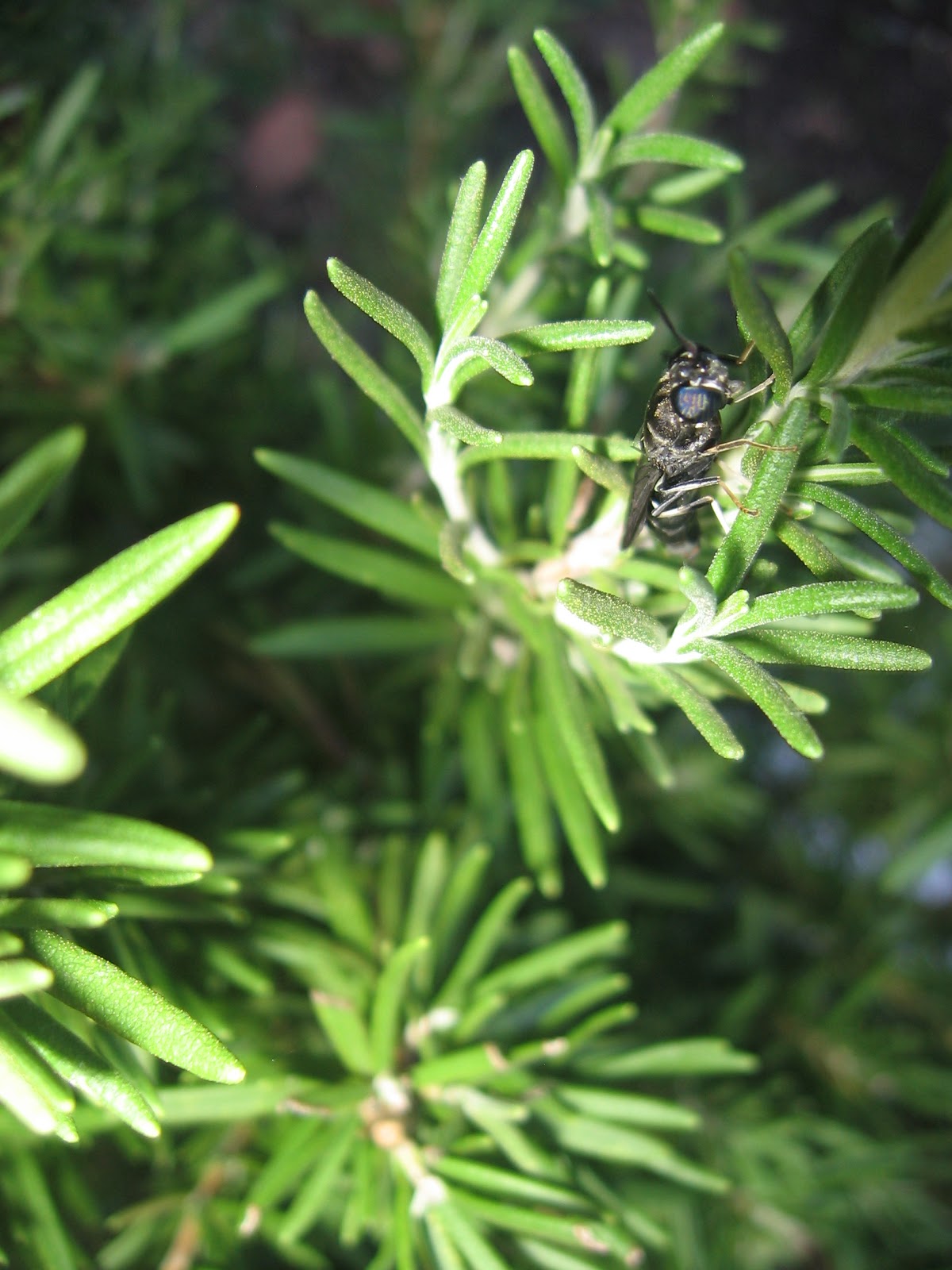
There have been a few soldier fly sightings in our yard before, always near our compost bins. But I've never gotten a photo because the large wasp-like creatures always fly off at the slightest disturbance. Today I managed to take several pictures -- with a flash, no less -- of one that remained determinedly in place on our little rosemary shrub, without even a twitch of its antennae.

Perhaps it was a female laying eggs?


The adult female Hermetia illucens or Black Soldier Fly (BSF), likes to lay her clusters of tiny eggs near a food source for the hatched-out larvae. Although she herself does not eat and does not even possess mouth parts, she is irresistibly drawn by the availability of decomposing kitchen scraps.

Thus, the rosemary shrub near the compost corner makes an excellent site for planting the next generation. I know that our local Hermetia moms make good choices because our bins always have an ample supply of larvae feeding on the freshest, juiciest layer of new compost material -- their preferred diet.

After first discovering these fascinating creatures, I have found myself irresistibly drawn to reading articles with titles like "The Bioconversion of Putrescent Waste" and watching videos on YouTube of proud gardeners showing off piles of garbage seething with fat Hermetia grubs. (It's amazing what an innocent hankering for tasty vegetables and beautiful flowers can lead to.)

The adult flies live only about a week, just long enough to reproduce. They are quiet, elusive, do not feed on anything and do not carry disease. They are quite common nearly everywhere, like the housefly; but most people are not aware of their existence.

Just start a compost bin that meets their standards, though, and see what happens. You will discover the grubs and be horrified. Then, as you learn more, you will become profoundly grateful for a free composting service rendered by Mother Nature. During their one to three month life span the grubs consume quantities of fresh waste. They work so fast that bacteria don't have a chance to make everything smelly and other types of flies are not attracted. They quickly establish what the experts call "niche dominance" and discourage the presence of fruit flies, blow flies, houseflies, and ants. Last but not least, or even last, the residue they leave behind when they crawl away to pupate is just right for redworms, who carry the breakdown process into the next stage of creating rich soil for your garden.

So if you see a shy BSF in your yard, treat it with all due respect.


Monday, October 4, 2010

A Confederacy of Worms


The first time I encountered solider fly larvae in my compost bin it was as a slowly heaving mass of damp leaves. The whole surface of the bin was creepily undulating up and down. When I used a trowel to push aside the thin layer of leaves, uncovering the recently added kitchen scraps, I saw the huge, whitish, maggoty creatures pictured above. Ewwww! Backing slowly away from the bin with a sick feeling in my stomach, I ran into the house and googled "huge maggots in compost!!!!"

That's how I found out about BSF, the black soldier fly, a great friend to lazy composters everywhere, we folks who never turn the pile, just add new layers and let it sit. Now, instead of recoiling in horror, I gaze fondly on the hard-working worms and urge them on.


BSF, you are my BFF.

The black soldier fly is an attractive large flying insect that looks more like a wasp than a fly. It has no mouth parts and lives briefly in order to mate and lay eggs. It does not bite, swarm, come into houses, or carry disease. The eggs are laid in wet, organic matter in the first stages of decomposition -- such as the layer of kitchen scraps in my compost bin.

The eggs hatch in just a few days into ravenously hungry larvae that start chewing their way through any nice juicy stuff they can find. They work so fast and wiggle around so much, aerating the pile where they are working, that there is no time for nasty smelling bacteria to get a foothold and create bad smells which attract the less desirable kinds of flies.

What's not to like? No smells, no flies, and very fast breakdown of organic matter, including materials usually not recommended for compost piles, such as dairy products.

They will eat anything, including manure, sewage, roadkill, etc., and are being studied for use in municipal waste systems. Although the thought of acres of undulating worms going after a city's worth of discarded organic matter is a bit nightmarish, it doesn't diminish my admiration for these first responders of Mother Nature's breakdown team.

When the larvae are ready to pupate, they crawl away from their feeding grounds, leaving behind a dark residue that is just right for the next set of responders.


Red wiggler worms like their organic matter a bit more aged than the greedy BSF larvae. When I see masses of red worms in my bin, I know the breakdown process has moved into the next phase. When the numbers decrease then it's time to add the compost to the garden beds. If I'm impatient to add some fertility ASAP I can use the compost at the red worm stage, adding some extra organic nitrogen to make up for the nitrogen needed to fuel humus making.

When the garden variety earthworms appear, it's a signal that the compost has now become soil. I have never seen earthworms in the compost bin, only in the garden. These worms, honored by Darwin for their soil building capacity, go after the tiny broken down bits of remaining organic matter and transform them into the castings that nourish good green growth.

This confederacy of worms works together to produce the rich medium needed for continuous vegetable production in our backyard.