Showing posts with label beans. Show all posts

Saturday, August 27, 2011

A Sad Story of Spider Mites


Years ago I saw an episode of the X-Files in which Scully and Muldur were dispatched to the Pacific Northwest to investigate the mysterious disappearance of several forest rangers. After the discovery of mummified remains and the usual series of nail-biting close-calls, the culprits were revealed to be clouds of tiny, alien, insect-like creatures descending from the tall evergreens to engulf unwary passers-by in cocoons of gossamer webbing. Once engulfed, the hapless victims were slowly relieved of their vital juices until nothing was left but a dessicated husk.

Something similar is happening in our garden this summer. Not to worry: we haven't lost any friends or family members. So far, thank goodness, the only victims are the beans and the zucchini.

I know it's just spider mites, not an alien invasion, but there is a sense of helpless horror in seeing the bean vines covered in webbing and slowly succumbing to a lethal infestation.


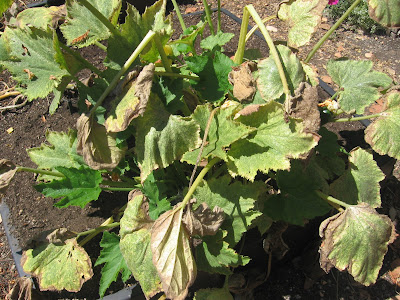


The whole crop of Kentucky Blues is a lost cause. They've been watered well and sometimes I follow the standard advice to hose them down to wash away the minuscule mites. It hasn't done a bit of good.


The first sign of trouble was a tell-tale stippling on the leaves. The mites -- not insects, but arachnids related to spiders and ticks -- live in colonies on the undersides of leaves and stick their mouth parts like little straws right into the cells of the leaves and suck them dry.

We've had this problem before but not so severely, just some spotting here and there. This year the leaves are so thoroughly stippled they change color and slowly dry out before dropping off.


The Green Bush zucchini, which was on its way to a very productive season, has been stopped in its tracks. The oldest leaves are dying and the new young leaves will no doubt get paler and paler before perishing like those unfortunate rangers in the fictional forests. Where are Scully and Muldur when you need them!


It's hard to believe that a creature barely visible to the naked eye can do such damage to the huge zucchini leaves, not to mention the entire bean crop. But in good times, such as the hot dry days of a California summer, a spider mite can go through its whole life cycle in a week. The population explodes exponentially. When one plant can no longer support the horde, the female mites float on a strand of webbing to a new adjacent plant with its as yet unmolested leaves. And, to make things worse, they can overwinter in mild areas like ours, ready to come right back next season as soon as conditions are right.

I can't quite remember what Scully and Mulder did to save the day -- I think it had something to do with shining bright lights on the alien beings, who only appeared in the dark of night. But something needs to be done.

My plan is to try compost tea and rock powder. Build the soil; save the plants. We'll see.

Monday, March 22, 2010

Fava Bean Envy


While driving through town, I noticed a front yard vegetable garden with fava beans about five feet tall, complete with blossoms. And in the community garden that abuts the nature area where C. and I take our weekly rambles, there are some almost as tall. Back home, the seeds I planted on February 28 are just starting to come up, only a few inches high so far.

I do admire those tall beautiful fava bean plants in other people's gardens. Although, if envy is in order, I am most envious of my own plants from last year. In the fall of 2008, I happened to see some seedlings at a local nursery and bought them as a cover crop, having read somewhere that that's how they are used. The label said they were "Windsors."


By spring they were eight feet tall and thriving. The photo is from March 21, 2009, a year ago precisely. The tall plants at the back are the favas. Rather than dig them in I let them keep growing to see what they would do. It was the first time I'd grown favas so I was curious.


It was quite a show. They put forth an abundance of astonishing white blossoms, pale lavender at the base with black polka dots on the main petals. The flowers were swarmed by fat bumblebees. Maybe the dots are supposed to look like bumblebees and create the appearance of a crowd, just as a restaurant likes to look crowded to attract more patrons.


The blossoms gave way to enormous green pods filled with large shapely seeds. Eventually, when the beds were needed for summer plantings, I uprooted everything and put it on the brush heap. There was way too much biomass for the compost bin.

We'll see what happens this year with a spring planting. The seeds are also Windsors, which, as it turns out, is an eating variety. If these plants make it to the harvesting stage, we can try eating the beans; if not, more biomass. The seed packet says they can be planted in early spring "when the crocus emerge" and that's what I did, so hopes are high.

Sunday, July 26, 2009

Haricot Verts


These are Tavera bush beans, a variety of French filet beans, sometimes called "haricot verts" (which is, I think, simply French for "green beans"). They ripened all at once on about ten bushes, an experimental planting that has yielded these lovely results. It's easy to see why the French would favor these elegant haricots, long, thin, and elegant as runway models.

This is the entire harvest, so far. They are amazingly delicious -- tender, sweet, and flavorful! Just blanch them for a few minutes, whole and untrimmed, in vigorously boiling water, and serve with a bit of butter, salt, and lemon.

Saturday, July 25, 2009

Harvest Kitchen

Last weekend was hot, high 80s. The cats were stretched out full length in the coolest spots they could find.

Not far away, a member of a supposedly more intelligent species was holed up in a stuffy little kitchen sweating over a boiling pot of beans. Or, to be exact, a non-boiling pot.

"A watched pot never boils," so goes the old saying. That was my first mistake, no doubt, in my week-end adventure of preparing a huge pile of Kentucky Wonder and Blue Lake beans for the freezer.

"Put the beans into a pot of boiling water and blanch them for three minutes," read the instructions. When I dropped several bowlfuls of chopped beans into vigorously boiling water it stopped boiling. I assumed the water needed to come back up to a boil before I started timing three minutes. Wrong. But I wouldn't know how wrong until later.

It took about eight minutes for the big pot filled with beans to come back to a boil. Then I let them boil for another three minutes. Wrong. Wrong.

"Plunge the beans into cold water with ice, to stop the cooking." That step proceeded as indicated. The beans looked beautiful and tasted even better. Completely delicious. After draining them, I couldn't stop snacking. That should have been a clue right there.


"Dry the beans," the instructions continued. "How?" I wondered. I spread them out on a bath towel and patted them dry, popping more than a few into my mouth. So far, so good -- or so I thought at the time.


The next step was to pack the yummy little beanies into freezer containers. The batch filled nine pint-sized containers. I put them into the freezer feeling very pleased with a most productive afternoon in my harvest kitchen. Did I mention the double batch of green soup? Lots of big pots were steaming up the kitchen that day.

Several days later we tried some of the beans for dinner, just to see how the freezing worked. Ewwww, bland and tasteless! Somehow I had managed to remove all trace of flavor.

With a little searching on the internet I came across a blog comments conversation -- can't remember where -- that addressed the issue of how long the beans should stay in the water. The suggestion was to make sure the ratio of boiling water to beans is such that putting the beans into the water does not stop it from boiling. The beans should not be cooked, just plunged in boiling water long enough to disable enzymes and kill bacteria that could cause them to spoil in the freezer. Live and learn. Now I know that beans that taste utterly delicious are beans that have been over-prepared for freezing.

It's not as if we don't have plenty more beans to experiment with. Next time will be better. But what to do with eight more pints of frozen, flavorless beans. Minestrone, anyone?

Thursday, July 9, 2009

From Blossom to Bean to Belly

You can really see the progression of growth here on this very fruitful spur of what I think are Blue Lake beans (note to self: always label the seed pots!!!). Blue Lakes are rounder and plumper than the more flattened Kentucky Wonders. Lined up on this spur: blossoms at the tip, a teeny tiny beanlet just starting out, and some maturing beans almost ready to pick. The last couple of weeks we had a few beans at a time, enough to grace a soup. Now we have a mixed bagful of both varieties, enough for a centerpiece dish: green beans almondine. Yum.

Planting history:
Variety: Blue Lake pole beans (probably)
Source: Squirrels Seeds
Seeds planted: March 29, 2009
Seedlings planted out: May 10, 2009
First harvest: Sometime around June 30

Tuesday, June 30, 2009

More Bean Ballet


Vaulting vines leap into the wild blue yonder. Now they have flowers and we've been picking a few full-sized Kentucky Wonders -- five or six, nothing to get excited about yet.

Planting History:
Variety: Kentucky Wonder pole beans
Source: Whole Foods (Sweetwater Nursery) seedlings
Seedlings planted out: May 10, 2009
First harvest: Sometime around June 24

Sunday, June 14, 2009

Holding on to the Air


The twining vines of the Kentucky Wonder beans reminded me of the wonderful remark from fabled ballerina Suzanne Farrell about her mentor George Balanchine. When she complained that a particular balanced pose was impossible because there was "nothing to hold on to," he said, "Hold on to the air."

That's what the vines have been doing, until today. They have curved over gracefully and most balletically onto the lattice. As I suppose even great ballerinas must do eventually -- give way to gravity.

Friday, June 12, 2009

Reach for the Sky!

The Kentucky Wonder beans are in a Kentucky Derby race into thin air, creating their own self-twined green pole and climbing up each other. These are the same tendrils pictured on June 8.

Monday, June 8, 2009

First Bean Tendrils Reach the Top

These are the first Kentucky Wonder bean tendrils that have snaked their way to the top of the bean poles. As they get taller they will wave around unsupported in the open sky for a while and then drape themselves over the lattice at the top of the poles.