Showing posts with label fruit. Show all posts
Sunday, September 2, 2012
Do I Dare to Eat a Pear?
It's a sparse year for pears -- the entire reachable crop is ripening on the dining room table. There are still a few unpicked beauties clustered at the very top of the tree, but for general purposes, what's available this season is in hand now.
Though lacking in numbers they make up for it in size and in perfection of color and shape. A single blushing pear in a blue bowl is almost too beautiful to eat.
But eventually flavor wins out over beauty. When they are at the peak of ripeness, I've never tasted such delicious pears. Last year, at the Heirloom Exposition in Santa Rosa, I studied the array of varieties laid out on long tables in the vast exposition hall, trying to figure out what is growing in our backyard. Our pears do resemble the Barletts; some of those on display had a reddish blush. But that's just a guess.
Fortunately, not knowing the variety doesn't impair the taste.
The best way to eat these pears is the simplest: cored and sliced into a bowl so there's nothing between you and the sweet juice and slightly grainy texture.
They are also delicious with a simple garnish of yogurt and walnuts: my current favorite afternoon snack.
And we don't like to let the summer pass without at least one Tarte Tatin made with our own pears. It has become one of our ritual recipes.
This year I tried making some pear sauce as well. Not too bad, though not as good as homemade applesauce. It would be an OK way to preserve the crop if there's too much to eat fresh.
The experimental pear leather was better than the pear sauce, but not nearly as good as the plum leather. Another fall back method for handling a large crop.
Another great year for pears is almost gone. Each year we get a little better at doing them justice.
Sunday, August 12, 2012
Making Plum Leather
Plum trees grow like weeds in our town, often springing up unbidden. At peak season ripe plums drop onto sidewalks and you have to step around the sticky paste of crushed fruit. Maybe that's why we've never paid a lot of attention to the little copse of plum trees in our backyard once the burst of bloom in early spring wanes. For so many years we've let the fruit drop on the ground and rot away in the ivy.
This year there has been an abundance of especially delicious and juicy purple plums. The easiest way to enjoy them is to stand by the tree and eat the fattest, purplest, sun-warmed specimens within reach. A bowlful on the dining room table make a nice accent and an occasional snack.
But so much goes to waste. What to do with this bumper crop? Even though the season is pretty much over, it seems a shame to let it pass without making an effort to preserve some of the bounty. Make jam? It takes too much time, is really messy, and needs a lot of sugar. Hmmmmm . . . . . what about plum leather? It can't be that hard to make. The only ingredient is ripe fruit. There is a dehydrator gathering dust under the bed.
Step 1: Gather the best and ripest fruit you can find. Wash it thoroughly.
Step 2: Remove the pits by squeezing the fruit between your fingers and picking out the pits from the gooey pulp. Be sure to capture all the liquid.
Step 3: Puree the pit-free mass of pulp and skins in the blender.
Step 4: Push the blended pulp through a strainer to remove the skins. Possibly you could do this before blending, but letting some of the skins mix into the pulp adds color, and perhaps adds nutrients.
Step 5: Brush some olive oil onto the drying rack in the dehydrator -- not too much or the end product is too greasy. You need a special drying rack for making fruit leather.
Step 6: Gently pour the strained puree onto the drying rack, using only enough to completely coat the surface of the rack. Store extra puree in the fridge for the next batch. Alternatively, invest in more drying racks because they stack and you can do several at once. (I haven't tried that.)
Step 7: Optional -- sprinkle on some grated coconut.
Step 8: Put the top on the dehydrator and set it on the highest temperature (155 degrees F). After a couple of hours, turn the temperature down to 135 degrees F and keep it going until the puree is thoroughly dried out. It helps to set things up in an out-of-the-way place like the garage, so the continuous noise doesn't drive you batty. The puree takes a long time to dry out. Turn the machine off at night, of course, if it takes longer than a day.
Step 9: Periodically test the puree by touching it gently with your finger -- if it's the least bit sticky it's not done. When finally done (hooray!) lift the lovely, translucent wreath of plum leather out of the machine. Plums have lots of natural pectin so the final material is firm and stretchy.
Step 10: Cut the wreath into pieces and wrap the pieces in waxed paper.
Step 11: Roll up the covered pieces and secure them well.
Step 12: Store in a covered plastic container in the fridge. Eat some right away and marvel at the fresh, fruity taste -- a much more concentrated flavor than the fresh fruit itself. Essence of plums. Share some with friends to hear their delighted response.
Labels:
eating from the yard,
food preservation,
fruit,
plum tree,
plums,
recipe,
trees
Saturday, November 19, 2011
Lemon Renaissance
The little potted Meyer lemon tree is finally coming into its own. There is a noticeable difference this season in size and abundance.
We acquired it by mail order in February 2009. It arrived in a cardboard box with the largest quantity of Styrofoam pellets I've ever encountered. It seemed to take forever to scoop them out and slowly uncover the tiny tree with two huge yellow lemons dangling like gaudy oversize earrings from twigs that could barely support them.
We gathered about five lemons the first year which I picked too soon in my eagerness, and none the second year because they kept falling off while still dark green and the size of a fingernail.
Whence this bumper crop? Maybe the time is right; it does take fruit trees a while to get going. Or perhaps it's the effects of compost tea and rock powder.

Each winter it needs protection from the frost. I've been watching the weather carefully and covering it sometimes when the forecasts skirt too close to 32 degrees. We've had no freezes yet. Will the lemons keep ripening even when frost-kissed? The label says it produces flowers and fruit year round in USDA Zones 9 and 10. We are Zone 10 so here's hoping for a Christmas harvest. B. says just to be safe we should bring it inside and make it into our Christmas tree. For one thing, it's already decorated!
Friday, August 27, 2010
Pears and Lilies as Seasonal Markers
The first ripened pears of 2010 dropped off the tree on August 16, in concert with the opening of the pink lilies growing at the base of the pear tree.
These two plants are good seasonal markers because their annual cycles are entirely in the hands of Mother Nature. The timing of the first zucchini blossom, for example, is affected by when I manage to get the plants into the ground but the pears and the lilies are on their own recognizance.
Last year, the first pears dropped on August 7 and the lilies started blooming on August 11. Thus, I conclude that the summer of 2010 is running about a week behind 2009, at least in our backyard. This is not as drastic as the two to three week delay of ripening that is plaguing the grape growers of our region, according to newspaper reports.
During most of this summer the temperature has hovered in the low 70s under persistent foggy skies. Nonetheless, our little micro climate is evidently not greatly affected, apart from our grumbling that it just doesn't seem like summer. The grumbling stopped entirely earlier this week when local temperatures shot up well over 100 for a few days. Now we are back to low 70s with no complaints!
One thing that is just the same as last year: Blackie the cat showed up to have her portrait taken with the first gathering in of pears. A remarkable coincidence, actually, because it's not like she's always sitting on the bench waiting for the paparazzi. Maybe she feels the pears and the August light set off her dusky fluffiness.
This photo is from August 16 because as soon as I saw the two pears on the ground I picked everything within reach. Pears should not ripen on the tree but should be picked when ready and stored in a cool place.
Here's what the lilies look like now, reaching their peak of bloom and just staring to wilt.
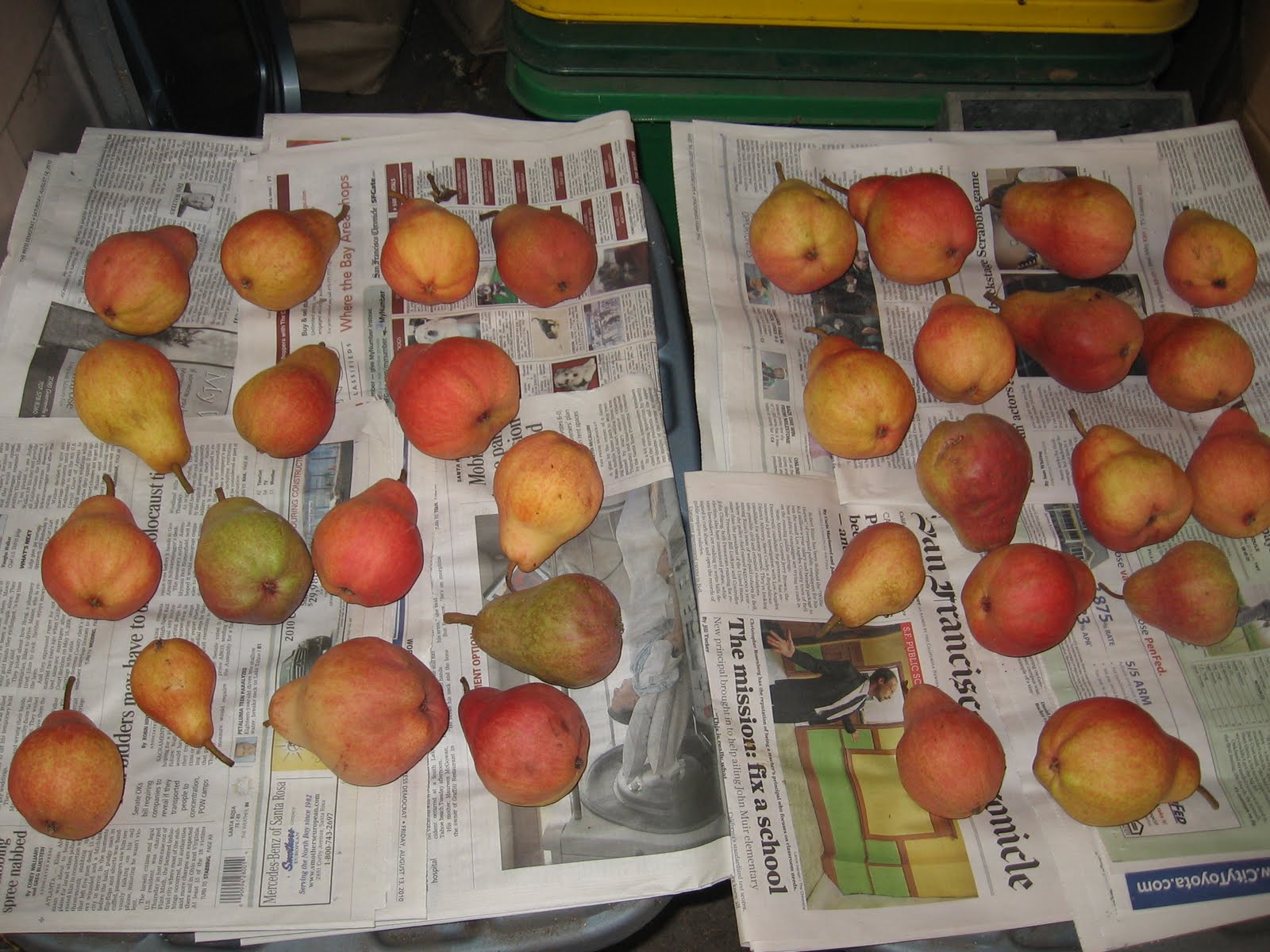
Here are the pears, laid out in the garage. A lot of them are already mushy, perhaps due to the blast of heat this week.
We are learning that the pear season is short and you have to move fast. Pears need to be picked all at once as soon as the first one drops, then stored right away and kept cool. They should be eaten a little bit before they feel ripe. I think they must ripen from the inside out, because when the outside seems perfect they are brown and mushy at the core. The ones that are golden with a rosy blush but still hard to the touch are the ones to go for.
Saturday, December 12, 2009
Winter Bounty
We had only three nights of temperatures in the twenties. By Thursday we were back to cloudy skies and predictions of rain, finally fulfilled today. All the winter-hardy plants are looking really perky now, coming into their own as their summer compatriots are reduced to limp brown rags, or, in the case of the nasturtiums, green goo.
This afternoon I went out in the rain -- accompanied by a wild-eyed, stir-crazed canine companion -- to do a little picking.
Pictured above, top row, left to right: Redbor kale, Blue Curly kale, a few leaves of dinosaur kale, right below the dinosaur kale some Red Lollo Antago lettuce, Rainbow chard, with some Bloomsdale spinach right below.
Bottom row, left to right: cilantro, Bronze Arrow lettuce, Black Seeded Simpson lettuce, arugula (a self-seeding volunteer coming up all over the garden), Forellenschluss lettuce.
A festival of vitamins and minerals!
The lemon tree seems fine. Some of its leaves have more of a yellow tinge than they did before the freeze, but that's all.
Tuesday, December 8, 2009
Everything's Frozen!
This morning, a little before eight, the backyard was a California version of a sparkling winter wonderland. All the greenery was still green but with a new and silvery aspect, stiffened by rhinestones of frost. The water in the birdbath was frozen solid with golden locust leaves suspended in the ice.
A dramatic seasons end for the pepper plants, also finally for the cherry tomatoes. Nasturtiums and basil were already on the way out.
The lemon tree, however, looked fine under its boxy blanket. I took the box off during the day and for tonight have covered the plant with frost protection cloth. We'll see how that works. Tonight will be just as cold.
Saturday, July 18, 2009
Diversity and Permanence Mean Abundance for All
Hooray for diversity. It's Mother Nature's way of keeping things interesting, complex, dynamic, and -- most important of all -- balanced. The balance of nature is no joke, as we are all finding out now that our species has thoroughly upset it. Despite the sobering odds, we can help restore the balance right in our back yards.
Here in the San Francisco Bay Area every little valley and hillside has its own micro-climate and unique habitat. We lucky locals get to be amateur horticulturists, if we are so inclined, trying things out and seeing what works in our personal piece of paradise. This fine-grained variation is generally true of California, where Sunset Magazine had to develop its own set of more than twenty climate zones because the limited number of USDA options aren't up to the job of covering the wide array of West Coast growing niches.
Diversity helps create the permanence of a rich ecosystem of mutually supportive living things. That's why our modern habitat gardens are not the tidy rows of mono-cropping we senior citizens may have pulled weeds in as children. More and more, our aesthetic ideal is a colorful jumble of different kinds of plants and different varieties of the same plant.
The goal of a permaculture gardener anywhere in the world is to work with existing natural surroundings to create a self-sustaining food forest. First you have to learn what is there already so you will have a better idea of what might be added.
Know your ground; become familiar with its patterns of sun and wind and rain. Know the soil and understand how water flows across the surface and collects in the low places. Understand what wants to grow there on its own and which insects and creatures have already set up housekeeping. Only then can you intelligently assemble just the right mosaic of trees, shrubs, vines, perennials, herbs, flowers, and -- oh, yes, last but not least -- vegetables. If you do it right, after several years the whole thing "pops" and becomes an intricate web of life that just goes on growing on its own. You can wander through your garden of Eden plucking this and that with nary a care and without breaking a sweat. That's the theory.
I've never seen an actual food forest although I've read about some in this area. There is a famous one down
But you don't have to be a high roller to get into the game. Our little micro-climate is, at certain times of year, such as right now, a modest middle-class Eden. The plum trees and blackberry vines that were here before we moved in are bearing ripe fruit. The ancient pear tree is resplendent with its not-quite-ready-to-eat harvest, with no effort on our part except some minor pruning now and then.
There's nothing like eating a handful of just-picked warm juicy plums on a summer afternoon or, on a sunny morning, picking fat blackberries and putting them directly onto a bowl of breakfast cereal.
We love the pears during the thirty seconds that each one is at the peak of ripeness -- and love the pear tree for its beauty all through the year.
Little by little by little I am coming to know this habitat and even though I'm not proactively building a true food forest I do cultivate many different varieties of herbs, flowers, and vegetables. We are doing our best to preserve a thriving and diverse community of plants that attracts myriad insects, butterflies, and birds along with the occasional possum, raccoon, and deer. There's plenty for everybody.
Diversity and permanence mean abundance for all.
Subscribe to:
Posts (Atom)