Saturday, March 2, 2013
Sunday, February 17, 2013
Waiting for Spring
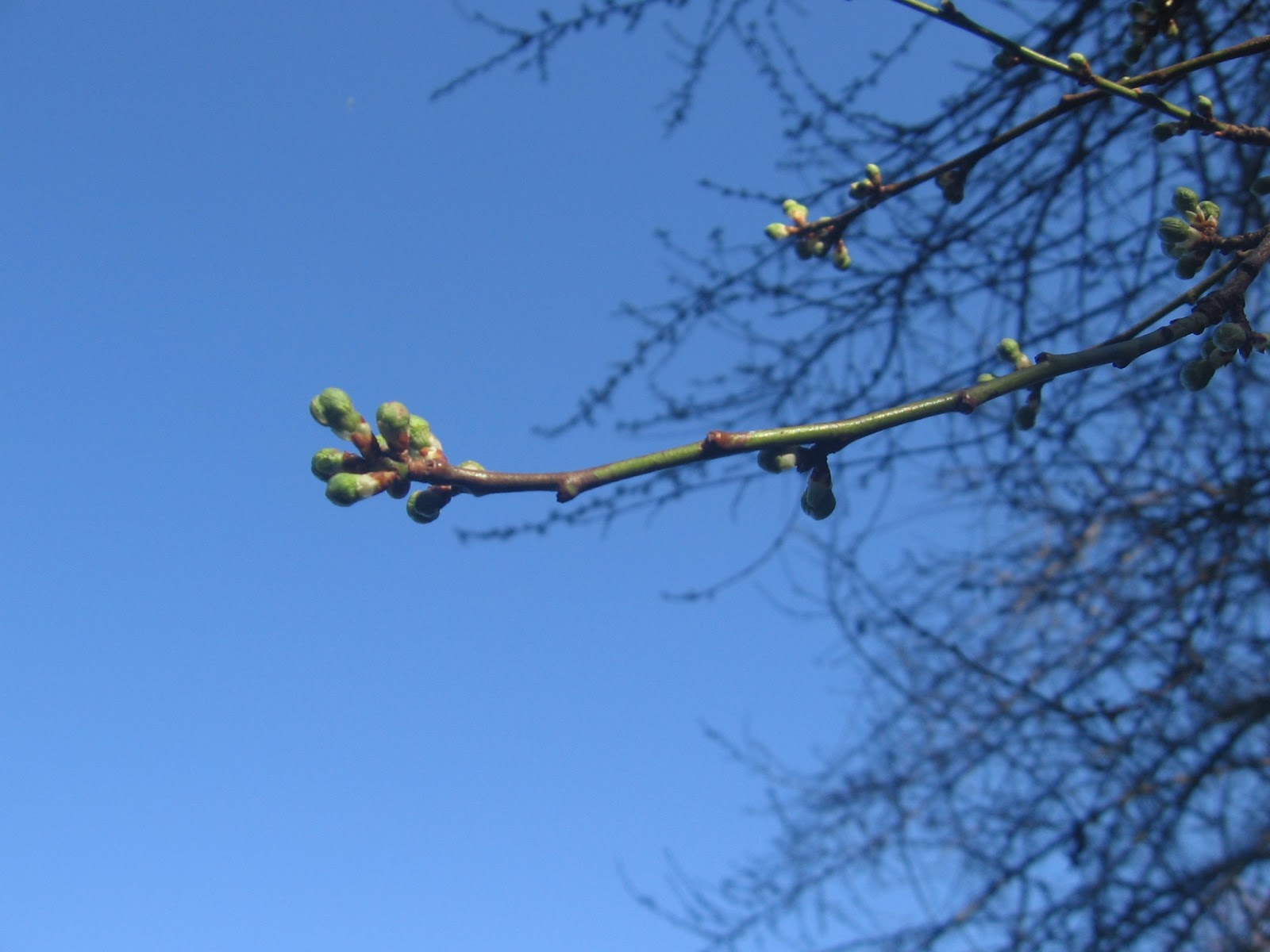
It's time for the plum blossom extravaganza to begin in our backyard, but continuing chill has put a damper on things. The best we can manage is to make a fuss over some fat buds lining the bare twigs at eye level and a few hard-to-see blossoms way up at the top of the tree -- a mere handful. Not much is happening in the neighborhood, either. Usually by Valentine's Day there is an appropriately festive display of ruffly pink and white bloom lining the streets.
As a reference point, last year on this exact date, February 17th, I took the annual iconic photo of a just-opened perfect white plum blossom low enough on the tree to allow for close-ups. This year, fat buds will have to do.
Plum blossoms call for haiku, of course, but will buds suffice? Pondering this deep question, I noticed the waxing half moon, faintly visible through the denuded upper branches of the tree (not very visible in my photo, unfortunately): a reminder that poetry is where you find it.
Half moon caught in the
Bare branches of the tall plum --
Yet time does not stop.
If time is still moving then spring will surely come.
Sunday, January 27, 2013
Winter Doldrums
When I stand and survey the backyard these days the usual allure is missing. The garden does not draw me; the weather is too cold. Granted, the temperature gets up into the high 50s and even mid 60s during the day and at least part of the time the skies are clear and sunny. But the psychological pull -- usually so irresistible -- is just not there. The chilly air, the cold ground, the wan sunshine seem to highlight the brown freeze-blasted plants and the scruffy bare branches of the trees. (No doubt, people in less temperate climate zones are justified in muttering: "Wimp.")
There is certainly plenty to do out back: clipping and pruning, putting wood chips on the paths, composting and mulching, on and on with a long list of usually enjoyable tasks that really need taking care of to get ready for the return of the planting season.
The relative lack of greenery exposes, in mute reproach, all the half-finished tasks from last autumn. The northern part of the garden is pretty much in limbo, suspended animation, waiting for the next surge of activity, like Sleeping Beauty awaiting a kiss from a Prince Charming who is simply not very motivated just now and prefers to stay inside and leaf through garden catalogs or read books on soil building. (Updated below.)
The only organized area is the southeast corner where several beds of winter greens have been supplying our table through the wet, cold months. There is a sense of order here if you don't peer too closely and notice that the plants look a bit storm battered and muddy, with slug-infested, decaying outer leaves. But nobody lingers here either. The most we can usually muster is a quick dash to pick what's needed at the moment, then a dash back to the warm kitchen. Wimps.
UPDATED: February 9, 2013. It must be said that, recently, a real Prince Charming has been doggedly clipping away at the towering rose thicket. Thank you, H.!!!!
Monday, January 7, 2013
Twelfth Night Tomatoes
Every year it's the same thing and every year it's different. Maybe that's the real appeal of gardening. The regular annual cycles provide a way to hold on to the minutiae of daily life, the precious details that slip away unless they are gathered into patterns. Long after you've forgotten what happened last year, a similar milestone shows up and a whole sequence of years comes into sudden focus.
I think that's how it became a kind of ritual to celebrate the last of the tomatoes. And there's usually been a handy holiday to coincide with using up the final few jewels collected from withered vines hanging in the garage.
In 2011 we had tomatoes on Valentine's Day (and beyond); the year before we celebrated with New Year's tomatoes; before that we've had Christmas Eve tomatoes. Part of the ritual has been to see how long the season can stretch, so we've been pushing the celebration later and later. But this year New Year's came and went and I realized we weren't going to make it to Valentine's Day. Last summer wasn't such a great season for our backyard tomatoes and the supply overwintering in the garage was meager to begin with. By this weekend we were down to a handful of Sungolds.
No worries. There was a perfectly respectable holiday just sitting there waiting to be noticed. January 6: Twelfth Night! What does it matter if we have never observed the last of the twelve days of Christmas? It was a fine time for one more feast. Since we were over-feasted and over-feted from the previous twelve days, we settled for a brunch, strictly in-house.
There were enough Sungolds for scrambled eggs with fresh parsley and thyme from the backyard, blending two garden seasons in one festive dish.
B. produced a handsome loaf, so we had homemade whole grain bread.
We also had a King cake, or Rosca de Reyes ("kings' ring") because, well, you know -- Twelfth Night. The Magi arrive bearing gifts. Celebrated with a special cake. I went to a local Mexican market to buy one ready made but the ones for sale there were clearly intended for large extended families. They made me think of the scene in My Big Fat Greek Wedding where the groom's family -- two nervous Anglo parents bearing a small Bundt cake -- comes to meet the bride's family -- a crowd of uncles, aunts, cousins, grandparents, second cousins and two very jovial parents presiding over a large feast.
So I went to Trader Joe's and bought a teeny coffee cake, some cream cheese, and various fruits and nuts to decorate the top. I hid in the cake one of those foil covered chocolate coins, because that's what you do with a Twelfth Night cake, hide a token in it. We weren't exactly sure what it means if you get the piece with the token. In the British tradition it evidently means you are king or queen of the revels; in the Hispanic tradition it means you have to make the tamales for Candlemas on February 2. But it didn't matter because no one got the coin until much later when the leftovers disappeared and whoever got it is not openly admitting to it, perhaps concerned about making those tamales. It wasn't me, I know that much.
Anyway, it was a very fine brunch. We toasted the occasion with goblets of water, the wine of heaven. And the Twelfth Night tomatoes still had their homegrown savor.
Sunday, November 4, 2012
The Elusive Soldier Fly
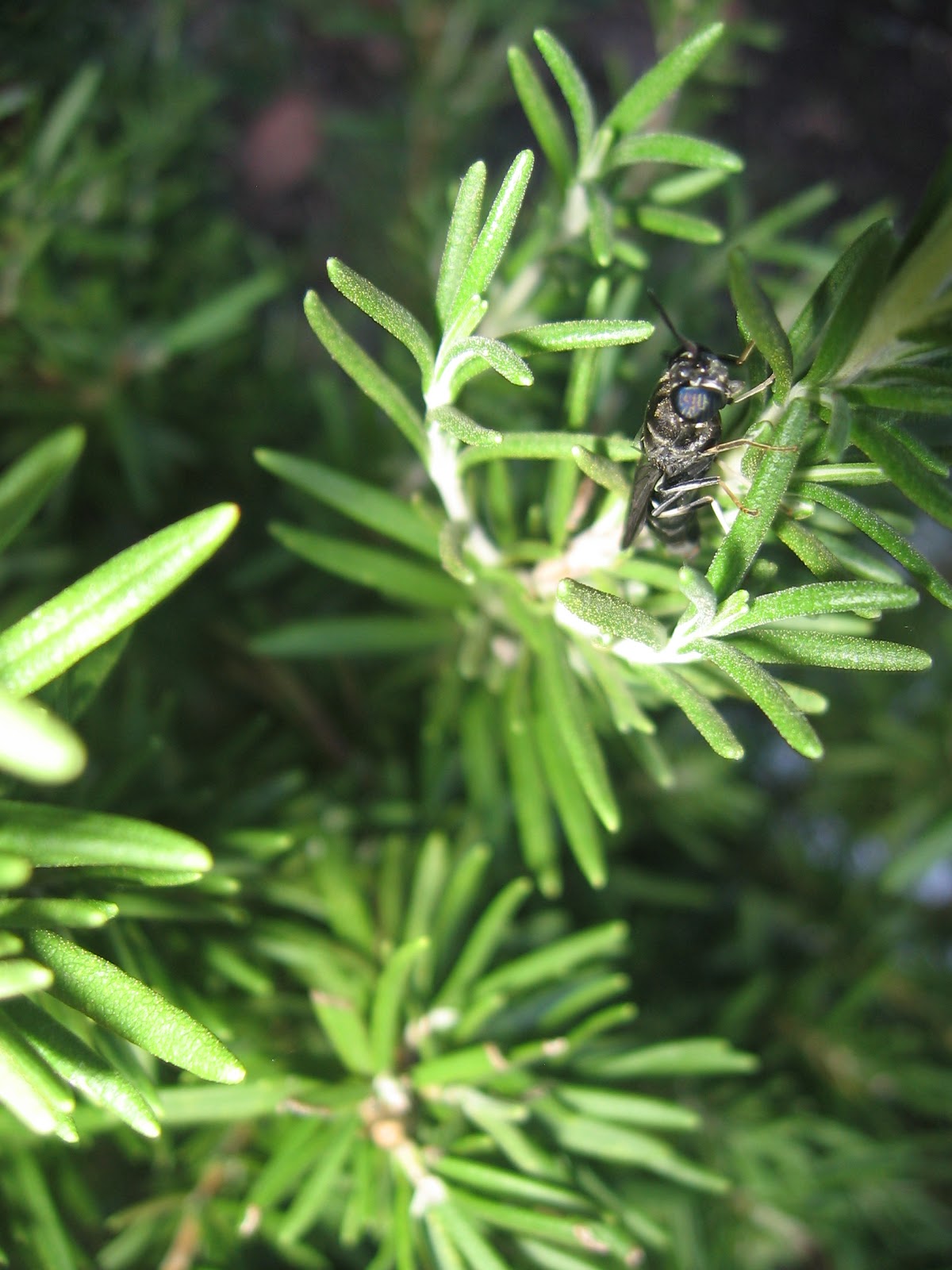
There have been a few soldier fly sightings in our yard before, always near our compost bins. But I've never gotten a photo because the large wasp-like creatures always fly off at the slightest disturbance. Today I managed to take several pictures -- with a flash, no less -- of one that remained determinedly in place on our little rosemary shrub, without even a twitch of its antennae.
Perhaps it was a female laying eggs?
The adult female Hermetia illucens or Black Soldier Fly (BSF), likes to lay her clusters of tiny eggs near a food source for the hatched-out larvae. Although she herself does not eat and does not even possess mouth parts, she is irresistibly drawn by the availability of decomposing kitchen scraps.
Thus, the rosemary shrub near the compost corner makes an excellent site for planting the next generation. I know that our local Hermetia moms make good choices because our bins always have an ample supply of larvae feeding on the freshest, juiciest layer of new compost material -- their preferred diet.
After first discovering these fascinating creatures, I have found myself irresistibly drawn to reading articles with titles like "The Bioconversion of Putrescent Waste" and watching videos on YouTube of proud gardeners showing off piles of garbage seething with fat Hermetia grubs. (It's amazing what an innocent hankering for tasty vegetables and beautiful flowers can lead to.)
The adult flies live only about a week, just long enough to reproduce. They are quiet, elusive, do not feed on anything and do not carry disease. They are quite common nearly everywhere, like the housefly; but most people are not aware of their existence.
Just start a compost bin that meets their standards, though, and see what happens. You will discover the grubs and be horrified. Then, as you learn more, you will become profoundly grateful for a free composting service rendered by Mother Nature. During their one to three month life span the grubs consume quantities of fresh waste. They work so fast that bacteria don't have a chance to make everything smelly and other types of flies are not attracted. They quickly establish what the experts call "niche dominance" and discourage the presence of fruit flies, blow flies, houseflies, and ants. Last but not least, or even last, the residue they leave behind when they crawl away to pupate is just right for redworms, who carry the breakdown process into the next stage of creating rich soil for your garden.
So if you see a shy BSF in your yard, treat it with all due respect.
Monday, October 1, 2012
Last Chance Zucchini
The zucchini vines have been moldering on the compost pile for some time now. It seemed early to pull them out but they looked so sad I had to put them out of their misery. Nonetheless, the zucchini season lingers on. Last weekend, I was surprised to find a few actual zucchini tucked away in the back of the refrigerator. They looked fine and I felt gleeful: here was a last chance opportunity for Zucchini Flatbread which we haven't made since the summer of 2011.
We got the recipe from Healthy Bread in Five Minutes a Day (pages 208 and 209) and follow it more or less as given except that I don't really measure the zucchini, parsley, and scallions very closely. Our final batch of zukes, coarsely grated, came to four cups and I used all of it, plus a big handful of backyard parsley, finely chopped, and several scallions sliced thin. And, although the official recipe doesn't call for garlic, I don't feel capable of heating olive oil in a pan without adding several cloves of smashed garlic and swirling them around to infuse the oil with that indispensable earthy essence before putting in the main ingredients.
When the mixture gets soft and the zucchini juices have mostly cooked off (too much juice makes for soggy bread), it's time to throw in a couple of big handfuls of finely grated Parmesan cheese and let it melt gently into the mix.
On impulse I took a look at the website that goes with the book to see if there were any updates, tips, or video instructions for that particular recipe. The most recent post, just the day before, presented a new take on Zucchini Flatbread, jazzed up with roasted cherry tomatoes. Serendipity! And the whole recipe was explained in detail with plenty of big, clear photos. No excuses for messing this up.
It was a simple matter to gather some cherry tomatoes from the yard and put them under the broiler for a few minutes until they started to collapse in on themselves and change color.
Meanwhile, B. was working on the bread part of the recipe. He uses the "five-minutes-a-day" system, and unlike me, follows the instructions carefully. Since he already had a container of dough in the fridge for the next batch of regular bread, all he had to do was pull off a grapefruit-sized lump and squeeze it and shape it into a smooth ball.
Everything came together once he had the dough rolled out and fitted onto our handy oven peel. All I had to do was spread the zucchini-cheese mixture evenly over the surface, sprinkle on some pine nuts (thank you, CostCo!) and dot the roasted tomatoes here and there -- forgetting that you are supposed to hold them back and add them after the flatbread comes out of the oven. Oh, well.
B had preheated the oven to 450 F in plenty of time to warm up the baking stone, about thirty minutes ahead. Then, with an experienced deftness, he slid the decorated flatbread smoothly off the oven peel and onto the heated stone. The long handle on the peel makes this maneuver easy to do despite a really hot oven, although it takes some practice to learn just how much uncooked dry polenta to sprinkle on the peel under the pizza so it will slide off, and just when to give the peel a sharp jerk to start the slide.
The final result was just as delicious as we remembered from the first time. And all the tampering with the recipe -- too much zucchini, added garlic, cooking the tomatoes twice -- turned out just fine.
Labels:
eating from the yard,
parsley,
recipe,
tomatoes,
zucchini
Sunday, September 2, 2012
Do I Dare to Eat a Pear?
It's a sparse year for pears -- the entire reachable crop is ripening on the dining room table. There are still a few unpicked beauties clustered at the very top of the tree, but for general purposes, what's available this season is in hand now.
Though lacking in numbers they make up for it in size and in perfection of color and shape. A single blushing pear in a blue bowl is almost too beautiful to eat.
But eventually flavor wins out over beauty. When they are at the peak of ripeness, I've never tasted such delicious pears. Last year, at the Heirloom Exposition in Santa Rosa, I studied the array of varieties laid out on long tables in the vast exposition hall, trying to figure out what is growing in our backyard. Our pears do resemble the Barletts; some of those on display had a reddish blush. But that's just a guess.
Fortunately, not knowing the variety doesn't impair the taste.
The best way to eat these pears is the simplest: cored and sliced into a bowl so there's nothing between you and the sweet juice and slightly grainy texture.
They are also delicious with a simple garnish of yogurt and walnuts: my current favorite afternoon snack.
And we don't like to let the summer pass without at least one Tarte Tatin made with our own pears. It has become one of our ritual recipes.
This year I tried making some pear sauce as well. Not too bad, though not as good as homemade applesauce. It would be an OK way to preserve the crop if there's too much to eat fresh.
The experimental pear leather was better than the pear sauce, but not nearly as good as the plum leather. Another fall back method for handling a large crop.
Another great year for pears is almost gone. Each year we get a little better at doing them justice.
Subscribe to:
Posts (Atom)